MSM 244: Just a second . . .

advisory, MSM, Tech, Web Spotlight No Comments »

Presented in collaboration with the Association for Middle Level Education.


Jokes You Can Use:


Did you hear about the guy who died after creating an enormous spreadsheet? He Excelled himself.


An elderly couple is beginning to notice that neither of them seem to be able to remember things as well as they used to. So, they go to see their doctor, who explains that there is nothing really wrong with, just typical memory loss associated with old age. He suggests that they each get notebooks and write notes to themselves to help remember things. The couple goes home and that evening while watching T.V. the man gets up and heads for the kitchen. His wife asks if he can bring her some ice cream when he returns. He says he will, and she says he should write it down. “I’m just going to the kitchen, I’ll remember.” “Well, I want that with nuts, too.” “O.K. he says ice cream with nuts.” She asks again if he’s going to write it down. “No, I’m just going to the kitchen.” “And a Cherry on the top?” He agrees and turns toward the kitchen again and she asks again about writing it down. Now the old man is angry, “Look, old lady I’m not senile, I can remember ice cream with nuts and a cherry on top.” He goes in the kitchen for 10 minutes and when he returns he sets a plate of bacon and eggs in front of his wife. She looks up and says, “Honey, you forgot my toast.”


TEACHER: What is the chemical formula for water?

SARAH: “HIJKLMNO”!

TEACHER: What are you talking about?

SARAH: Yesterday you said its H to O!


Her husband had been slipping in and out of a coma for several months yet she stayed by his bedside every single day. When he came to, he motioned for her to come nearer. As she sat by him, he said, “You know what? You have been with me all through the bad times. When I got fired, you were there to support me. When my business fell, you were there. When I got shot, you were by my side. When we lost the house, you gave me support. When my health started failing, you were still by my side. Well, now that I think about it, I think you bring me bad luck!


Advisory:

What is a second?

How long is a second? Who decided what a second is? How did people agree that a second is a second?

http://www.youtube.com/watch?feature=player_embedded&v=NXRVtfCpLr4#

Hand Gestures

Many times we tend to use our hands to explain our needs and thoughts. The same hand gesture may mean something quite nasty and offensive to a person from a different cultural background. Hand gestures are a very important part of the body language gestures. In this article we shall understand what are hand gestures.

http://www.buzzle.com/articles/hand-gestures-in-different-cultures.html


The Etch-a-Sketch

http://www.youtube.com/watch?feature=player_embedded&v=hq3Et9gOISI

Middle School Science Minute

by Dave Bydlowski (k12science or davidbydlowski@mac.com)


MIDDLE SCHOOL SCIENCE MINUTE-BEST 6-8 TRADE BOOKS PART 2


Each year the National Science Teachers Association announces the outstanding science trade books from grades K-12.  This list includes books published in 2012.  This is the second in a series of podcasts that will look at the best books for grades 6 – 8.


The books included in this podcast are:

1.  Book of Blood by HP Newquist

2.  Invincible Microbe by Jim Murphy and Alison Blank

3.  Sneed B. Collard III’s Most Fun Book Ever About Lizards by Sneed B. Collard III


Also wanted to share a couple of comments regarding the last show:

1.  A great place for free textbooks is: ck12.org

They produce free texts that can be used on computers, kindles, iPads, other tablets, etc.  Their books geared to middle and high school.

2.  Regarding funding of the Common Core.  The House has talked about not funding anything for MDE regarding Common Core.  But it is far from reality.  The House must propose its budget, then the Senate, their budget, then a team of 6 comes together to finalize the budget, from the two plans.  It does not have anything to do with districts funding the common core, only MDE.


From the Twitterverse:

*Matt Gomez ‏@mattBgomez 53m

RT @Robitaille2011: Inquiry-based teaching is not daunting. Just do it… http://ow.ly/1Wnncs  #satchat

* Kyle Calderwood ‏@kcalderw 3h

8 Useful Apps for Working on Video Projects on iPad http://goo.gl/8Xk8v  #njed #edtech #ipaded

* Chris Sousa ‏@csousanh 3h

MT“@imcguy: Product placements in standardized tests? Really? –Marketing a Test that Markets to Students http://feedly.com/k/10PRKFk #edchat

* Mental Floss ‏@mental_floss 4h

What 11 Pairs of Eyeballs Watching a Movie Looks Like — http://bit.ly/13Cqiuh

* In-finity Education ‏@Infeducation 8h

RT @Ideas_Factory: Useful➡The Teacher’s Guide To Pinterest http://zite.to/ZJcQRd

* Scott McLeod ‏@mcleod 8m

Digital Citizenship Goals in Education http://bit.ly/19Ke7LL

* Colette Cassinelli ‏@ccassinelli 23m

HS Idea: Have an #edcamp style faculty mtgs – tchrs choose school topics sessions to attend led by tchrs & document conversations #cpchat

* Joe Mazza ‏@Joe_Mazza 49m

Nice list of MAC/PC Screencasting tools (free & paid) created “by the room” https://docs.google.com/document/d/1iJuwScXPlBkYDsslfqJeDYV5h1oLt0EUpxdVgFxyvlk/edit … #edcampphilly

* Jason Bedford ‏@bedfordtweet 21h

Devices that were once used for fun are now educational tools. How do we balance Stimulating vs Distracting tech? http://blogs.kqed.org/mindshift/2013/05/with-tech-tools-how-should-teachers-tackle-multitasking-in-class/ …

* Miguel Guhlin ‏@mguhlin 8m

10 Phrases That Can Solve Any Work Problem http://amex.co/14zTOTE  #eclead

* Gary Johnston ‏@GaryJohnston1 1m

18 Myths About Education That Are All Too Easy To Believe http://www.teachthought.com/trends/18-myths-about-education-that-are-all-tooeasy-to-believe/ … via @teachthought

* Monte Tatom ‏@drmmtatom 16 May

Rethinking Acceptable Use Policies to Enable Digital Learning ~ #fhuedu642 #TETA ~ for @MSMatters followers http://www.cosn.org/Default.aspx?TabId=8139 …

“Google Play for Education Promises What Teachers Have Wanted from Android” #edtech #TETA #fhuedu642 ~ for @MSMatters http://feedproxy.google.com/~r/freetech4teachers/cGEY/~3/DYlIJH2zg3I/google-play-for-education-promises-what.html …

#mschat every Thursday at 8:00 pm Eastern Standard Time.


Resources:

Parenting

Variety of short videos that are useful for parents.

http://m.kidsinthehouse.com/

Web Spotlight:

Response: Using — Not Misusing — Ability Groups In The Classroom

By Larry Ferlazzo on May 12, 2013 11:55 PM


The teacher points to a round table in her classroom and tells her students, “Those of you with little or no ability, sit here.” Then she walks across the room and gestures to another table and announces, “Those of you with high ability, sit here.”

It’s very threatening to students to hear it referenced by the teacher, even if the ability is high. If it’s a high ability, students spend the majority of the class trying to protect their status as the one who always gets the right answer or finishes early. If it’s a low ability, students spend the majority of the class avoiding assignments: Why should I attempt this, they think, when it’s just one more proof that I’m stupid?

Ability implies something permanent, unchangeable.

Instead of “ability,” I recommend teachers use, “readiness.” “Readiness” implies a temporary condition: I’m not ready, but I can become so.

Tracking and grouping are contentious topics in many schools, but add my voice to the chorus of teachers who love homogeneous grouping

You read that right: homogeneous, not heterogeneous, grouping is the way to go – as long as it’s temporary and group membership is dynamic, not static.

Homogeneous grouping is effective for students who need a particular need met: They struggle with writing introductions, they need to adjust their lifting technique in the weight room, they still don’t understand stoichiometry,

Heterogeneous groups, on the other hand, also serve positive instructional purposes – fresh ideas, connections, everybody has something to contribute, learning to work with others. Let’s be clear, however: Always placing struggling students with advanced students doesn’t work well for either group.

Dr. Tae, (see his Eastside Prep Ted Talk on comparing classroom teaching to learning a skateboarding trick below) that we don’t really know how long it takes anyone to learn any one standard, nor do we know exactly how long it takes to learn a complex inter-weaving of standards applied in flexible ways.

Grouping students should be done based on what we know about students and how to maximize their learning, not because we were told to group students in a differentiated instruction seminar.

In high school this achieved by students taking advanced coursework. In elementary and middle schools, however, there is not the economy of scale to offer varied and advanced coursework, so special attention should be given to training teachers to provide advanced/accelerated instruction in their own classes as warranted, and to provide advanced students in these grade levels with at least two to three hours a day of advanced curriculum experiences. Less than this amount of time doesn’t meet advanced students’ needs.

In addition, in looking at the research and comparing it to the real classroom experiences, my colleagues and I have found that success in either grouping comes with the teacher’s willingness and preparedness to respond to students’ specific learning needs, i.e. to provide differentiated instruction. Absent that training and willingness, either format is just as inert, or worse, just as damaging.

When wrestling with whether or not to group students, consider these questions:

• Is this the only way to organize students for learning?

• Where in the lesson could I create opportunities for students to work in small groups?

• Would this part of the lesson be more effective as an independent activity?

• Why do I have the whole class involved in the same activity at this point in the lesson?

• Will I be able to meet the needs of all students with this grouping?

• I’ve been using a lot of [insert type of grouping here] lately. Which type of grouping should I add to the mix?

http://blogs.edweek.org/teachers/classroom_qa_with_larry_ferlazzo/2013/05/response_using_–_not_misusing_–_ability_groups_in_the_classroom.html


Standards Based Grading Videos

Lots of videos to help explain Standards based grading. Broke out into Introductory (SBD101), discipline specific, and leadership.

http://sbgvideos.org/

(Also check out video of a presentation delivered at the  MAMSE 2013 Conference).


A Dress-Code Enforcer’s Struggle for the Soul of the Middle-School Girl

JESSICA LAHEYFEB 14 2013, 12:18 PM ET


I work hard to let my girls know that I respect them for their brains and character—regardless of whether they put their cleavage or the length of their legs on display. But I hate arguing about whether or not a skirt covers a girl as far down as her arms hang.

I hate having to defend my right not to see a girl’s underwear.

When I taught high school, my solution was simple: A box of monstrously ugly, gigantic men’s T-shirts purchased at the local thrift store provided cover-up and sufficient incentive for my female students to keep their upper bodies covered. No muss, no fuss, easy enforcement. They laughed, I laughed.

But middle school? Middle school is a whole other can of worms. Sixth graders are mere children, while eighth graders are burgeoning adults; their minds and bodies change more rapidly than they realize. During these chaotic middle years, they evolve from carefree kids to body-obsessed teenagers almost overnight. One day they can’t pay attention in class because they’re thinking about ponies and their pet guinea pigs, and the next they’re incapacitated by daydreams about the opposite sex.

Dresses that fit up top six weeks ago might not cover burgeoning cleavage today, and skirts that skimmed the knee last month might not hide their underpants during this morning’s math class. Their favorite dresses go from charming to indecent in a blink of an eye.

Perhaps Susan Sarandon said it best in the film version of Little Women (even if she was not quoting Louisa May Alcott’s original Marmee). Meg has just returned from Sally Moffat’s coming-out party, for which she was dressed, made-up, and corseted by the other girls. Laurie is horrified by her cleavage and her drinking, and Meg is embarrassed by her behavior and motivations. Marmee consoles her with the words I yearn to say to my female students, particularly the girls who are just beginning to understand the power of their physicality:

Meg: It was nice to be praised and admired. I couldn’t help it.

Marmee: Of course not. I only care what you think of yourself. If you feel your value lies in being merely decorative, I fear that someday you might find yourself believing that’s all you really are.

Time erodes all such beauty, but what it can not diminish is the wonderful workings of your mind. Your humor, your kindness, and your moral courage. These are the things I cherish so in you.

http://m.theatlantic.com/sexes/archive/2013/02/a-dress-code-enforcers-struggle-for-the-soul-of-the-middle-school-girl/273155/

Half-Baked Ideas . . .


Conference

  • Would you give up a day in summer to learn about Moodle (online learning)?

  • Would you pay for it?

  • What would you want to get out of it?

MSM 243: And there go the sirens . . . .

advisory, MSM, Podcast, Tech No Comments »

Presented in collaboration with the Association for Middle Level Education.


Jokes You Can Use:

A man was walking on the beach one day and he found a bottle half buried in the sand. He decided to open it. Inside was a genie. The genie said,” I will grant you three wishes and three wishes only.” The man thought about his first wish and decided, “I think I want 1 million dollars transferred to a Swiss bank account. POOF! Next he wished for a Ferrari red in color. POOF! There was the car sitting in front of him. He asked for his final wish, ” I wish I was irresistible to women.” POOF! He turned into a box of chocolates.


Q: What does a stamp say to an envelope?

A: Stick with me and we’ll go places.


What is the best time to go to bed?

When the bed won’t come to you.


Eileen Award:


  • Twitter: Sarah Cooper

  • Happy Birthday Award: Ron King


Advisory:

7 Bridges

http://mashable.com/2013/05/03/google-maps-seven-bridges/

Middle School Science Minute

by Dave Bydlowski (k12science or davidbydlowski@mac.com)


MIDDLE SCHOOL SCIENCE MINUTE-BEST 6-8 TRADE BOOKS PART 1


Each year the National Science Teachers Association announces the outstanding science trade books from grades K-12.  This list includes books published in 2012.  This is the first in a series of podcasts that will look at the best books for grades 6 – 8.


The books included in this podcast are:

1.  Alien Deep: Revealing the Mysterious Living World at the Bottom of the Ocean by Bradley Hague.

2.  Black Gold: The Story of Oil in our Lives by Albert Marrin and Alfred A. Knopf.

3.  Bomb: The Race to Build–and Steal–the World’s Most Dangerous Weapon.


From the Twitterverse:

* Larry Ferlazzo ‏@Larryferlazzo

The Best Ideas On How To Finish The School Year Strong…. http://larryferlazzo.edublogs.org/2013/05/02/the-best-ideas-on-how-to-finish-the-school-year-strong/#.UYUUHoWCOUE.twitter …

* Kelly Hines ‏@kellyhines

am thinking about using 20% projects as my “homework” for next year… kids would love! #edcampnc

* Timothy D. Slekar ‏@slekar

“digital natives” is nothing more than techno slang invented by marketing executives. http://atthechalkface.com/2013/05/04/douglas-county-school-district-run-forrest-run/ … @DianeRavitch

* Clif Mims ‏@clifmims 1h

4 Ways To Improve School Communication Using Social Media http://ow.ly/kFowh  #edtech #cpchat

* Kyle Calderwood ‏@kcalderw

Using Twitter for Teachers’ Professional Development http://goo.gl/wmWRS  #njed #edchat #smchat #cpchat

* Clif Mims ‏@clifmims 1h

Minnesota Senate Passes Education Bill That Ends High-Stakes Tests http://ow.ly/kFm3I  #education #edchat

* Richard Byrne ‏@rmbyrne 2h

Teenage Life in Ancient Rome – A TED-Ed Lesson http://ow.ly/kHfW2

* Bradley Lands ‏@MrLands

@Jennifer_Hogan research tells us that resiliency is the number one skill that students will need to be successful #satchat

* Karen Bosch ‏@karlyb 3h

Practice Grammar with Technology – nice list of online grammar games! http://www.techlearning.com/Default.aspx?tabid=67&entryid=5736 …

* Monte Tatom ‏@drmmtatom 19h

“The 4 Stages of Technology Integration in Education” ~ #EdTech & #mLearning ~ #fhuedu642 #fhuedu320 => @MSMatters http://www.educatorstechnology.com/2013/05/the-4-stages-of-technology-integration.html?utm_source=feedburner&utm_medium=feed&utm_campaign=Feed%3A+educatorstechnology%2FpDkK+%28Educational+Technology+and+Mobile+Learning%29 …

* Monte Tatom ‏@drmmtatom 19h

“Top 10 #iPad Apps for Lesson Planning” ~ #EdTech & #mLearning ~ #fhuedu320 ~ for @MSMatters followers http://www.educatorstechnology.com/2013/05/top-101-ipad-apps-for-lesson-planning.html?utm_source=feedburner&utm_medium=feed&utm_campaign=Feed%3A+educatorstechnology%2FpDkK+%28Educational+Technology+and+Mobile+Learning%29 …

* Monte Tatom ‏@drmmtatom 19h

“New: Free social writing platform for teachers & students” ~ #fhuedu320 #fhucid #edtech ~ for @MSMatters followers http://www.eschoolnews.com/2013/05/01/new-free-social-writing-platform-for-teachers-and-students/ …

#mschat every Thursday at 8:00 pm Eastern Standard Time.


Resources:

Generated Paper

Free “paper”.

  • Graphs & grid

  • Children

  • Games (BattleShip, Tic-Tac-Toe, Sudoku)

  • Wire framing

  • Music

  • Language

  • Calendar

http://generatedpaper.com/en


News:


The First Race to the Top

By WILLIAM J. REESE
Published: April 20, 2013


To teachers everywhere, the message is clear: Raise test scores. No excuses.

For the first time, examiners gave the highest grammar school classes a common written test, conceived by a few political activists who wanted precise measurements of school achievement. The examiners tested 530 pupils — the cream of the crop below high school. Most flunked.

The testing groundwork was laid in 1837, when a lawyer and legislator in Massachusetts named Horace Mann became secretary of the newly created State Board of Education, part of the Whig Party’s effort to centralize authority and make schools modern and accountable.

Mann claimed in 1844 in a nationally publicized report that Prussia’s schools were more child-friendly and superior to America’s.

The examiners explained in a lengthy report that they wanted “positive information, in black and white,” to reveal what students knew.

All summer, Howe and his colleagues hand-graded the tests, evaluating 31,159 responses. The average score was 30 percent. The committee wrote a searching commentary on the outcome and prepared tables ranking the schools by average score.

The examiners’ report lambasted the schools. “Some of the answers are so supremely absurd and ridiculous,” the committee noted, that one might think the pupils were “attempting to jest with the Committee.” Pupils had memorized material they often did not understand. Those who could repeat lines from the famous poem “Thanatopsis” could not define the word in the title. Students could not explain whether Lake Ontario flowed into Lake Erie or the other way around. Anyone who has ever listened to children who just took a standardized test can imagine their consternation.

Tests, they said, would identify the many teachers who emphasized rote instruction, not understanding. They named the worst ones and called for their removal.

They censured the head teacher in the segregated Smith School for not seeing potential in African-American children, whose scores were abysmal.

They presciently suggested that tests would one day compare schools across national boundaries.

Mann told Howe to deflect criticism from the examiners by blaming the masters for low scores.

What can we learn from the advent of what we learned to call “high-stakes testing”? What transpired then still sounds eerily familiar: cheating scandals, poor performance by minority groups, the narrowing of the curriculum, the public shaming of teachers, the appeal of more sophisticated measures of assessment, the superior scores in other nations, all amounting to a constant drumbeat about school failure.

Poor children lag and affluent parents patronize the most exclusive schools to separate their children from anyone labeled “below average.” The survival instinct encourages many teachers to teach to the test, relying on the rote methods that the original exams sought to expose.

We have come a long way since the summer of 1845. Public education, then in its infancy, is now universal. Testing yields essential, valuable knowledge about school performance, but its exaggerated use distorts teaching and ignores the broader purpose of education.

http://www.nytimes.com/2013/04/21/opinion/sunday/the-first-testing-race-to-the-top.html?ref=opinion&_r=2&


You’ll Be Shocked by How Many of the World’s Top Students Are American

The U.S. claims one-third of the developed world’s high-performing students in both reading and science.

When you look at the average performance of American students on international test scores, our kids come off as a pretty middling bunch. If you rank countries based on their very fine differences, we come in 14th in reading, 23rd in science, and 25th in math. Those finishes led Secretary of Education Arne Duncan to flatly declare that “we’re being out-educated.”

But averages also sometimes obscure more than they reveal.

When it comes to raw numbers, it turns out we generally have far more top performers than any other developed nation.

Among OECD nations in 2006, the United States claimed a third of high-performing students in both reading and science, far more than our next closest competitor, Japan.

Part of this is easy to explain: The United States is big. Very big.

… our high scorers are balanced out by an very large number of low scorers. Our education system, just like our economy, is polarized.

It seems pretty likely, in other words, that China has more young math and science geniuses at its disposal than we do (whether that’s something that should be keeping any of us up at night is another issue).

You can’t replicate a country’s style of education without replicating its culture,

http://www.theatlantic.com/business/archive/2013/04/youll-be-shocked-by-how-many-of-the-worlds-top-students-are-american/275423/


In Utah’s digital shift, students turning the page on traditional textbooks

A shift from traditional textbooks to e-books is gaining speed in Utah, as the state Office of Education coordinates efforts to develop digital texts in science, math and language arts. At least two state math texts are already available and the first of the science texts will be released this summer.

But schools can use the savings from free open-source textbooks to buy digital devices for students to read them, said David Wiley, an associate professor in instructional psychology and technology at Brigham Young University who studies innovation as a Shuttleworth Fellow.

Or, he added, schools can print out open-source textbooks at a lower cost than buying traditional texts from publishers.


http://www.sltrib.com/sltrib/news/56179223-78/digital-textbooks-students-open.html.csp


Free Teacher PD Courses

https://www.coursera.org/courses?cats=teacherpd


MSM 242: Troy went Quayle Hunting . . .

advisory, AMLE, MSM, Podcast, Tech, Web Spotlight No Comments »

Presented in collaboration with the Association for Middle Level Education.

Jokes You Can Use:

“I was recently on a tour of Latin America, and the only regret I have was that I didn’t study Latin harder in school so I could converse with those people.”

– J. Danforth Quayle

“If we don’t succeed, we run the risk of failure.”

– J. Danforth Quayle

“Republicans understand the importance of bondage between a mother and child.”

– Vice President Dan Quayle

“Welcome to President Bush, Mrs. Bush, and my fellow astronauts.”

– Vice President Dan Quayle

“Mars is essentially in the same orbit… Mars is somewhat the same distance from the Sun, which is very important. We have seen pictures where there are canals, we believe, and water. If there is water, that means there is oxygen. If oxygen, that means we can breathe.”

– Vice President Dan Quayle, 8/11/89

“What a waste it is to lose one’s mind. Or not to have a mind is being very wasteful. How true that is.”

– Vice President Dan Quayle

“The Holocaust was an obscene period in our nation’s history. I mean in this century’s history. But we all lived in this century. I didn’t live in this century.”

– Vice President Dan Quayle, 9/15/88

“I believe we are on an irreversible trend toward more freedom and democracy – but that could change.”

– Vice President Dan Quayle, 5/22/89

“One word sums up probably the responsibility of any vice president, and that one word is ‘to be prepared’.”

– Vice President Dan Quayle, 12/6/89


Eileen Award:


  • Twitter: Grosse Isle Middle School, Jeff Wilson


Advisory:

What happens if you get rid of traffic lights?

http://www.youtube.com/watch?feature=player_embedded&v=gVW-YAQCSVs#!


Initials & Acronyms

http://twentytwowords.com/2013/04/24/the-words-and-names-behind-over-50-famous-acronyms-and-initials/


The new $100 bill

Talk about money. What is it’s role? What other things could we do?

http://qz.com/77806/meet-the-new-100-bill-the-worlds-most-popular-bank-note/


Juggling enhances connections in the brain

Learning to juggle leads to changes in the white matter of the brain, an Oxford University study has shown.

http://www.ox.ac.uk/media/news_releases_for_journalists/091011.html


45 Odd Facts about US Presidents

http://davidwarlick.com/2cents/?p=4119


How Parents Around the World Describe Their Children, in Charts

How would their parents describe them?

http://www.theatlantic.com/international/archive/2013/04/how-parents-around-the-world-describe-their-children-in-charts/274955/

Middle School Science Minute

by Dave Bydlowski (k12science or davidbydlowski@mac.com)


MIDDLE SCHOOL SCIENCE MINUTE-SENSE OF PLACE


I was recently reading the March, 2013 issue of “Science Scope,” a magazine for middle school science teachers, published by the National Science Teachers Association.  An article that caught my attention was:

Field Trip Pedagogy for Teaching: “Sense of Place” in Middle School.  It was written by Paul R. Sheppard, Rebecca Lipson, David Hansbrough, and Joan Gilbert.


The focus of the article was to have middle school teachers  teach “sense of place” to their middle school students.  They believe that this means that teachers need to take their students on trips “to the field.”


http://k12science.net/Podcast/Podcast/Entries/2013/4/8_Middle_School_Science_Minute-Sense_of_Place.html


From the Twitterverse:

* Clif Mims ‏@clifmims

Five Reasons I Love Using QR Codes in My Classroom by @ClassTechTips http://ow.ly/kro8R  #aaim2013

* Scott McLeod ‏@mcleod

I teach kids not data points http://bit.ly/Z43vTw

* Jane Balvanz ‏@JaneBalvanz

A brief history of Pearson’s problems with testing http://www.washingtonpost.com/blogs/answer-sheet/wp/2013/04/24/a-brief-history-of-pearsons-problems-with-testing/ …

* Will Richardson ‏@willrich45

Is Common Core cutting-edge education or just use of a dull blade? http://buff.ly/11s1KAU

* Braiden Harvey ‏@Braiden

ROBERT SCOBLE: I Just Wore Google’s Glasses For 2 Weeks And I’m Never Taking Them Off: Tech guru Robert Scoble… http://bit.ly/12yehES

* Jeff Herb ‏@InstTechTalk

Broadcast your Presentation to Student Devices using Presefy http://inst.tc/WOoUUU

* jennyluca ‏@jennyluca

@Scobleizer: My two-week review of Google Glass: https://plus.google.com/111091089527727420853/posts/ZLV9GdmkRzS … The most important new product since the iPhone.” #tcplc

* Mark Barnes ‏@markbarnes19 9

More On MOOC’s – Here are some new additions to The Best Posts & Articles On MOOC’s: The Plusses and Pitfalls of… http://ow.ly/2wsGTX

* Larry Ferlazzo ‏@Larryferlazzo

RT @RoxannaElden: Six Student Study Habits That Teachers Need, Too: https://pilambda.org/horizons/class-dismissed-six-student-study-habits-that-teachers-need-too/ …

Monte Tatom ‏@drmmtatom

The power of networks ~ #fhuedu642 #fhuedu320 #PLN ~ for @MSMatters followers http://youtu.be/1EntORVBoEM

* Monte Tatom ‏@drmmtatom 25 Apr

“My 24 Most-Used Education Apps [What Are Yours?]” | Edudemic ~ #fhuedu320 #edtech #ipadapps http://edudemic.com/2013/04/most-used-education-apps/ …

#mschat every Thursday at 8:00 pm Eastern Standard Time.


Resources:

Sound Gator

Looking for sounds for a presentation?


Our licensing terms are simple:

You may use the sound effects you download in your films, videos, multimedia projects, presentations, games and just about any other project – but you are not allowed to sell, license, distribute or post online the sound effects on their own, even if you modify them.

The sound effects meant to be incorporated into your projects. They are not meant to be distributed in any way as sound effects or ringtones. This should be common sense.

If you have any questions, do not hesitate to contact us at:

contact [at] soundgator.com


http://www.soundgator.com/


Online Timers

One of the challenges of teaching in a block schedule is that some high school and many middle school students struggle to focus for 80 minute, 90 minute, or longer blocks of time. I always try to break up blocks like this into shorter segments with breaks. To prevent breaks from running too long, I always use a timer. I also use timers to time break-out activities. Whenever it is possible to do so, I like to display the timer countdown on a projector or whiteboard so that all of the students can see it. Here are five free timers that you can use for these purposes.

http://www.freetech4teachers.com/2013/04/5-free-timers-to-help-you-time.html#.UXvxKStASD4


Cursive Writing . . . There’s an App for That!

“Cursive Writing HD” is an useful application for all ages who are taking their first step into learning cursive writing.


This app is very easy and fun to use.

It provides not only letter by letter but 234 words, which show the users how individual(lower and upper case) letters are combined into words and sentences.

If you are looking for a cursive writing app, then look no further.


** Features

- Learn to write both upper-case and lower-case letters A to Z.

- Each letter will be shown the way to trace it.

- Stroke guidelines and pronunciation of each letter are provided.

- Practice connecting the letters together

- Type any sentences you want and practice writing them.


“Practice makes perfect !!!”


https://itunes.apple.com/us/app/cursive-writing-hd/id561681288?mt=8


Web Spotlight:

The Oyez Project

The Oyez Project began in the friendly confines of Wrigley Field in the late 1980s as the Chicago Cubs continued to break the hearts of its many diehard fans. It was during one such game that the idea of creating a multimedia-based Supreme Court experience took root. The first iteration was a series of complex HyperCard stacks built on a baseball-card metaphor. The “Hitchhiker’s Guide to the U.S. Supreme Court” demonstrated the power of multimedia integration with serious academic content. Many Northwestern University undergraduates worked on various versions before the development of a web-based application. The development of a web-based version of the project stems from the foresight of Richard Barone and Joe Germuska of Northwestern’s then nascent Learning Technologies Group. Though the Oyez Project is now more than 20 years old, it remains true to its initial objective: to make the work of the Supreme Court of the United States accessible to everyone through text, images, audio, and video.

http://www.oyez.org/


8 Amazing On-line Courses for Students

The recent surge in free online courses, led by top universities such as MIT, has opened up a whole new level of distance learning to students all around the globe. As well as entire degree and university courses that can be pursued online, it’s also possible to find fantastic shorter courses on specific topics that can be ideal for use in the classroom, or for students to follow in their own time, whether researching a specific project, or as part of a flipped classroom model.

Here are 8 of the best free online courses for students…

http://www.fractuslearning.com/2013/04/26/free-online-courses-for-students/

http://visual.ly/monolingual-vs-bilingual?utm_source=visually_embed


Testing Examples

http://www.ccsstoolbox.com/parcc/PARCCPrototype_main.html

http://www.parcconline.org/samples/mathematics/grade-7-mathematics


Listener Response:


What are your thoughts on homework assignments? Read the Twitter chat (Storify version) with Ken O’Connor, Rick Wormeli, Nancy Blair, and many others.

http://storify.com/thomascmurray/sbgchat-on-quality-assignments-4-10-13?utm_source=t.co&awesm=sfy.co_q4Sh&utm_campaign&utm_content=storify-pingback&utm_medium=sfy.co-twitter


News:


The Future is Uncertain. It’s Time to Start Asking the Right Questions.

Asking questions is essential to learning. That was an essential lesson from one of history’s first great teachers, Socrates. Or, as the wise Rabbi Steven Greenberg puts it: “we train children at the Passover seder to ask why, because tyrants are undone and liberty is won with a good question.”

And yet, children are not asking questions nearly enough. In fact, data from the U.S. school systems tells us that the average high school student asks one question of substance per month in a classroom.

http://bigthink.com/big-think-tv/the-future-is-uncertain-its-time-to-start-asking-the-right-questions


iPad App/idea:

Cursive Writing . . . There’s an App for That!


“Cursive Writing HD” is an useful application for all ages who are taking their first step into learning cursive writing.


This app is very easy and fun to use.

It provides not only letter by letter but 234 words, which show the users how individual(lower and upper case) letters are combined into words and sentences.

If you are looking for a cursive writing app, then look no further.


** Features

- Learn to write both upper-case and lower-case letters A to Z.

- Each letter will be shown the way to trace it.

- Stroke guidelines and pronunciation of each letter are provided.

- Practice connecting the letters together

- Type any sentences you want and practice writing them.


“Practice makes perfect !!!”


https://itunes.apple.com/us/app/cursive-writing-hd/id561681288?mt=8


MSM 241: Common Core – Calculate, Visualize and Code.

advisory, MSM, News, Podcast, Tech, Web Spotlight No Comments »

Presented in collaboration with the Association for Middle Level Education.

Jokes You Can Use:

Two philosophers were sitting at a restaurant, discussing whether or not there was a difference between misfortune and disaster.

“There is most certainly a difference,” said one. “If the cook suddenly died and we couldn’t have our dinner that would be a misfortune __ but certainly not a disaster. On the other hand, if a cruise ship carrying the Congress was to sink in the middle of the ocean, that would be a disaster __ but by no stretch of the imagination would it be a misfortune.


Socrates came upon an acquaintance that ran up to him excitedly and said, “Do you know what I just heard about one of your students?” “Just a minute,” Socrates replied. “Before you tell me I’d like you to pass a little test. It’s called the Test of Three. “The first test is Truth. Are you sure that what you will say is true? “Oh no,” the man said, “Actually I just heard about it.” “So you don’t really know if it’s true, Socrates said. Now let’s try the second test, the test of Goodness. Is what you are about to tell me about my student something good?” “No, on the contrary..” “So,” Socrates interrupted, “you want to tell me something bad about him even though you’re not certain it’s true?” The man shrugged, rather embarrassed. Socrates continued. “You may still pass though, because there is a third test, the filter of Usefulness. Is what you want to tell me about my student going to be useful to me at all?” “Well it ..no, not really..” “Well, concluded Socates, “If what you want to tell me is neither True nor good nor ever Useful, why tell it to me at all?” The man was defeated and ashamed. This is the reason Socrates was held in such high esteem. It also explains why he never found out what Plato was up to.


A teacher wanted his students to improve their spelling skills. So, he decided to have each of them come up to the front of the class and tell the class about their fathers’ profession or trade and to spell such profession or trade.

The teacher called up Johnny as the first student, and Johnny said, “My father is a baker, and you spell it B-A-K-E-R. If my father was here today, he would give everyone a cookie.”

“Very well,” the teacher said, and called Jim to the front. Jim said, “My father is a banker and you spell it: B-A-N-K-E-R. If he was here today, he would give everyone a quarter.

“Great,” said the teacher and called Tim to the front. Tim said: “My father is an electrician, and you spell it: E –E- L -K… E- L- E-K….”

Tim was having a hard time spelling, so the teacher said, “Tim, why don’t you sit and think about the spelling for a few minutes. In the meantime, we’ll have Peter come up and tell us about his father.”

Peter said, “My father is a bookie: B-O–O-K-I-E. And if my father was here today he would bet, 9 out of 10 that Tim would not spell ELECTRICIAN.”

In the doctors office two patients are talking “You know, I had an appendectomy last month and the doctor left a sponge in me by mistake” “A sponge!” exclaims the other “And do you feel much pain” “No pain at all”, says the first, “but do I get thirsty!”

Eileen Award:

  • Twitter: Brian Brushwood, Joy Kirr, Amber Gress

Advisory:

Point of View

Turn the sound off. Watch the first 8 seconds. Ask the class to describe what is going on. Watch the next 7 seconds. Ask the class if their view is different. Now have them describe again. Then watch the rest. Discuss with them about point of view and seeing the whole versus snippets.

http://www.youtube.com/watch?feature=player_embedded&v=E3h-T3KQNxU

Middle School Science Minute

by Dave Bydlowski (k12science or davidbydlowski@mac.com)


I was recently reading “The NSTA Ready-Reference Guide to Safer Science, Volume 2,” written by Ken Roy.  This book is available in the National Science Teachers Association’s online store at:

http://nsta.org/store


In this podcast, I share Ken’s response to the following question:

What is the requirement for keeping Material Safety Data Sheets (MSDS) or Safety Data Sheets (SDS) available for employees in the laboratory?


From the Twitterverse:

* Larry Ferlazzo ‏@Larryferlazzo

RT @BarnettCTQ: John Merrow raises big ??? re Michelle Rhee w/ Chris Hayes http://ow.ly/k1YQ0  - beginning of end for Rhee-form agenda?

* Will Richardson ‏@willrich45

Why your 8-year-old should be coding | VentureBeat http://buff.ly/ZeKCQG

* Scott McLeod ‏@mcleod

Principal warns parents: ‘Don’t buy the bunk’ about new Common Core tests http://wapo.st/15akbQ4  #edreform #iaedfuture

* Karen Bosch ‏@karlyb

MI educators, don’t miss the Connected Educator conference next Saturday in Jackson! http://bit.ly/13vWdh8

* Distance Education ‏@onlinecourse

How to Transition Your Traditional Classroom to the Web - http://dedu.org/bAiORu

* Jeff Herb ‏@InstTechTalk

Teach Current Events Using Apps http://inst.tc/TR3Moz  #edtech #edchat

* Elizabeth Bushey ‏@inklesstales 7h

How to Teach the Six Word Memoir in History Class – kbkonnected: Great writing activity! #literacy #sschat http://tmblr.co/ZyNMzxiZnQ0x

* Bill Ivey ‏@bivey 57m

@SchlFinance101 @fredbartels I once said it’s as if we’re searching for the one best teacher in the country who can remotely teach all kids.

* Glen Westbroek ‏@gardenglen

Cutting-edge camera discovers new images of snowflakes in free fall http://ksl.fm/14k2qyz  #scichat #STEM

* Will Richardson ‏@willrich45

Plan your digital afterlife with Inactive Account Manager http://buff.ly/16PLXPW  E-state planning. #edchat #parenting

* Monte Tatom ‏@drmmtatom

“How NOT to Teach Online: A Story in Two Parts” | Online Learning | HYBRID PEDAGOGY • #fhuedu642 #eLearning http://www.hybridpedagogy.com/Journal/files/How_Not_to_Teach_Online.html?utm_source=feedburner&utm_medium=feed&utm_campaign=Feed%3A+HybridPed+%28Hybrid+Pedagogy%3A+A+Digital+Journal+of+Teaching+%26+Technology%29#unique-entry-id-118 …

* Todd Bloch ‏@blocht574

RT @barbarawmadden: #rechat You want to pick up on some cool metaphors…Watch ONE episode of Duck Dynasty. :) #rechat

#mschat every Thursday at 8:00 pm Eastern Standard Time.

Resources:

Mural.ly

Visually organize documents.

https://beta.mural.ly/

Calculators

Use can use the site or install it on your blog/website. Available:


  • Scientific

  • Graphing

  • Programming

  • Equation Solver

http://web2.0calc.com/

Web Spotlight:


11 kinds of people I’ve noticed and how to decide who you want to be

Posted by Vicki Davis


  1. The poo-poo-ers

  2. The look-through-ers

  3. The get-round-to-ers

  4. The froo-froo-ers

  5. The pontificators

  6. The never-follow-through-ers

  7. The preener seeners

  8. The jump-in-to-ers

  9. The I-know-everything-because-I’m-rich-er

  10. The slackers

  11. The do-ers


http://coolcatteacher.blogspot.com/2013/04/11-kinds-of-people-ive-noticed-and-how.html


WOW Math

Need help with Algebra 1 & 2 or AP Calculus AB? This website can help you. Why the name WOWmath? Well, I have found that many students, parents, and teachers say “WOW!” when they see all the resources I offer on this website. So, I hope that this site will make you say “WOW” as it helps you in your math class.

http://wowmath.org/


10 Apps For More Organized Project-Based Learning

There are a variety of ways to support students in project-based learning, including organized digital learning spaces that support creative thinking, collaboration, and ultimately project management. Below are 10 apps for more organized project-based learning.


http://www.teachthought.com/apps-2/10-apps-for-more-organized-project-based-learning/


News:


Today, School is a Little Less Interesting

There is a growing percentage of America’s teachers, who have never taught in classrooms without the intimidation of high-stakes testing.

Every year, there are fewer teachers who have known the experience of confidently entering their classrooms with creativity, passion and the freedom to replace their textbooks with learning experiences that are unique, personal, powerful and authentic.

We must kill high-stakes testing before we do not have anyone left, who remembers how to be a teacher-philosopher.

http://davidwarlick.com/2cents/?p=4123


Common Core: friend or foe?

Common Core – a unifying force or another educational policy hoop to jump through?

I, for one, will continue to champion the Common Core. Here’s why.

As I work to implement the Common Core this year, I have had many opportunities to collaborate. I have worked with my peers, both in-building and across the country through virtual networks, such as the Center for Teaching Quality’s Collaboratory.

I wonder, have we been underestimating our students’ abilities all along?

But the standards have become a catalyst for discussions that need to happen in all corners of education.

It doesn’t matter who created the Common Core; it matters who is implementing the standards in the classroom every day. That would be teachers like me.


http://www.ednewscolorado.org/voices/voices-common-core-friend-or-foe


iPad App/idea:

Free today:

Focus on Plant:  It covers four basic areas of plant areas, including plant parts.  the plant cell, the plant physiology, and the life cycle of plants.  Just tap on terms to get detailed breakdowns and close-up images.  The app also includes a searchable and audible plant science glossary.


MSM 240: Evaluate 2000 Calories, Lessons, Makayama.

advisory, Lesson Plan, Podcast, Tech, Web Spotlight No Comments »

Presented in collaboration with the Association for Middle Level Education.

Jokes You Can Use:

Q: Where do cows go on Fridays?

A: To the Moooovies


One day Mikey was sitting in his apartment when his doorbell unexpectedly rang. He answered the door and found a salesman standing on his porch with a strange object.

“What is that?” Mikey asked. “It’s a thermos,” the salesman replied. “What does it do?” asked Mikey. “This baby,” the salesman said, “keeps hot things hot and cold things cold.”

After some deliberation Mikey bought one, deciding it would really help his lunch situation. The next day he arrived at the plant where he works. Sure enough, all the other employees were curious about his new object. “What is it?” they asked.

“It’s a thermos,” Mikey replied.

“What does it do?” they asked.

“Well,” Mikey says in a bragging manner, “It keeps hot things hot and cold things cold.”

“What do ya got in it?”

To which Mikey says, “Three cups of coffee and a popsicle.”


Eileen Award:

  • Twitter: John Harrison, Seb Haire


Advisory:


What does 2000 Calories Look like?

Here’s what your daily allowance actually looks like.

http://www.youtube.com/watch?feature=player_embedded&v=rgaqwFPU7cc

Inspired by:

http://www.wisegeek.com/what-does-200-calories-look-like.htm


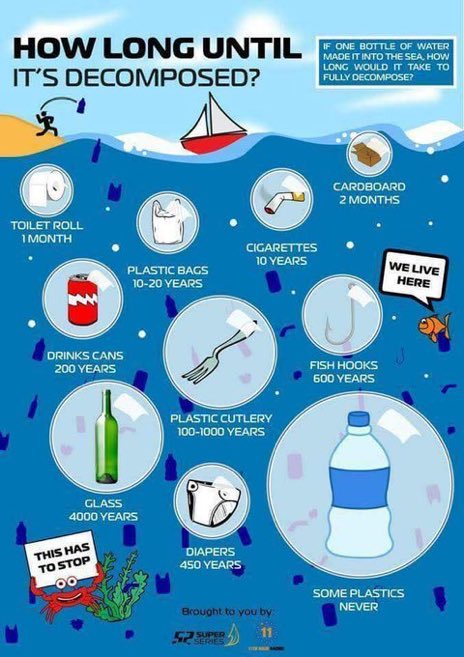
How long does Trash last?

http://visual.ly/trash-how-long-it-really-lasts


Most Valued Possessions


http://www.petapixel.com/2013/03/21/portraits-of-refugees-posing-with-their-most-valued-possessions/

Middle School Science Minute

by Dave Bydlowski (k12science or davidbydlowski@mac.com)


Water Stewardship


I was recently reading the March, 2013 issue of Science Scope, a magazine for Middle School Science Teachers, published by the National Science Teachers Association.  Nicole Nelson, wrote an article entitled “Using School-Yard Restoration to Engage Students in Water Stewardship”  In this article she shared her techniques for getting middle school students to personally connect to the ideas of conservation and stewardship in their own communities.


The major resource that she used was the Earth Partnership for Schools (EPS) Restoration-Based curriculum.  You can find this resource by Googling:

EPS, water stewardship curriculum

or visit:

http://greatlakesearthpartnership2012.wikispaces.com/Water+Stewardship+Curriculum

http://www.therouge.org/


From the Twitterverse:

* Steve Dembo ‏@teach42

Coolest. Dice. Ever. (How often have you said THAT??) But what would you use them for? “DICE+ pre-orders for $40″ http://buff.ly/YgY3jc

* russeltarr ‏@russeltarr

Excellent Teacher Training Videos! #topfilm http://tinyurl.com/6vufcg2

* Larry Ferlazzo ‏@Larryferlazzo

RT @alexanderrusso: Middle School Students Short on Lunch Money Ordered to Throw Food in the Trash http://ow.ly/jO0er

* Will Waidelich ‏@WillWaidelich

Name Brand Education? http://wp.me/p1Jl35-ci  via @blocht574 @AMLE

* Tom Murray ‏@thomascmurray

A6: Educators looking to evaluate rigor should look at Webb’s Depth of Knowledge (DOK) — strategic and extended thinking. #satchat

* Kelly Hines ‏@kellyhines

Interesting. “@sanmccarron: Principal plays surprising role in why new teachers quit http://shar.es/dIfuW

* Diane Ravitch ‏@DianeRavitch

Cody: Time to Hold Bill Gates Accountable http://wp.me/p2odLa-4q1

* Jeff Herb ‏@InstTechTalk

Apple TV in the Classroom http://inst.tc/Ln1hpY  #edtech #edchat

* Richard Byrne ‏@rmbyrne

Five Free iPad Apps for Creating Video Lessons (AKA Flipped Classroom Lessons) http://ow.ly/jMQtZ

* Gary Johnston ‏@GaryJohnston1

5 Brilliant ‘Design Your Own Game’ Websites for Students http://www.fractuslearning.com/2013/04/04/design-your-own-game/ … via @FractusLearning #minecraft

* Scott McLeod ‏@mcleod

Lesson design groups now giving each other feedback. Striving for cognitive complexity, student agency, & tech infusion. #nesa_sec #edtech

* Monte Tatom ‏@drmmtatom 16h

“Online Teacher Emergency” • #fhucid #eLearning #fhuedu642 #fhuedu320 #TETA http://feedproxy.google.com/~r/PowerfulLearningPracticeLLC/~3/g2wd1iwjB-E/ …

#mschat every Thursday at 8:00 pm Eastern Standard Time.


Resources:

Lesson Plan Organization

Looking for a place to enter and organize your lesson plans? This provides quick links to the Common Core.

http://www.commoncurriculum.com/


Web Spotlight:

Creating Classrooms We Need: 8 Ways Into Inquiry Learning

“Our whole reason for showing up for school has changed, but infrastructure has stayed behind,”

1.   BE FLEXIBLE.

2.   FOSTER INQUIRY BY SCAFFOLDING CURIOSITY.

3.  DESIGN ARCHITECTURE FOR PARTICIPATION.

Example: Laufenberg asked her students to watch President Obama’s State of the Union address and respond to what they watched and heard. She gave her students the option to either post comments on Twitter (fully public), Facebook (semi-public), Moodle (walled garden) or for low-tech participants, play Bingo with key words the students anticipated they might hear.

4. TEACHERS TEACH KIDS, NOT SUBJECTS.

5. PROVIDE OPPORTUNITIES FOR EXPERIENTIAL LEARNING.

6. EMBRACE FAILURE.

Laufenberg made a point of defining the difference between “blameworthy” and “praiseworthy” failure. Blameworthy failure is when the student just decided not to participate in a project. But praiseworthy failure is quite different: kids take risks and experiments knowing that they might not get it right the first time.

7. DON’T BE BORING.

“I always told my kids, if I got boring, they should let me know, and if they got boring, I’d let them know,”

8. FOSTER JOY.

“If by the end of the year, they still need me, I haven’t done my job,” she said. “I’m not coming with them to college. They have to be self-driven, independent thinkers.”


http://blogs.kqed.org/mindshift/2013/03/creating-classrooms-we-need-8-ways-into-inquiry-learning/

News:

Realistic Expectations for New Teacher Evaluation Systems

I’ve asked a number of prominent accountability hawks that question over the past six years and the answer I’ve heard most frequently is “5 to 10 percent.”

For over a century, school reformers have been dissatisfied with how teachers are evaluated, yet overhauling rating systems has not, historically, been an effective way to improve educational outcomes for kids. This is like hoping to lose weight by buying a new, high-tech scale, without changing your diet or exercise routines.

During the late nineteenth century, the New York City schools used an “excellent-good-fair-bad” rating system for teachers. When reformer William Maxwell became superintendent in 1898, he complained that 99.5 percent of teachers were rated “good” and instituted a plan to grade teachers on an A-D scale instead

In prominent education journals, dissident principals like Alexander Fichlander, a Brooklyn leftist, explained that the paperwork involved with implementing the system was so burdensome that administrators rushed through it; what’s more, there was little incentive to spend a lot of time rating teachers if the district provided no extra funding or training to those who needed to improve.

But if the new evaluation systems end up being more about paperwork than about improving practice, then they, too, will fail to improve instruction and will lose their political palatibility.

http://www.danagoldstein.net/dana_goldstein/2013/04/realistic-expectations-for-new-teacher-evaluation-systems.html


Common Core supporter: ‘I see the opportunity being squandered’

standards “represent the greatest opportunity for history teaching and learning to be widely re-imagined since the Committee of Ten set the basic outlines for American education over a hundred years ago.”

with each step towards implementation I see the opportunity being squandered. We cannot possibly continue to move solely in the direction of “college and career readiness” in History & Social Studies education without ensuring that “civic” readiness is valued equally

teachers working in Common Core states are currently engaging with the changes demanded by the Common Core. In too many places, this is happening without sufficient time and supports,

All systems are moving full speed ahead to assess core skills without sufficient consideration of the end to which these skills are applied.

Primary and secondary schools cannot merely be a farm system for universities and jobs. Rather, as public institutions, they must ensure that a new generation will be prepared for active civic engagement as youth and adults.

backwards design is not a simple linear process. These assessments will exist before anyone has had a chance to develop curricula that will prepare students for the assessments.

it is naive and simplistic to assume that changes to the standards and assessments will not be necessary once implementation occurs.

http://www.washingtonpost.com/blogs/answer-sheet/wp/2013/03/20/common-core-supporter-i-see-the-opportunity-being-squandered/


Essay-Grading Software Offers Professors a Break

will make its automated software available free on the Web to any institution that wants to use it

Although automated grading systems for multiple-choice and true-false tests are now widespread, the use of artificial intelligence technology to grade essay answers has not yet received widespread endorsement by educators and has many critics.

“There is a huge value in learning with instant feedback,” Dr. Agarwal said. “Students are telling us they learn much better with instant feedback.”

Les Perelman, has drawn national attention several times for putting together nonsense essays that have fooled software grading programs into giving high marks.

“Let’s face the realities of automatic essay scoring,” the group’s statement reads in part. “Computers cannot ‘read.’ They cannot measure the essentials of effective written communication: accuracy, reasoning, adequacy of evidence, good sense, ethical stance, convincing argument, meaningful organization, clarity, and veracity, among others.”

The EdX assessment tool requires human teachers, or graders, to first grade 100 essays or essay questions. The system then uses a variety of machine-learning techniques to train itself to be able to grade any number of essays or answers automatically and almost instantaneously.

“This is machine learning and there is a long way to go, but it’s good enough and the upside is huge,” he said. “We found that the quality of the grading is similar to the variation you find from instructor to instructor.”

“It allows students to get immediate feedback on their work, so that learning turns into a game, with students naturally gravitating toward resubmitting the work until they get it right,”

“One of our focuses is to help kids learn how to think critically,” said Victor Vuchic, a program officer at the Hewlett Foundation. “It’s probably impossible to do that with multiple-choice tests. The challenge is that this requires human graders, and so they cost a lot more and they take a lot more time.”

With increasingly large classes, it is impossible for most teachers to give students meaningful feedback on writing assignments, he said. Plus, he noted, critics of the technology have tended to come from the nation’s best universities, where the level of pedagogy is much better than at most schools.

http://www.nytimes.com/2013/04/05/science/new-test-for-computers-grading-essays-at-college-level.html?_r=1&

MSM 239: The Genius Hour & Self Defense . . .

advisory, AMLE, Podcast, Tech, Web Spotlight No Comments »

Presented in collaboration with the Association for Middle Level Education.

Jokes You Can Use:

Little Johnny comes downstairs crying. His mother asked, “What’s the matter now?”

“Dad was hanging pictures, and just hit his thumb with hammer,” said little Johnny through his tears. “That’s not so serious,” soothed his mother. “I know you are upset, but a big boy like you shouldn’t cry at something like that. Why didn’t you just laugh?

“I did!” sobbed Johnny.


A man lying on his deathbed called to him, his lawyer, his doctor, and his pastor. “I am going to die tonight,” and I want to prove that when you go to heaven you can take it all with you. So to my three most trusted friends, you three of course, I am leaving 50,000 dollars in these envelopes. When I die you must come to my funeral and put the envelopes in my coffin with me.” The man handed the three men identical envelopes.

A day later they each received news that, that night the old man had died . So each knew they must go to his funeral and fulfill his death wish.

Standing over the coffin one week later the pastor confessed, ” I can’t hide what I’ve done. I took 10,000 dollars from the envelope because the church needed to be painted.”

Then as he did so the doctor also started to fidget then finally confessed “I took 30,000 dollars from my envelope because the hospital needed a new wing.”

Then the lawyer said plainly “You bunch of crooks! I wrote him a check for the full amount!”


I don’t mean to say the economy is bad, but yesterday the ATM gave me an IOU.

Eileen Award:

  • Twitter: Karen Webster

  • Google+: Dawnette Brenner


Advisory:

WHAT IS POVERTY?

Poverty is hard to define, even though it is a term that we use very often.

“Poverty lines vary in time and place, and each country uses lines which are appropriate to its level of development, societal norms and values”

– The World Bank,

Poverty Analysis Overview

The Poverty Line project is an attempt to show what it means to be poor, by taking photos of daily amounts of food you can buy if your income lies at the poverty line.

http://www.thepovertyline.net/

Ice Cream Currency Calculator

Who values ice cream the most? What about other items?

http://visual.ly/ice-cream-currency-calculator


Middle School Science Minute

by Dave Bydlowski (k12science or davidbydlowski@mac.com)


Progression of Ideas

I was recently reading the March, 2013 issue of Science Scope, a magazine for Middle School Science Teachers, published by the National Science Teachers Association.  Joe Krajick, wrote and article entitled “The Next Generation Science Standards: A Focus on Physical Science.”  In this article he shared many ideas of why all students should have a basic understanding of Physical Science.


He went on to write about the importance of the progression of ideas.  Here is an example of the progression of ideas for the structure and properties of matter:

*  By the end of 2nd grade, students will have developed a descriptive model.

•  By the end of 5th grade, students will have developed a particle model.

•  By the end of 8th grade, students will have developed an atomic molecular model.

•  By the end of 12th grade, students will have developed an atomic structure model.


You can find more info at:

http://k12science.net/Podcast/Podcast/Entries/2013/3/15_Middle_School_Science_Minute-Progression_of_Ideas.html


From the Twitterverse:

* Patrick Larkin ‏@patrickmlarkin

The Problems with “The Rise Of Tablets As Textbooks” via @ryanbretag #beyondtextbooks http://bit.ly/YQRvUU

* Kate Maccoll ‏@kmacc1 28 Mar

Check out Cathy Hunt’s iPad Artroom. Well worth a look! http://www.ipadartroom.com/  #slide2learn #ade2013

* Jeff Herb ‏@InstTechTalk 8h

Edmodo – Facebook for the Classroom http://inst.tc/HYIXqb  #edtech #edchat

* Monte Tatom ‏@drmmtatom 24 Mar

Mobile Learning On The Interwebs http://flip.it/2tQlk  #iPads #fhuedu320 #fhuedu642

* Monte Tatom ‏@drmmtatom 24 Mar

A Simple Yet Powerful Student Blogging Activity http://flip.it/Yt9ym  #fhuedu320 #fhuedu642

* Monte Tatom ‏@drmmtatom 22 Mar

Monosnap – A Screen Capture Tool for Mac, Windows, iOS & Chrome http://flip.it/1K4hG  #fhucid #fhuedu320

* Donna Boucher ‏@MathCoachCorner 54m

@bcurrie5: Blubbr – Create Interactive Quizzes Using YouTube Clips http://www.freetech4teachers.com/2013/01/blubbr-create-interactive-quizzes-using.html#.UVY3oXCVclk.twitter … #edtech #elemchat #mschat” Awesome!

* Two Teacherz ‏@askteacherzcom 1h

Testing Culture = Atlanta Ex-Schools Chief Indicted http://nyti.ms/XMRuku  #TwoThumbZdown #edchat #satchat #mschat #MichEd #Rheediculous

* Mr Z (Josh) ‏@MrZsMath 2h

5 Ideas for the One iPad Classroom – Getting Smart by Susan Oxnevad http://zite.to/10fKL4w  #edtech #mschat

* LitLife ‏@LitLifePD 22h

RT @middleweb: The developmental needs of tweens are unique @RickWormeli has 5 strategies for tween tchrs http://bit.ly/13rjHVO  #mschat

#mschat every Thursday at 8:00 pm Eastern Standard Time.

Resources:

Genius Hour — Let Your Students Challenge Themselves

What would happen if we gave kids one hour a week to work on anything they wanted? Would you expect to find a classroom completely out of control? Or worse, a classroom, where students choose to do as little as possible for that one hour?

http://www.angelamaiers.com/2013/03/genius-hour-let-your-students-challenge-themselves.html


Web Spotlight:

The Senate Social Network

Social network analysis has been around since long before MySpace, Facebook, or the modern Internet itself. But the ubiquity of these platforms makes representations of data as social networks more familiar and accessible to readers. For example, here’s a representation of the Senate as a social network, in which any two senators are “friends” if they vote the same way at least 75 percent of the time.

The math behind social networks borrows a few things from physics, beginning with a spring system that gradually resolves into a coherent picture, as you can see in the animation. While the nodes are colored according to the senator’s party for visual effect, the network itself has no knowledge of partisanship. The divide is a natural consequence of a highly partisan legislature.

http://visual.ly/senate-social-network-diagram?view=true


News:


The Internet is just like junior high

If life is just like high school, then the Internet might be an age group lower. Much of our digital world means never having to leave junior high school behind.

If, as cultural critic Neil Postman asserted, TV ended childhood — the medium provided an impetus for young people to act older, which created hand-wringing about generations growing up too quickly — the Internet has done the opposite, she says.

http://www.cnn.com/2013/03/27/tech/web/internet-junior-high-school/index.html


Teachers and school staff turn to self-defense training

As school professionals nationwide re-evaluate plans for keeping schoolchildren safe, more teachers, staff and parents turn to self-defense training, defense instructors across the country say.

As school professionals nationwide re-evaluate plans for keeping school children safe in light of recent school shootings, more teachers, administrators and some parents are turning to self-defense training, self-defense instructors and educators nationwide say. Some people say it is the wrong approach to improving school safety.

“Teachers should be more prepared than just hiding under the desk,” Jerry Chenault said. “Self-defense isn’t the answer, but it is an answer.”

South Dakota passed a bill this month permitting teachers who undergo the same training as law enforcement to carry weapons on school campuses. The law will go into effect July 1 and is largely geared toward the state’s rural schools that are often at a distance from law enforcement centers, said Tony Venhuizen, spokesperson for the governor’s office. “Self-defense training also makes sense,” but each school district should decide for themselves, he said.

http://www.usatoday.com/story/news/nation/2013/03/24/teachers-self-defense-training/1987841/


Study: Middle School Algebra Push Yields Minimal Performance Gains

Many states are pushing students to take Algebra 1 in middle school to prepare them for advanced math in high school. A new analysis, however, suggests that increased enrollment hasn’t led to higher math performance for states on the National Assessment of Educational Progress.

Mr. Loveless said the study suggests that advanced math in middle school may be “watered down” as more students of different ability levels in math take the course.

http://www.edweek.org/ew/articles/2013/03/27/26mathside.h32.html?tkn=SXCCNl9EenxZ4V7fdKm8Cqcg%2FpMV5AP8%2B806&cmp=clp-sb-ascd


Are We Creating a Generation of Observers?

By Stephen R. Herr

I think most educators have a growing sense of concern that their students are turning into a generation of observers. The many watch the few.

I worry that, in our classrooms, we have become focused on celebrating the lives of others, at the expense of the act of creation.

As Socrates noted over 2,000 years ago, “The unexamined life is not worth living.” Perhaps, in 2013, the unexamined event is not worth perpetuating.

http://www.edweek.org/ew/articles/2013/03/27/26herr.h32.html?tkn=NXCF2%2FjcKyr2FM%2Fv9Y%2B%2BQbQJ%2Fo0VSM%2F5lf8n&cmp=clp-sb-ascd


Common-Core Tests to Take Up to 10 Hours

Districts will get 20 days to administer

By Catherine Gewertz


New tests being designed for students in nearly half the states will take eight to 10 hours, depending on grade level, according to guidance released last week.

The other group of states designing tests, the Smarter Balanced Assessment Consortium, has already come out with time estimates for its tests. Students in those 24 states will face testing times of seven to 8.5 hours. Now that PARCC has issued its test-time projections, educators in 22 other states and the District of Columbia know how much time students will need to take those exams.

The amount of time students will have to complete both the performance-based and end-of-year components in math and English/language arts:

  • Grade 3: 8 hours
  • Grades 4-5: 9 hours, 20 minutes
  • Grades 6-8: 9 hours, 25 minutes
  • Grades 9-10: 9 hours, 45 minutes
  • Grades 11-12: 9 hours, 55 minutes
  • For students: Five to nine days

For schools and districts: Up to 20 days for the performance-based component of the test, and up to 20 days for the end-of-year component. Schools may administer the tests in narrower windows of time if they have the capacity to do so.

iPad App/idea:

Turn your iPad into a Document Camera

Stage

https://itunes.apple.com/us/app/stage-interactive-whiteboard/id584574701?mt=8

Stand:

http://www.ipaddocumentcamera.com/

http://www.maxcases.com/shop/max-handstand-dx/

AppleTV


Half-Baked Ideas . . .

Are conferences better if they are free or paid?


MSM 237: The Socially Awkward Show

advisory, MSM, News, Podcast, Tech, Web Spotlight No Comments »

Presented in collaboration with the Association for Middle Level Education.

Jokes You Can Use:

While Mark was shopping for pet supplies, one of the sales people came running up to him. “Mark! Mark! I just saw someone driving off with your BMW!”
“Dear God! Did your try to stop him?” “No,” said the clerk, “but don’t worry. I got the license plate number!”

A man goes to the doctors and asks why he’s been feeling ill. The doctor examines him and replies “I’m sorry to tell you, you’ve got the disease known as Yellow 24.” “What’s that?” the man asks. “It means your internal organs have started turning yellow – you’ve got 24 hours to live”.
The man goes home and tells his wife the bad news. His wife says “Well, will you come to bingo with me tonight then? Otherwise you’ll never be able to.” The man agrees so he and his wife go to the bingo. He finds that he’s won the one-line and £10. He begins to think this isn’t such a bad day after all. Twenty minutes later, he’s won the full house and £150. He enters the lucky draw, worth £500, and wins that too. The bingo caller calls him up on stage.
He says “I don’t believe it, mate. You’ve won three competitions in a total of £660 in one night. You must be the luckiest man on the earth!”
The man says “Well, no, I’m not. I’ve got Yellow 24.”
The bingo caller looks down at the piece of paper he’s holding and starts clapping. “I don’t believe it; he’s won the raffle as well!”

Nurse: Good morning Mr. Smith, you seem to be coughing much more easily this morning.
Mr. Smith: That’s because I’ve been practicing all night.

Eileen Award:

  • Twitter: Robert McGarry, Ashley Blankenship, Michelle Corbat, Jonathan Swegels, Sally Baldridge, Andy Zimmer, Emil Ahangarzadeh
  • Facebook: Karen Decker, C. Joan Seager, Linda Perukel
  • Google+: Jason Neiffer
  • Diigo: Keith Schoch, Ron King


Advisory:

Brain Food

Lateral Thinking Puzzles
http://www.rinkworks.com/brainfood/p/latreal1.shtml

Good Will Hunting

http://twentytwowords.com/2013/03/04/the-math-on-the-chalkboard-in-good-will-hunting-was-relatively-simple/

Restaurant run by Owner with Down’s Syndrome

http://www.youtube.com/watch?feature=player_embedded&v=y6He0FWoFj0

Oreo Separating Machine

http://twentytwowords.com/2013/03/02/physicist-builds-ultra-important-machine-an-oreo-separating-robot/

Middle School Science Minute

by Dave Bydlowski (k12science or davidbydlowski@mac.com)

Fire Blanket

I was recently reading the NSTA Ready Reference Guide for Safer Science, Volume 2, written by Ken Roy, director of environmental health and safety for Glastonbury Public Schools in Glastonbury, CT. Within the book are topics dealing with “Safer Science” and questions that teachers have sent him regarding “Safer Science.”

From the Twitterverse:

* Daniel Hodge ‏@hodgedvcves
Cool app to create posters “Phoster” #4thchat #5thchat pic.twitter.com/C4eCIpSBra
* Terie Engelbrecht ‏@mrsebiology
RT @Ron_Peck: Dan Pink: How Teachers Can Sell Love of Learning to Students http://goo.gl/eTsLE  via @zite
* Chad Lehman ‏@imcguy
31 Top Apps for Education from FETC 2013 — THE Journal http://thejournal.com/articles/2013/02/26/31-top-apps-for-education-from-fetc-2013.aspx?=FETCLN …
* Jennifer Loetzerich ‏@J_Loetzerich
Algebra I Livebinder http://www.livebinders.com/play/play?id=330272 …
* russeltarr ‏@russeltarr
http://Free-Loops.com  provides free loops and audio clip downloads #topaudio http://tinyurl.com/ckg8bwt
* Parentella ‏@Parentella
Seems Like This Canadian “Parent Academy” Has Some Good Ideas http://bit.ly/YggOBj  #education
* Eye On Education ‏@eyeoneducation
3 Strategies for Helping Students Motivate Themselves http://ow.ly/ib8dr  @LarryFerlazzo #edchat #teachchat #ntchat
* Philippa Isom ‏@PhilippaIsom
For us new Edmodo users http://blog.edmodo.com/category/teacher-stories/ …
* Scott McLeod ‏@mcleod
The Nerdy Teacher: Professionals Make Time for Learning #edchat http://bit.ly/XNyguY
* Will Richardson ‏@willrich45
Twelve Things You Were Not Taught in School About Creative Thinking http://buff.ly/vOHItu  #edchat
* Monte Tatom ‏@drmmtatom
Free World Digital Library for Teachers & Students http://flip.it/shSB2  #fhuedu642 #fhuedu320 ~ for @MSMatters followers
#mschat every Thursday at 8:00 pm Eastern Standard Time.

Resources:

Twitter Is Perfect for Socially Awkward People

By Peter DeWitt on February 26, 2013 6:14 PM
Socially awkward sounds so much better than workaholic.
Twitter has one more benefit that happens naturally, and that is the relationship it can build between different stakeholders in the system.
http://blogs.edweek.org/edweek/finding_common_ground/2013/02/twitter_is_perfect_for_socially_awkward_people.html?cmp=SOC-SHR-TW

Use Celly to Setup a Free Text Messaging Group Chat

Text messaging is one of the best ways to communicate with groups today. For teachers wanting to setup text messaging systems with students, Remind101 is one of the best, free options available. Our OM parent group used Cel.ly to set our group up because it’s easy, straightforward, free, and even has free iOS app. If you’re wanting to setup Cel.ly for a school group, see this celly @ school page.
http://www.speedofcreativity.org/2013/03/03/use-celly-to-setup-a-free-text-messaging-group-chat/


Web Spotlight:

Students Share Characteristics Of Their Favorite Teachers

http://edudemic.com/2013/02/characteristics-favorite-teachers/

Homework Why’s and Homework-Wise

If we are relying on homework as the main way to teach responsibility, we are in trouble.
http://chriswejr.com/2010/10/13/homework-whys-and-homework-wise/

Words Matter: What Values Do Your Words Convey?

I encourage people to choose their words wisely, because the words we choose have a powerful effect on other people. As this post showed, the words we choose matter not only for teachers, but for anyone else who plays an important role in someone’s life.
http://www.angelamaiers.com/2013/03/words-matter-what-values-do-your-words-convey.html

Primary Source Analysis Guides for Students and Teachers

http://www.freetech4teachers.com/2013/03/primary-source-analysis-guides-for.html

Why we have our best ideas in the shower: The science of creativityPosted on Thursday, February 28th, 2013

Written by Leo Widrich

Another ingredient, that’s very important for us to be creative is dopamine: The more dopamine that is released, the more creative we are…
Dopamine alone, which gets triggered in hundreds of events, where we aren’t very creative, can’t be the only reason. Another crucial factor is a distraction, says Harvard researcher Carson…
Lastly, after you have received an influx in dopamine, can be easily distracted by an extremely habitual task like showering or cooking, a relaxed state of mind is absolutely important to be creative, says Jonah Lehrer…
http://blog.bufferapp.com/why-we-have-our-best-ideas-in-the-shower-the-science-of-creativity

News:

Amplify Tablet comes to the Education Market

With the Amplify Tablet, students gain a mobile learning device that is organized around their in-school courses and out-of-school interests. The tablet becomes their digital backpack, filled with all of the content, assignments and activities of their classes, as well as tools to individualize their learning and explore their interests.
http://www.amplify.com/tablet/

iPad App:

Too Noisy for iPhone, iPad, and iPod

This app measures the volume of the classroom in a graphic that can be displayed.  Not that they wonder how loud they are.  Ever.  But now you can show them!

MSM 236: A Quandary, 200 calories and Cross Cutting Concepts of Baby Food

advisory, Podcast, Tech No Comments »

Presented in collaboration with the Association for Middle Level Education.


Jokes You Can Use:

What scares the daylights into you?
In which month do kids talk the least?
What’s a perfect gift for someone who has everything?
Remember, teenagers rarely make the same mistake twice.

Eileen Award:


  • Facebook: Brigitte Darling
  • Google+: Jim Peterson

Advisory:

Quandary

Quandary is a free, online game that engages your students in ethical decision-making and develops skills that will help them recognize ethical issues and deal with challenging situations in their own lives.
There are three episodes (scenarios) in Quandary. Each takes about 10-30 minutes to complete, depending on the speed of the player.
Quandary’s registration system allows players to save their progress after each episode and return by logging-in at a different time. It’s not necessary to register to play the game, but note that progress will not be saved.
http://www.quandarygame.org/
Check out the Teacher’s page: http://www.quandarygame.org/teachers

One Sentence Stories

Have students create one sentence stories that describe them in the future. These can be video’d.
http://www.youtube.com/watch?feature=player_embedded&v=ndqdD6EXat4#!
Dan Pink’s Version:
http://www.danpink.com/2011/01/whats-your-sentence-the-video

Baby’s first foods

Baby

http://visual.ly/babys-first-foods-around-world

200 Calories

What does 200 calories look like?
http://imgur.com/a/w9nHF

Middle School Science Minute

by Dave Bydlowski (k12science or davidbydlowski@mac.com)

Cross Cutting Concepts

An important component of the Next Generation Science Standards are the Cross Cutting Concepts.  They are the important themes that pervade science, mathematics, and technology.  The seven crosscutting concepts are:
*  Patterns
*  Cause and Effect: Mechanism and Explanation
*  Scale, Proportion and Quantity
*  Systems and System Models
*  Energy and Matter: Flows, Cycles, and Conservation
*  Structure and Function
*  Stability and Change

Keep up the great work,
Dave

By the way, I added a Twitterverse to my bi-monthly Michigan Science Matters Network eBlast.  Check it out at:
http://www.msta-mich.org/educator-support/84-science-matters/256-science-matters-e-blast-january-24-2013

From the Twitterverse:

* russeltarr ‏@russeltarr
Spritz this perfume on your e-reader to make it smell like a paper book: http://tinyurl.com/cekfsrq
* Larry Ferlazzo ‏@Larryferlazzo
Via @nprnews: Contagion On The Couch: CDC App Poses Fun Disease Puzzles http://n.pr/XQutff
* Eye On Education ‏@eyeoneducation
Using Google Hangouts for Teacher Development http://ow.ly/hTvU1  @Edutopia #edchat #teachchat #edtech #profdev
* Tim Childers ‏@tchilders
Free Technology for Teachers: Create Animated Videos With Wideo http://buff.ly/XtwqiD  I think you’ll like this one!
* Carol A. Josel ‏@schoolwise
Teacher job satisfaction at 25-year low | HechingerEd Blog: http://hechingered.org/content/teacher-job-satisfaction-at-25-year-low_6076/#.USis__V4GCs.twitter …
* Diane Ravitch ‏@DianeRavitch
Indiana Senate Halts Implentation of Common Core http://wp.me/p2odLa-43q
* Sean Banville ‏@SeanBanville
“Women talk three times more than men” A 26-page / 30-online-activity lesson - http://bit.ly/ZoZycW  #esl #efl #twinglish #esol
* Timothy Gwynn ‏@tgwynn
“Thank you, apostrophes for being pretty cool. Even though sometimes you can be a bit possessive.” -@jimmyfallon
* Monte Tatom ‏@drmmtatom
Ways to Teach Using Infographics http://flip.it/6V711  #fhuedu320
* Monte Tatom ‏@drmmtatom
17 Real-World Ways #iPads Are Being Used In Schools http://flip.it/53Y3P  #fhuedu320 #fhuedu642 #mLearning

Good Afternoon! I’m live on TwitCasting from my MacBook! ( #fhuedu642 EDU 642 Advanced Tech http://moi.st/92da74  )#mschat every Thursday at 8:00 pm Eastern Standard Time.

Resources:

Tapestry

Great one way books for iPad, iPhones, etc. Easy to use.

http://tapestry.is/

Historical Dictionary

A glossary of historical terms
http://www.historytoday.com/dictionary

Public Domain Images

These are images that are free to use for presentations.
http://pixabay.com/

Web Spotlight:


In Iowa, our Department of Education brags about elementary schools that cut recess

In the 2004-2005 school year, 18 4th graders took the state reading test at Charter Oak-Ute Elementary. Only 14 were deemed proficient, for an AYP percentage of 78%. That apparently sparked a 7-year quest to raise test scores.
Today the Iowa Department of Education (DE) touted Charter Oak-Ute Elementary as one of the 5 schools (out of 1,409 in the state) that’s supposedly proving that poverty does not equal destiny. In fact, DE boldly said on its home page:

It may be well known that high-poverty schools will have lower proficiency rates than their more affluent counterparts. Sure, it’s well known. But it is wrong.*  [yes, that was our Department of Education dismissing decades of peer-reviewed research on student learning outcomes in high-poverty schools]

http://dangerouslyirrelevant.org/2013/02/in-iowa-our-department-of-education-brags-about-elementary-schools-that-cut-recess.html

A Liberal Decalogue: Bertrand Russell’s 10 Commandments of Teaching

by Maria Popova
Perhaps the essence of the Liberal outlook could be summed up in a new decalogue, not intended to replace the old one but only to supplement it. The Ten Commandments that, as a teacher, I should wish to promulgate, might be set forth as follows:

  1. Do not feel absolutely certain of anything.
  2. Do not think it worthwhile to proceed by concealing evidence, for the evidence is sure to come to light.
  3. Never try to discourage thinking for you are sure to succeed.
  4. When you meet with opposition, even if it should be from your husband or your children, endeavor to overcome it by argument and not by authority, for a victory dependent upon authority is unreal and illusory.
  5. Have no respect for the authority of others, for there are always contrary authorities to be found.
  6. Do not use power to suppress opinions you think pernicious, for if you do the opinions will suppress you.
  7. Do not fear to be eccentric in opinion, for every opinion now accepted was once eccentric.
  8. Find more pleasure in intelligent dissent than in passive agreement, for, if you value intelligence as you should, the former implies a deeper agreement than the latter.
  9. Be scrupulously truthful, even if the truth is inconvenient, for it is more inconvenient when you try to conceal it.
  10. Do not feel envious of the happiness of those who live in a fool’s paradise, for only a fool will think that it is happiness.

http://www.brainpickings.org/index.php/2012/05/02/a-liberal-decalogue-bertrand-russell/

Several years ago, we decided to design a more comprehensive way of evaluating our students’ success in our middle school. We acknowledged that grades are just one measure of how students can experience success in school.
The SAP has changed our school. Our students are aware of where they are in their education experience, and have ownership in the process. Almost every student knows his or her grades, attendance, Acuity and STAR score as well as overall points. Students, parents, teachers, and administrators are crystal clear about whether a student is on track to pass or fail.

http://www.freetech4teachers.com/2013/02/guest-post-student-accountability.html

The Independent Project

The Independent Project is an alternative student driven school-within-a-school that was started at Monument Mountain Regional High School by a student.
Eight students were accepted into the pilot program of the school, which ran for one semester and is now complete. The school, dubbed The Independent Project, is now in the stage of redesign and replication.
http://www.theindependentproject.org/the-white-paper/

Mycestro™

A 3D mouse that fits on the index finger and allows you to control your computer with hand gestures and mouse functions.
http://www.kickstarter.com/projects/mycestro/mycestrotm-the-next-generation-3d-mouse?ref=live

Markup

Our mission is to achieve a paperless classroom. With Markup, teachers can grade assignments on the iPad.
http://www.kickstarter.com/projects/1834203895/markup-paperless-grading-for-teachers?ref=category

News:


Perfectly preparing a generation for its own history

“The fallacy of competitive education is its obsession with remembered right answers. The fallacy of right answers is that today success depends less on right answers and more on finding good answers and using them to accomplish meaningful goals. What does the game of school do to children who are more inclined to find and invent good answers than memorize correct answers?

….

As long as we race [to the top], scoring points by teaching the same answers for the same tests to every child, then we’re perfectly preparing a generation for its own history.”

http://dangerouslyirrelevant.org/2013/02/perfectly-preparing-a-generation-for-its-own-history.html


MSM 235: The Longest Day . . . or Show . . .

advisory, MSM, Podcast, Web Spotlight No Comments »

Presented in collaboration with the Association for Middle Level Education.   

Jokes You Can Use:

Why was the broom late for work?
Did you hear that Oxygen and Magnesium are going out?
Did you hear about the two antennas that got married?
What is ET short for?

Advisory:

From rotary to Siri: How the phone numbering system came and went

The recent death of John E Karlin of Bell Labs, the father of the push-button phone and other innovations, has sparked a lot of reminiscing about land line phones. According to the New York Times, Karlin was also “the most hated man in America” for killing the named exchanges (like Butterfield 8). However the story of how our phone numbers got to be the way they are is a much longer and more interesting one.
In 1950 it got really interesting, with the introduction of area codes. The designers wanted to minimize the number of numbers people had to dial, so all the area codes were set up to have 1 or 0 as the second number. The switches were set up so that if first number dialed was a 0 then it went to operator. If the second digit was 1 or 0, then it was an area code. If the second number was another number, then it knew it was a local rather than long distance number. That’s how it was going to distinguish between 7 and 10 digit numbers.
http://www.treehugger.com/gadgets/number-crisis-world-zone-1.html

Bazooka shoots ping-pong balls at Mach speed

The magic of physics can turn the mundane into something marvelous. Mark French, a mechanical engineering professor at Purdue University, designed a supersonic air-powered ping-pong ball cannon that shoots the lightweight object at speeds so fast I would consider the device a lethal weapon of science.
A ping-pong ball reportedly blasts out of the special cannon at speeds equivalent to Mach 1.23 — nearly as fast as an F-16 fighter jet.
http://news.cnet.com/8301-17938_105-57569069-1/bazooka-shoots-ping-pong-balls-at-mach-speed/

Ocean Facts:

In celebration of the upcoming premiere of DinoFish on Nat Geo Wild (Sunday, April 1, 10pm EST/PST), I’m excited to present the first of what we we hope will be a long series of comic strips by Dr. Byron Beekle.  We will be presenting a whole series of these comics today and through the weekend, we hope you enjoy.
http://tvblogs.nationalgeographic.com/2012/03/30/amazing-ocean-facts-premiere/

Telling the Truth

http://gawker.com/5982653/something-tells-me-john-is-lying-about-not-eating-those-sprinkles

MIT Media Lab

Learning Creative Learning is a course offered at the MIT Media Lab. It introduces ideas and strategies for designing technologies to support creative learning. This semester, for the first time, P2PU and the Media Lab are working together to bring the course online. We are opening up the seminars, course materials, and hands-on activities to anyone with a computer and Internet access. It’s a big experiment, we expect to learn a lot, and we hope you’ll enjoy it.
What you are looking at here is a BIG experiment. For the first time, we are opening the course to online participants. In the spirit of learning and technology, we hope that participants will jump in as collaborators rather than passive recipients. We want to tinker together. Things will break, but we are committed to fixing them along the way. We invite you to break and fix them together with us.
http://learn.media.mit.edu/

The Shame of Smell…

http://www.retronaut.com/2013/02/when-tears-of-shame-smell/

Blend into the environment

http://bencebakonyi.com/index.php?/projects/transform/

Things that fit perfectly into other things

http://thingsfittingperfectlyintothings.tumblr.com/

Middle School Science Minute

by Dave Bydlowski (k12science or davidbydlowski@mac.com)

INTERVIEWS TO EXPLORE STUDENT IDEAS

I was recently reading the January, 2013 of Science Scope, a magazine for middle school teachers, published by the National Science Teachers Association.  In the magazine was an article entitled, “Using Interviews to Explore Student Ideas in Science,” written by Rosemary Russ and Miriam Gamoran Sherin.  The focus of the article is that educators need to be aware of what children already know because teaching that builds on students’ existing ideas and is likely to produce robust and meaningful learning.

Keep up the great work,
Dave
PS — Loved the magic trick idea in the last podcast and how it helps with spelling.

By the way, I added a Twitterverse to my bi-monthly Michigan Science Matters Network eBlast.  Check it out at:
http://www.msta-mich.org/educator-support/84-science-matters/256-science-matters-e-blast-january-24-2013

From the Twitterverse:

* Todd Williamson ‏@Twilliamson15
@vtdeacon up for Pringles Challenge again this year? Even if not, would love for you to pass it along! http://ow.ly/hOq6X
* Monte Tatom ‏@drmmtatom
5 Free Video Editing Tools For Project-Based Learning [PC & Mac] http://flip.it/W4HBZ  #fhucid #fhuedu320 #eLearning ~ for @MSMatters

Cool Graphic on Learning in The 21st Century http://flip.it/tk3z8  #eLearning #fhuedu642 #fhuedu320 #fhucid ~ for @MSMatters followers

6 Examples Of Successful Classroom Tablet Integration http://flip.it/dgMdA  #fhuedu642 #fhuedu320 #mLearning

How To Secure Your Online Data http://flip.it/cS8Rw  #fhucid #fhuedu642 #fhuedu320 ~ for @MSMatters followers

A Dress-Code Enforcer’s Struggle for the Soul of the Middle-School Girl – Jessica Lahey – The Atlantic http://flip.it/6Onv0  #fhupsy306

How to Fuel Students’ Learning Through Their Interests | MindShift http://flip.it/WFAr6  #fhuedu508 #fhuedu320 #fhucid #fhupsy306

The 16 Apps & Tools Worth Trying This Year http://flip.it/Zx8Md  #fhucid #fhuedu642 #fhuedu320 #eLearning

* Ron King ‏@mthman
MT@Philip_Cummings: My Middle Schoolers Actually LOVE Our Unit Overview Sheets! http://buff.ly/15l0tzo  via @plugusin #midleved #mschat
* Scott B. Goldscher ‏@ScottBGoldscher
Why Scoopit Is Becoming An Indispensable Learning Tool http://zite.to/XIzWF1  #edtech #edchat
* DeeAnna Nagel ‏@TherapyOnline
Boy meets girl. Girl strips on webcam. Tells boy to do the same. Girl blackmails boy http://nakedsecurity.sophos.com/2013/02/18/blackmail-webcam-strippers/ …
* amber mac ‏@ambermac
GTA: talking the coolest fitness gadget around on @1045CHUMFM this morn 825am
* Scott McLeod ‏@mcleod
New bookmark: New Tools Seek to Evaluate Ed Tech Products http://bit.ly/WGadzM
* Cheryl Lykowski ‏@CLykowski
12 Interesting Ways To Start Class Tomorrow http://zite.to/12Zx89V  via @zite
* Diane Ravitch ‏@DianeRavitch
How Charter Schools Exclude the Kids They Don’t Want http://wp.me/p2odLa-3YA
* eInstruction ‏@eInstruction
2013 Presidents’ Day Quiz. http://wapo.st/WH4k5l
#mschat every Thursday at 8:00 pm Eastern Standard Time.

Resources:

http://thisishangingrockcomics.tumblr.com/post/42546243887/actual-diary-entry-from-when-i-was-in-5th-grade-oh

Copy Right Poster

http://edudemic.com/wp-content/uploads/2013/02/teachers-copyright.jpg

A Periodic Table of Visualization Methods

http://www.visual-literacy.org/periodic_table/periodic_table.html

A Cleaner Internet

We make iPhone, iPod and iPad apps as well as browser extensions that declutter the video viewing experience.
http://clea.nr/

Web Spotlight:

Killing Lincoln

http://killinglincolnconspiracy.com/

Dio

Make your own space.
https://www.dio.com/

News:


Disease and sleep: Recent studies find new links

One in five U.S. adults shows signs of chronic sleep deprivation, and a shortage of sleep has been linked to health problems as different as diabetes and Alzheimer’s disease. Recent studies have found some interesting connections between illness and what is happening in our brains as we snooze.

http://www.washingtonpost.com/national/health-science/disease-and-sleep-recent-studies-find-new-links/2012/12/03/003ef1ba-3d9e-11e2-bca3-aadc9b7e29c5_graphic.html

MSM 234: There is a squirrel eating your internet connection.

advisory, MSM, News, Podcast, Tech, Web Spotlight No Comments »

Presented in collaboration with the Association for Middle Level Education.

Jokes You Can Use:

http://rack.3.mshcdn.com/media/ZgkyMDEzLzAyLzAxLzZiL1FUZTVoZ2cuMTczNWYuanBn/b9ee4fce/fb8/QTe5hgg.jpg

Which side of the chicken has more feathers?
What do you call a man who shaves 20 times a day?
Why should you never trust an atom?
What do you call Santa’s little helpers?
What did the hat say to the hat rack?

Eileen Award:


  • Facebook:  Karen Decker


Advisory:


Money Tips for Parents & Teens

http://dailyinfographic.com/money-101-for-parents-teens-infographic

The Radio Show

http://www.brainpickings.org/index.php/2013/01/29/radio-an-illustrated-guide-ira-glass-jessica-abel/
The $2 ebook is available here: https://store.thisamericanlife.org/ProductDetails.asp?ProductCode=RADIO%3AANILLUSTRATEDGUIDE

Water Changes Everything

http://www.coolinfographics.com/blog/2012/12/31/water-changes-everything.html

Magic Trick

http://www.youtube.com/watch?feature=player_embedded&v=tlQiuCeezUA

Politeness

http://www.youtube.com/watch?feature=player_embedded&v=nhekhBKkDXw

Middle School Science Minute

by Dave Bydlowski (k12science or davidbydlowski@mac.com)

I was recently reading the NSTA Ready Reference Guide for Safer Science, Volume 2, written by Ken Roy, director of environmental health and safety for Glastonbury Public Schools in Glastonbury, CT. Within the book are topics dealing with “Safer Science” and questions that teachers have sent him regarding “Safer Science.”  The focus of this podcast is on a question from a teacher regarding the teaching of science in a mathematics classroom.

By the way, I added a Twitterverse to my bi-monthly Michigan Science Matters Network eBlast.  Check it out at:
http://www.msta-mich.org/educator-support/84-science-matters/256-science-matters-e-blast-january-24-2013

From the Twitterverse:

* ConnectEDU ‏@ConnectEDUInc
“Change happens at the speed of trust” #learnlaunch13
* Larry Ferlazzo ‏@Larryferlazzo
The Best Ways To Deal With Rudeness In Class http://larryferlazzo.edublogs.org/2013/02/02/the-best-ways-to-deal-with-rudeness-in-class/#.UQ0oJY43ax4.twitter …
* Richard Byrne ‏@rmbyrne
Blubbr – Create Interactive Quizzes Using YouTube Clips http://ow.ly/hlOGY
* Karen Horne ‏@mrskhorne
@syded06 Now I have discovered google docs (and free!) I rarely use Microsoft office, the purchase of a chromebook was the icing on the cake
* Will Richardson ‏@willrich45
“The Coming KIPP Bubble” http://buff.ly/11sEGkH  Long, but interesting. #edchat #education
* Will Richardson ‏@willrich45
Posted: The Missing Layer http://buff.ly/11u35pY  Sincerely interested in your comments/thoughts. #education #edreform #edchat
* Scott McLeod ‏@mcleod
DI: Learning no longer has to stop http://bit.ly/VDfkA4  #edtech
* Mark Barnes ‏@markbarnes19
Quizpoo Is An Easy & Unique Tool For Making Online Tests – Quizpoo lets you create, without requiring registration, … http://ow.ly/2uD2tN
* Sheri Edwards ‏@grammasheri
CCSS: Teaching Argument vs. Evidence | MiddleWeb #midleved http://www.middleweb.com/5719/ccss-teaching-argument-vs-evidence/ …
* Scott McLeod ‏@mcleod
Rigor v. Vigor. Let’s change the conversation here in Iowa! http://bit.ly/WLQD5G  #iaedfuture #plaea
#mschat every Thursday at 8:00 pm Eastern Standard Time.

Resources:

Reading Rockets

Reading, and a love for reading, begins at home. The Reading Tip of the Day widget offers easy ways for parents to help kids become successful readers
http://www.readingrockets.org/sharing/widgets/tipoftheday/

iCivics

iCivics prepares young Americans to become knowledgeable, engaged 21st century citizens by creating free and innovative educational materials.
In 2009, Justice Sandra Day O’Connor founded iCivics to reverse Americans’ declining civic knowledge and participation. Securing our democracy, she realized, requires teaching the next generation to understand and respect our system of governance. Today iCivics comprises not just our board and staff, but also a national leadership team of state supreme court justices, secretaries of state, and educational leaders and a network of committed volunteers. Together, we are committed to passing along our legacy of democracy to the next generation.
In just two years, iCivics has produced 16 educational video games as well as vibrant teaching materials that have been used in classrooms in all 50 states. Today we offer the nation’s most comprehensive, standards-aligned civics curriculum that is available freely on the Web.
http://www.icivics.org/

Web Spotlight:


The One Math Skill You Need to Succeed at Work


  • The key to improving today’s workforce could lie in the elementary school math class, new research shows.
  • lack of a specific math skill in first grade correlated to lower scores on a seventh-grade math test
  • United States Center for Educational Statistics revealed that one in five adults lacks the math competency expected of an eighth-grader
  • specific numerical skill as a target, we can focus education efforts on helping deficient students as early as kindergarten and thereby give them a better chance at career success in adulthood
  • identified was “number system knowledge,” which is the ability to conceptualize a numeral as a symbol for a quantity and understand systematic relationships between numbers.
  • The study found that having this knowledge at the beginning of first grade predicted better functional mathematical ability in adolescence.
  • “Poor understanding of mathematical concepts can make a person easy prey for predatory lenders,” he said. “Numerical literacy, or numeracy, also helps with saving for big purchases and managing mortgages and credit-card debt.”
  • 180 13-year-olds who had been assessed every year since kindergarten for intelligence, memory, mathematical cognition, attention span and achievement.

http://www.businessnewsdaily.com/3856-how-elementary-math-class-can-improve-today-s-worker.html?

Where the iPhone 5 Kicks the Mars Rover’s Butt

“You’re carrying more processing power in your pocket thanCuriosity,” Ben Cichy, chief flight software engineer, told an audience at this year’s MacWorld. Specifically:

  • Processors: Curiosity’s is 132MHz; the iPhone 5’s is 1.3 GHz.

  • Memory: Curiosity’s has 128 MB; the iPhone 5 has 1 GB.

  • Storage: Curiosity holds 4 GB; iPhone 5 holds 64 GB.

  • OS: Curiosity runs Wind River VxWorks 6.7 Real-time OS; the iPhone runs iOS 6.

One of the team’s biggest challenges is having to script instructions for Curiosity within a 12 to 16 hour window. Each day, after the lander downloads the latest batch of data to the 100 scientists watching her movements, the team determines what they want her do next and make sure that their goals align with Curiosity’s capabilities. Then the software team writes the necessary script and sends it off via uplink. Because of the roughly 14 minutes it takes for the instructions to reach Mars, all of this has to be done within the window, when Curiosity is sleeping.
http://slashdot.org/topic/bi/mars-rover-curiosity-less-brainpower-than-apples-iphone-5/

Teach This! Teaching with lesson plans and ideas that rock 01/29/2013

Posted by Vicki Davis

http://coolcatteacher.blogspot.com/2013/01/teach-this-teaching-with-lesson-plans_29.html

The Google Science Fair is an online science competition open to students ages 13-18 from around the globe. We’re looking for ideas that will change the world. To get started, all you’ll need is a Google account.

http://www.freetech4teachers.com/2013/01/google-wants-to-hear-from-teenage.html

News:

Data: No deus ex machina


  • Data-based decision-making is all the rage. Secretary of Education Arne Duncan (2009) has emphatically declared, “I am a deep believer in the power of data to drive our decisions. Data gives us the roadmap to reform. It tells us where we are, where we need to go, and who is most at risk.”
  • Data expose inequities, create transparency, and help drive organizational improvement.
  • But something is amiss – push to narrow schooling to test scores and graduation rates
  • the data—which are relatively crude, consisting mostly of reading and math scores—are unequal to the heavy weight they’re asked to bear.
  • Data can be a powerful tool. But we must recognize that collecting data is not using data; that data are an input into judgment rather than a replacement for it; that data can inform but not resolve difficult questions of politics and values; and that we need better ways to measure what matters, rather than valuing those things we can measure
  • Ellwood Cubberley (1919), cheered such assessments, insisting, “We can now measure an unknown class and say, rather definitely, that, for example, the class not only spells poorly but is 12 percent below standard” (p. 694)
  • Standardized tests have meant nothing less than the ultimate changing of school administration from guesswork to scientific accuracy. The mere personal opinions of school board members and the lay public … have been in large part eliminated.
  • In the 1960s and 1970s, proponents of data and accountability again insisted that they had it right.
  • Lessinger was hardly alone; more than 4,000 books and articles on data and education accountability were published in the late 1960s and early 1970s
  • Yet in 2001, No Child Left Behind’s architects started from the bipartisan conviction that U.S. schooling was nearly bereft of good data.

http://www.aei.org/article/education/k-12/leadership/data-no-dues-ex-machina/

CA Gov. Jerry Brown: “I would prefer to trust our teachers”

California Jerry Brown just gave his State of the State address.

  • We seem to think that education is a thing—like a vaccine—that can be designed from afar and simply injected into our children.
  • I would prefer to trust our teachers who are in the classroom each day, doing the real work – lighting fires in young minds.

http://larryferlazzo.edublogs.org/2013/01/24/ca-gov-jerry-brown-i-would-prefer-to-trust-our-teachers/

Why You Truly Never Leave High School

  • There are some people who simply put in their four years, graduate, and that’s that. But for most of us adults, the adolescent years occupy a privileged place in our memories, which to some degree is even quantifiable: Give a grown adult a series of random prompts and cues, and odds are he or she will recall a disproportionate number of memories from adolescence
  • Yet there’s one class of professionals who seem, rather oddly, to have underrated the significance of those years, and it just happens to be the group that studies how we change over the course of our lives: developmental neuroscientists and psychologists.
  • For years, we had almost a religious belief that all systems developed in the same way, which meant that what happened from zero to 3 really mattered, but whatever happened thereafter was merely tweaking.”


  • “If you put adults in a similar situation”—meaning airlifted into a giant building full of strangers with few common bonds—“you’d find similar behaviors.” Like reality television, for instance, in which people literally divide into tribes, form alliances, and vote one another off the island. “And I think you see it in nursing homes,” says Faris. “In small villages. And sometimes in book clubs.” And then I realized, having covered politics for many years: Congress, too. “It’s not adolescence that’s the problem,” insists Faris. “It’s the giant box of strangers.”
  • As adults, we spend a lot of time in boxes of strangers. “I have always referred to life as ‘perpetual high school,’
  • Today, we also live in an age when our reputation is at the mercy of people we barely know, just as it was back in high school, for the simple reason that we lead much more public, interconnected lives. The prospect of sudden humiliation once again trails us, now in the form of unflattering photographs of ourselves or unwanted gossip, virally reproduced. The whole world has become a box of interacting strangers.
  • Maybe, perversely, we should be grateful that high school prepares us for this life. The isolation, the shame, the aggression from those years—all of it readies us to cope. But one also has to wonder whether high school is to blame; whether the worst of adult America looks like high school because it’s populated by people who went to high school in America. We’re recapitulating the ugly folkways of this institution, and reacting with the same reflexes, because that’s where we were trapped, and shaped, and misshaped, during some of our most vulnerable years.
  • one datum was interesting: At 24, the princesses had lower self-esteem than the brainy girls, which certainly wasn’t true when they were 16.
  • Until Facebook, the people from my high-school years had undeniably occupied a place in my unconscious, but they were ghost players, gauzy and green at the edges. Now here they were, repeatedly appearing in my news feed, describing their plans to attend our reunion. And so I went, curious about whom they’d become. There were the former football players, still acting like they owned the joint, but as much more generous proprietors. There were the beautiful girls, still beautiful, but looking less certain about themselves. There was my former best pal, who’d blown past me on her way to cheerleaderhood, but nervous in a way I probably hadn’t recognized back then. I was happy to see her. And to see a lot of them, truth be told. We’d all grown more gracious; many of us had bloomed; and it was strangely moving to be among people who all shared this shameful, grim, and wild common bond. I found myself imagining how much nicer it’d have been to see all those faces if we hadn’t spent our time together in that redbrick, linoleum-­tiled perdition. Then again, if we hadn’t—if we’d been somewhere more benign—I probably wouldn’t have cared.


Tony private schools aren’t paying their teachers based on test scores

My child should not be responsible for anyone’s pay based on one test on one day. . . . I keep checking the tony private schools to see when they are going to pay their teachers based on test scores and I have yet to find one that thinks this is credible nor do any believe in this data-driven model of high stakes testing for their students.
http://dangerouslyirrelevant.org/2013/01/tony-private-schools-arent-paying-their-teachers-based-on-test-scores.html

WP Theme & Icons by N.Design Studio
Entries RSS Comments RSS Log in