MSM 636: No Pets, No Plants, No People
Summary:
Shawn and Troy talk about Moodle, culture of the kids, quiet hallways, and more. Dave styles some learning about Science.
Jokes:
R.I.P. boiled water.
- You will be mist.
My New Years resolution is to stop leaving things so late.
I was just looking at my ceiling. Not sure if it’s the best ceiling in the world, but it’s definitely up there.
I had a pair of racing snails. I removed their shells to make them more aerodynamic, but they became sluggish.
How many seconds are in a year?
For Valentine’s day, I decided to get my wife some beads for an abacus. It’s the little things that count.
My child is studying to be a surgeon, I just hope they make the cut.
If you ever get a call from an unknown number, pick it up and say “Hi, you’re on the air.”
Did you hear about the guy who invented Lifesavers? They say he made a mint.
Middle School Science Minute
by Dave Bydlowski (k12science or davidbydlowski@mac.com)
K12Science Podcast: Learning Styles
I was recently reading the July-August 2024 issue of Science and Children, a journal published by the National Science Teaching Association.
In this issue, I read the “Science 101” section, written by Matt Bobrowsky. He wrote a Q and A article entitled: “Q: If Students Have Different Learning Styles, What Kinds of Science Activities Are Best for Reaching All Students?”
For a more well-rounded educational experience, teachers can use “multimodal” teaching. Examples include visual, kinesthetic, and auditory. But that does not mean that students have specific “learning styles.” If students believe they have a particular “learning style” it can lead to a self-limiting mindset.
http://k12science.net/learning-styles/
Reports from the Front Lines
- Students in the Hallways
- Annual Training
- ACTEM
- Thanking Your Past Self – Documentation Tips
- Moodle Movement
- New Curriculum Director
The Social Web
Uuuh, the #H5P core is now shipped with CKEditor version 5, so get the latest update of your H5P integration (and hope it supports the latest version of H5P core already)
Marcus Green @marcusgreen@fosstodon.org
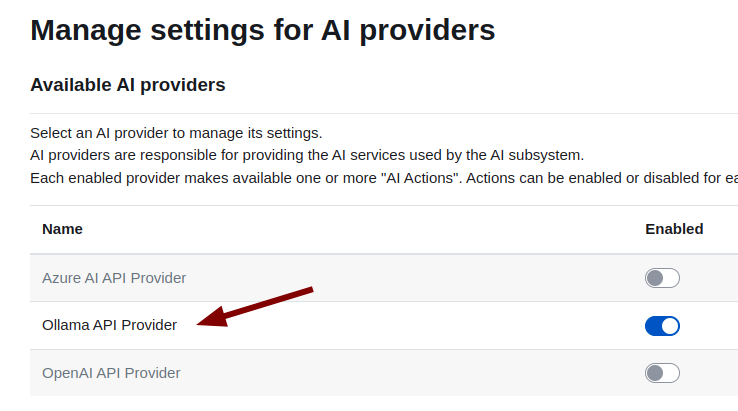
This screenshot was taken from a recent version of #Moodle 4.5dev+ (alpha code) which includes the new #AI Subsystem. #Ollama allows you to host #LLM’s on your own hardware. By that I mean you can unplug the internet and interact with various Models.
I am rather excited by it.
Gerald R. Ford Presidential Library @Ford_Library
“Civics for All of US” student Constitution programs kick off this week! Join us for a live webinar and discover how the Constitution connects to our communities: https://civics.archives.gov/webinars #ConstitutionDay #CivicsforAllofUS
#ConstitutionDay is coming up on Sept. 17! Teach students about the text, history, and relevance of the U.S. Constitution, Bill of Rights, and additional amendments with our video series, The Constitution EXPLAINED, created with @CivicEducation. https://bit.ly/4d1muJG
We have the perfect game for #ConstitutionDay! Our Constitutional Compromise game challenges your students to find a way forward for a young nation as disagreements mount. Experience the main historical debates of the Constitutional Convention with https://bit.ly/4gcMaWb
Because #ConstitutionDay (Sept. 17th) falls in the thick of the 2024 election season, check out our curated page of Street Law curricular resources on voting, elections, and the presidency. https://store.streetlaw.org/election-votin
Word of the day is ‘bayard’ (16th century): one who has the supreme self-confidence of ignorance.
Strategies:
Free Reading
A Way to Increase Free Reading Outside of Class
…pare down the teacher-centered lessons, and free up enough time for “Free Reading Friday,”…
Most students were able to commit to reading 100-150 pages per week. This worked out to be about the same amount of time as they were spending before, but the weekly goal gave them more agency in deciding when to read, and many students reported that this helped them develop a better reading routine.
Students don’t spend “Free Reading Friday” reading. Instead, our Friday class is focused on talking and writing about free reading.
https://www.middleweb.com/51237/a-way-to-increase-free-reading-outside-of-class/
Resources:
26 Tips for Beginning Teachers, from A to Z
https://www.middleweb.com/51194/26-tips-for-beginning-teachers-from-a-to-z/
AXIS The Culture Translator
1. Impossible Creatures
What it is: The US edition of a fantasy book for middle-graders is expected to be one of the bestselling titles of the year.
What parents should know: Impossible Creatures, by British author (and Oxford fellow) Katherine Rundell, became an instant bestseller when it was published in the UK last year. The premise of the book is simple (and a bit Narnia-esque): a young man discovers a portal to a hidden world where creatures like griffins, sphinxes, and dragons exist. What follows is equal parts action and adventure in the vivid tradition of Robert Louis Stevenson. The book has some darker themes and violence, but reviews say it ultimately serves as a morality tale about duty, sacrifice, and doing what is right.
2. Young Americans, Online
What it is: A newly-published survey showed that Gen Z and millennials say they feel more like “themselves” online than offline.
What it tells us about the rising generation: It is, perhaps, not all that surprising that a majority (45%) of Gen Z say they feel more like themselves online. This is a generation that has grown up expressing themselves in digital spaces. What is a bit of a surprise is that those that feel more themselves online beat out those that feel more at home offline by only 3%. Compare this to the millennial split in the statistics, where 47% said they feel more at home online than offline and 40% felt more fully themselves in person. Gen Z may see online life as indistinguishable from “real life,” but they may also be more likely to bring the same sort of caution to life online that previous generations brought to life offline.
“Monday” Video
A parody on the “Friday” video . . . . But for Monday.
Web Spotlight:
Infinite Mac
Infinite Mac is a collection of classic Macintosh and NeXT system releases and software, all easily accessible from the comfort of a (modern) web browser.
Pick any version of System Software/Mac OS or NeXTStep/OPENSTEP from the 1980s or 1990s and run it (and major software of that era) within a virtual machine. You can also run a custom version with your choice of machine and virtual disks. Files can be imported and exported using drag and drop, and System 7 and onward have more advanced integrations as well – refer to the welcome screen in each machine for more details.
Sort out your life! 100 tiny tricks to help with everything from digital overwhelm to lumpy sugar and unpaid bills
Food Mood
https://artsandculture.google.com/experiment/food-mood/HwHnGalZ3up0EA
Random Thoughts . . .
Click the Play button below to listen to the show!
Podcast: Play in new window | Download