MSM 225: Advisory! Advisory! Advisory!

Presented in collaboration with the Association for Middle Level Education.

Eileen Award:

  • Scoopit:
  • Twitter: Paige Johnson
  • Facebook:
  • Google+:
  • iTunes:
  • eMail:


Jokes You Can Use:

One reason the Military Services have trouble operating jointly is that they don’t speak the same language. For example, if you told Navy personnel to “secure a building,” they would turn off the lights and lock the doors. The Army would occupy the building so no one could enter. Marines would assault the building, capture it, and defend it with suppressive fire and close combat. The Air Force, on the other hand, would take out a three-year lease with an option to buy.

A woman worries about the future until she gets a husband.
A man never worries about the future until he gets a wife.
A successful man is one who makes more money than his wife can spend.
A successful woman is one who can find such a man.

Advisory:

You are Predictable

Make the board ahead of time, or put it on a Promethean Board.
http://www.youtube.com/watch?feature=player_embedded&v=DaWcL3oOd-E

Business Cards

Have the kids design business cards for famous people, fictional characters, historical figures, etc.
http://thisisnthappiness.com/post/35780275184/business-cards

10 Bets that you can win

Use these to create a challenge for students. Encourage them to think together. This can help prime the thinking. These are really just problem solving opportunities.
http://www.tastefullyoffensive.com/2012/11/another-10-bets-you-will-always-win.html

Perceptives

On the cover of American Prospect, Joel Sternfeld’s ode to roadside America, was a ghoulish photo. A fireman shops for a pumpkin as the farmhouse — whose fire presumably brought him to this very acres — burns in the background. Its fiery destruction perfectly complemented the wintry leaves, the spoilt pumpkins, and from the foreground, with his hands tightly clasped upon a prized possession, the orange-clad firefighter: an American Nero.
http://iconicphotos.wordpress.com/2012/10/25/joel-sternfeld-mclean-virginia-december-1978/

Middle School Science Minute

by Dave Bydlowski (k12science or davidbydlowski@mac.com)

Reflecting on Data

Recently I gave a talk at a new teacher orientation for the Rouge Education Project, a water quality monitoring project on the Rouge River, in the Michigan counties of Wayne and Oakland.  The purpose of the talk was to share ideas on curriculum.  The two areas I focused in on were:
1.  Inquiry Analysis and Communication
2.  Reflection and Social Implication

To learn more about the Rouge Education Project, please visit:
http://www.therouge.org

From the Twitterverse:

* Monte Tatom ‏@drmmtatom
#iPad in schools 102 http://zite.to/TPKz8R  via @zite #fhuedu320 #fhuedu642

11 Excellent Ways Teachers Can Use Google Docs http://flpbd.it/tH96v  #fhuedu320 #eLearning #fhuedu642

6 Reasons To Get A Tutor http://flpbd.it/6Jxee  #fhuedu610 #fhuedu508

* YouAndI School ‏@YouAndISchool
#Teachers have such an awesome job. Here is a teachers survival kit for everyday living http://tinyurl.com/chnt56h
* Patrick Larkin ‏@patrickmlarkin
Gamification 101: Why A Badge Is Better Than An A via @terryheick #edchat #bhschat
* Miguel Guhlin ‏@mguhlin
10 evernote uses in classroom http://dlvr.it/2VSPF4
* Lisa Dubernard ‏@onboardlearning
Good blog about the “culture of excellence” #satchat http://blog.eboardsolutions.com/accountability/wait-for-superman-or-build-transformation-teams/ …
* Kyle Calderwood ‏@kcalderw
Infographic: The Anatomy of a Great Teacher http://zite.to/T7jkIn  #njed #edtech #edchat
* Sandy Kendell ‏@EdTechSandyK
18 Snapshots Of iPad Integration | #edtech #mlearning @scoopit via @tperranhttp://sco.lt/7ApQbB

10 Ways To Use Technology To Teach #Writing http://edudemic.com/2012/11/10-high-tech-ways-to-teach-writing/ … via @edudemic #edtech #literacy

* EdTechTeacher ‏@EdTechTeacher21
iPad Resources and More iPad Summit Blog Posts
* Audrey Nay ‏@audrey_nay
Great livebinder – Top 5 Reasons 2 Use Your Library http://www.livebinders.com/play/play/119021 … #advocacy #tlchat #ozteachers #nswdec #austl
* Kristen Stringfellow ‏@SouthKingSuper
“Twitter Cheat Sheet (for any “newbies” out there) pic.twitter.com/ne3u3mZY #NCTE12
* Gerald Aungst ‏@geraldaungst
Why while presenting do so many ed conference speakers avoid the very strategies they promote? #irony #fail
* Lee Ann Spillane ‏@spillarke
Save the date 2/6/13 Digital Learning Day @sjhayes8 #ncte12
#mschat every Thursday at 8:00 pm Eastern Standard Time.

Resources:

Circuits

Circuits.io was founded in 2012 by Karel Bruneel and Benjamin Schrauwen. After struggling for years to design and teach to design electronics using existing EDA tool, they felt that electronics design needed an urgent jolt. Learning from how software is designed, they came up with the following magic recipe which is at the heart of circuits.io: (i) allow to easily build on pre-designed electronics modules, (ii) use intuitive tools that hide much of the complexity in software, and (iii) embrace the open hardware movement. Furthermore, we will soon allow easy PCB ordering right from circuits.io, no more messing with Gerber files. We promise that circuits.io will always be free for open hardware designs and that you can export all your designs, we will never lock in what actually is yours.
http://www.circuits.io/

8 GREAT GRADING APPS FOR IPAD

After posting about some of the best gradebook tools for teachers we got an email from one of our readers asking about some grading apps for iPad. We looked into our archive and found a post that we have published almost a year ago containing some great grading apps for iOS users but because thousands of apps have been created since the posting of that list we deemed it important that we do a general scan to review the new emerging grading apps. We found quite many but we only handpicked the ones mentioned below.
http://www.educatorstechnology.com/2012/11/8-great-grading-apps-for-ipad.html

Web Spotlight:

A Cure for the Mania of Multiple Drafts, Multiple Formats, X 100

By Ariel Sacks
In my last post, I described my utter failure to effectively organize and manage my students’ drafting process for writing projects.  This job has become much more complicated over the years with the availability of various technological tools for writing.  New, clear parameters are definitely necessary.
http://transformed.teachingquality.org/blogs/shoulders-giants/11-2012/cure-mania-multiple-drafts-multiple-formats-x-100

Everything That Will Go Extinct In The Next 40 Years

Futurist website nowandnext.com put together this awesome infographic predicting all of the technologies, behaviors, and ideas that will probably be distant memories by 2050.
Among their predictions: no more retirement four years from now, no more secretaries six years from now, and no more free parking or sit-down breakfasts by 2019.
The European Union is seen as surviving the current crisis before extinct in 2039.
http://www.businessinsider.com/everything-that-will-go-extinct-in-the-next-40-years-2012-8#ixzz29zsNrc6U

News:

The [editor of Phi Delta Kappan] concludes by asserting that “every classroom should have excellent teaching every hour of every day.” I would add that every child should also have an excellent parent who serves them excellent food and provides them with an excellent home in an excellent neighborhood. Let’s also add excellent healthcare and excellent supervision every hour of every day as well. If we could accomplish all of that, we would have the highest achieving students on earth.
http://dangerouslyirrelevant.org/2012/11/while-we-wait-for-wise-lawmakers-to-emerge.html

AMLE Annual Conference Sessions:

Dr. Debbie Silver, paid session.

Standard Introduction:
Teach through stories.
The self-reference depends on when the story happened in her life.
Middle school song by Monte Selby:  “Get Back Up Again.”

“He has a relentless commitment to his dream
so he’ll watch and ask
Then walk for books to read
Builds his talent with desire,’
Loads of time and endless fire
Always redefining persevere”

“So he tries and he tries, with a smile, then he cries
Countless falls, break the skin, get back up
Start again and again
Then he stays up late when he knows he shouldn’t
Tells his parents that he couldn’t – quit.”

Middle school is the last best hope for some of these kids.

“What lies behind us and what lies in front of us are but tiny matters as compared to lies within us.”  – Ralph Waldo Emerson
We have kids that have already given up before they got there.
Research is clear, you cannot motivate anybody.  They have to motivate themselves.  (That’s interesting!)
Mindset-The new Psychology of Success by Carol Dweck
Elizabeth’s Story:
Which of the five choices are the right response:
1.  You tell her you thought she was the best.
2.  Tell her she was robbed of a ribbon that was rightfully hers.
3.  Reassure her that gymnastics is not that important.
4.  Tell her she has the ability and will surely win the next one.
5.  Tell her she didn’t deserve to win.
Video:  Charlotte & Johnathan
How do we help students become self-motivated?
Failure has become an entity instead of a state of being.
We need to get kids to understand that falling is part of the process, not the end state of things.
Advertisement video:  CapriSun commercial where the Mom goes and protects the kids to the point of being stupid.
Replace the term Self-Esteem with Self-Efficacy (Bandura)
Self-Efficacy:
What does it do?  It influences:
•The choices we make
•The effort we put forth
•How long we persist when we confront obstacles
•How quickly we “bounce back” from setbacks or failures.
Learned helplessness
When kids have power over their environment, they will blossom.
“Anything easily attained is cheaply held.”
Zone of Proximal Development:  Lev Vygotsky
The greatest way to get people self motivated is to raise the bar just beyond their reach.
Letting students do what they can already, it is demotivating.
Lifting the leg example.
What kids are starved for is adult attention.
The Zip Line Adventure
Cartoon:  Scaffolding
Scaffolding
Describe a scenario in which you were asked to perform a task far beyond your current ability level and no scaffolding was provided.  How did you respond to the challenge?  What happened?
Handout item:  Scaffolding Instruction Guidelines
Deci & Ryan
Helping Kids Be Successful:
•  Autonomy:  Go do it.
•  Competency:  They have to feel they have the knowledge to do it.
•  Relatedness:  Connecting it to other things and people.
The story of Andy:
Cartesian Diver:  You can do it with condiment packages evidently.
Be careful of over effusive praise.
Andy and the drums.
Doug Moreland Band
Seventh Sun
One of Andy’s character traits is his very strong self-discipline.
The ability to delay self-gratification.
Many lack the ability to defer gratification
Video:  The Marshmallow Test
65% of the kids waited.
65% were:
•more socially competent
•more personally effective
•more self-assertive
•Better able to cope with life’s frustrations.
• . . . see handout
210 more points on SATs.
(Mischel, Schoda, and Peake, 1988)
These skills can be taught!
Tips for helping Children with Impulse control
In class do not allow students to raise hands or blurt answers.  When asking for a response require students to wait 10-15 seconds before calling on someone randomly (I pick up from a cup of craft sticks with the name of a different student on each one).
•  Model “think alouds” for the students.
1.  The adult performs a task while “thinking out loud.”  For example, “Before I start to do this activity.  I need to read all the directions.  After I read all of the directions, I will check and make sure all of the materials are here.  Then I will begin with step #1.

3.  The student performs the task while instruction them self out loud.
Teach students the “Stop and Think” 5 step problem solving strategy:
1.  “What am I supposed to do?”  (Figure out what exactly what the problem is.)
2.  “Look at all the possibilities
•  Role play with the students the problem and possible solutions that occur in recurring social events.
•  Use a timer to indicate periods of independent work and reinforce appropriate behavior with positive feedback.
•  Use the words “For now . . . ”
“I don’t want to do this.”  “That’s ok, you’ll do this ‘for now’.”
Steps in Deliberate Practice.
•  Remember that deliberate practice has one objective:  to improve performance. ” People who play tennis once a week for years don’t get any better if they do the same thing each time.”  Ericson has said, “Deliberate practice is about changing your performance, setting new goals and straining yourself to reach a bit higher each time.”
•  Repeat, repeat, repeat.  Repetition matters.  Basketball greats don’t shoot ten free throws at the end of team practice, they shoot five hundred.
•  Seek constant, critical feedback.  If you don’t know how you’re doing, you won’t know what to improve.
•  Focus ruthlessly on where you need help.  while many of us work on what we’re already good at, says Ericsson, “those who get better work on their weakness.”
•  Prepare for the process to be mentally and physically exhausting.  that’s why so many people . . see handout.
Motivation:
Intrinsic and Extrinsic Motivation
Psychological reactance relates to a classic distinction made by motivational psychologists:  the distinction between intrinsic and extrinsic motives.  An activity intrinsically motivating if a person does it voluntarily, without receiving payment or other type of reward.  An activity is extrinsically motivated if it is performed primarily for external reinforcement such as food or money.
The Chit Example:
How to turn play into work:  Lepper and Green (1974)
What are classroom rewards?
•  Extrinsic rewards can be denied as rewards that come from an aoutside source such as the teacher.  Rewards include the obvious bonuses such as prizes, certificates, special privileges, gold stars, stickers, candy gum, redeemable tokens, grades, or even money.  Teacher praise is also considered to be an extrinsic reward as are more subtle signs of approval such as thumbs up signs, smiles, nods, hugs, or pats on the back.
•  Intrinsic rewards can be defined as rewards that are inherent or the natural consequence of behavior.
Activity:  Describe how praise can sometimes do more harm than good.  Give examples from your experience.
Using Classroom Rewards
•  Task-contingent rewards are available to students for merely participating in an activity without regard to any standard of performance (i.e. anyone who turns in a homework paper gets an A.)
-Detrimental to motivation
•  Performance-contingent rewards are available only when the student achieves a certain standard (i.e. anyone who has at least 93% correct responses on the homework paper gets a sticker.)
*  Success-contingent rewards are given for good performance and might reflect either success or progress towards a goal (i.e. anyone who has at least 93% correct responses on the homework paper or improves from their previous score.)
Guidelines for using Classroom Rewards
•Use the weakest reward required to strengthen a behavior.
•When possible, avoid using rewards as incentives.
•Reward at a high rate in the early stages of learning and reduce the frequency of rewards as learning . . .
“It is the nature of man to rise to greatness, if greatness is expected of him.”
-John Steinbeck
Song:  “Fly on the Wall” by Monte Selby
The Key Principles of SFP are these:
A.  We form certain expectations of people or events.
B.  We communicate those expectations with varous cues.
C.  People tend to respond to these cues by adjusting their behavior to match them.
D.  The result is that the original expectation becomes true.
“Hamstrung by unrealized potential.”  Don’t praise anything a child cannot control.
Jordan’s Nike commercial:  “Over and over again I’ve failed in life, and that’s why I succeed.”
Realize that inappropriate praise can do more harm than good.
Attribution theory:  Why do individuals say they fail?
• Task Difficulty
•  Luck
•  Innate Ability or Talent
•  Effort
External (controlled by other than self)
•  Task Difficulty
•  Luck
•  Innate ability or talent
Internal (controlled by self)
•  Effort
Mindset:  The new psychology of success.  Dr. Carol Dweck (2006)
Fixed Mindset (Entity Theory)
Growth Mindset
Dr. Dweck’s Interview Video
Being praised for the easy problems caused students to go back to the easy stuff because they were successful at it.
Students praised for effort, generally were more willing to take on harder tasks.
Implicit Personality Theory.

The Book:  The little girl on the front is a character of a little girl named Stephanie.
We must view young people not as empty bottles to be filled, but as candles to be lit.  (The burning of the ditto transfer paper)

Website:  debbiesilver.com   Password:  iamateacher
I’m number 24.  Randomizer says
EY-88 Code for CEUs.

MSM 224: Spewing Forth: Alternate Show Weeks

Presented in collaboration with the Association for Middle Level Education.

Eileen Award:

  • Scoopit:
  • Twitter:
  • Facebook:  Steve Ralston
  • Google+:
  • iTunes:  Steve Ralston
  • eMail:

Jokes You Can Use:

One Halloween a man was walking down the street and heard a thumping noise behind him. Looking behind him he saw a coffin following him, upright. He was a bit nervous and began walking a little bit faster. The coffin continued, “thumpety thump, thumpety thump”. He began running and the coffin kept up and began opening and closing, “”thumpety thump, thumpety thump clap, “thumpety thump, thumpety thump clap”. Terrified he ran to his front door, and went inside, slamming the door and locking it. The coffin continued, “thumpety thump, thumpety thump – CRASH” it came right through the door, He ran up the stairs, and right behind him, “thumpety thump, thumpety thump clap, “thumpety thump, thumpety thump clap”. He rushed into the bathroom and slammed the door, but the coffin broke through the door – “thumpety thump, thumpety thump crash”. Terrified the man grabbed the first thing he could, a bottle of Robutusin and threw it – and the coffin stopped!

One psychologist greets another on the street: “You’re fine, how am I?”

Socrates came upon an acquaintance that ran up to him excitedly and said, “Do you know what I just heard about one of your students?” “Just a minute,” Socrates replied. “Before you tell me I’d like you to pass a little test. It’s called the Test of Three. “The first test is Truth. Are you sure that what you will say is true? “Oh no,” the man said, “Actually I just heard about it.” “So you don’t really know if it’s true, Socrates said. Now let’s try the second test, the test of Goodness. Is what you are about to tell me about my student something good?” “No, on the contrary..” “So,” Socrates interrupted, “you want to tell me something bad about him even though you’re not certain it’s true?” The man shrugged, rather embarrassed. Socrates continued. “You may still pass though, because there is a third test, the filter of Usefulness. Is what you want to tell me about my student going to be useful to me at all?” “Well it ..no, not really..” “Well, concluded Socates, “If what you want to tell me is neither True nor good nor ever Useful, why tell it to me at all?” The man was defeated and ashamed. This is the reason Socrates was held in such high esteem. It also explains why he never found out what Plato was up to.

Advisory:

Antipodes

http://www.jasondavies.com/maps/antipodes/

Last Wish

Lifelong football fan Danny Webber had one last wish – to meet QB Andrew Luck and the Indianapolis Colts. With help from the Colts organization and wonderful workers at the Heritage House, his wish was granted. Watch as Inside the NFL cameras were there to capture this truly heart-warming story.
http://www.youtube.com/watch?v=uU1sK9HLpFo&feature=youtu.be

Middle School Science Minute

by Dave Bydlowski (k12science or davidbydlowski@mac.com)

Volcano Safety
This podcast is based on the Question of the Month from the Scope on Safety section of the October, 2012 issue of Science Scope, a magazine for middle school science teachers, published by the National Science Teachers Association.  The question of the month is written by Ken Roy, director of environmental health and safety for Glastonbury Public Schools in Glastonbury, Connecticut.

The question of the month deals with the use of ammonium dichromate in the classroom.

We won’t blow our tops on this one.

From the Twitterverse:

* Orion School View ‏@OrionSchoolView
ALL teachers should read this! Ten Commandments For Educators Who Teach Kids on the Autism Spectrum http://enabledkids.ca/?p=2076  via @EnabledKids
* Valerie Lees ‏@ValerieLeessd36
This is what interdisciplinary learning can give us:students offer overnight solution to gas station crises #Sandy http://huff.to/Ydl312  #fb
* Kevin J. Galbraith ‏@KevG
How Are Districts Covering the Tech. Costs of Common Core? http://zite.to/RzLc6h
* Diane Ravitch ‏@DianeRavitch
Do you have your armband? “Just let me teach.” http://www.washingtonpost.com/blogs/answer-sheet/wp/2012/11/01/just-let-me-teach-arm-bands-taking-off/ …
* Scott McLeod ‏@mcleod
China as number two — or even number three
* Catherine Flippen ‏@CatFlippen
Instead of teachers evaluating other teachers, use method called “Idea Bandit”–visit a classroom, “steal” a great idea. #edadmin
* Eye On Education ‏@eyeoneducation
How to Design Open-Ended Assignments to Meet the #CommonCore http://ow.ly/eZncK  #edchat #ccss #engedu #literacy #ccchat
* Emily Wyble ‏@wyblee
#edcampGR presenters switching back and forth on the Apple TV between the iPad mini and the “regular.” Co-teaching possibilities?
* Kevin Creutz ‏@kevcreutz
Three Video Explanations of Why We Change Our Clocks This Weekend via @rmbyrne #edtech
* Larry Ferlazzo ‏@Larryferlazzo
Ideas for English Language Learners | ‘Gangnam Style,’ ‘Emotion Words’ and More http://nyti.ms/Sfnew1
* Scott McLeod ‏@mcleod
New bookmark: Library Of Congress Unveils Massive Common Core Resource Center | @edudemic
* Sandra Wozniak ‏@sanwoz
Are you using elections to teach critical thinking? Great resources #satchat
* Sandy Kendell ‏@EdTechSandyK
How to clean Apple products including iPad | #mlearning #edtech #ipaded @scoopit http://sco.lt/98tt4L
* Rick Wormeli ‏@RickWormeli
School superintendent to Thomas Friedman: Why you are wrong about Race to the Top http://www.washingtonpost.com/blogs/answer-sheet/wp/2012/10/31/school-superintendent-to-thomas-friedman-why-you-are-wrong-about-race-to-the-top/ …
* Sandra Wozniak ‏@sanwoz
HOTS & Bloom’s by @JillBromen on @scoopitGreat critical thinking resources. #gtchat #edchat

Resources:

Higher Order Thinking Strategies and Tools

“The following Online Interactive Thinking Strategies and Tools are designed to provide a scaffold which enables students to think with more depth and structure. When using them, ask students to continually reflect on and justify which Habits of Mind best suit how they are thinking.”

There are some terrific organizers here that would be easy to replicate.
http://learningcurveplanner.com.au/thinking-tools.html

The Victorians Learn to work like a historian

This website introduces primary pupils to historical sources. It helps children to think and work like historians by using objects, images and documents from the collections of the V&A and The National Archives to learn about the Victorian period. Begin with this tutorial to get the best out of the six themed units that follow.
This short starter activity introduces the learning model that guides and supports pupils’ work throughout the resource.
The approach for dealing with sources has been broken down into four steps. A simple mnemonic, L-A-C-E, helps pupils to remember them.
Two online presenters guide pupils through each unit. They introduce a range of different historical sources and ask various prompt questions at each step of the LACE process. There is some variation between these questions, to accommodate the different types of sources used in this resource, but they retain the same focus throughout:
LOOK: Describe what you can see.
ASK: What questions do you need to ask, and answer, to make sense of what you have seen?
CONCLUDE: What have you learned about the issue that you are investigating from this source?
EXPAND: What more would you like to know about? How can you find out?
The steps in the LACE process are not always mutually exclusive. In fact, evaluating evidence is often an iterative process. Pupils may sometimes engage with the different steps in a non-linear way. When this happens it is not a problem. The main purpose of this approach is to encourage pupils to develop different types of questions to progress their understanding of the evidence.

http://www.nationalarchives.gov.uk/victorians/resources.htm
http://www.nationalarchives.gov.uk/victorians/Default.aspx

A visual A-Z of the hidden treasures of language.

As a lover of language and words, especially obscure and endangered words, I was instantly besotted with Project Twins’ visual interpretations of unusual words, originally exhibited at the MadArt Gallery Dublin during DesignWeek 2011.
http://www.brainpickings.org/index.php/2012/07/02/project-twins-unusual-words/

Public Domain Comics

We are the best site for downloading FREE public domain Golden Age Comics. All files here have been researched by our staff and users to make sure they are copyright free and in the public domain. To start downloading just register an account and enjoy these great comic books. We do not charge per download and the goal of the project is to archive these comic books online and make them widely available.
http://digitalcomicmuseum.com/

Web Spotlight:

Can Your Kid Read Graphs and Charts?

As these visual displays become more and more ubiquitous, it is all the more important that students know how to read, interpret, and summarize the information presented. It’s become an essential element of overall literacy.
As students get older, it’s important for them to learn not only how to be intelligent viewers of graphic representations, but wary and cautious viewers. While charts and graphs obviously are a boon to our ability to communicate information about large numbers or complicated relationships, there are also hidden pitfalls.
http://www.theatlantic.com/national/archive/2012/10/can-your-kid-read-graphs-and-charts/263689/


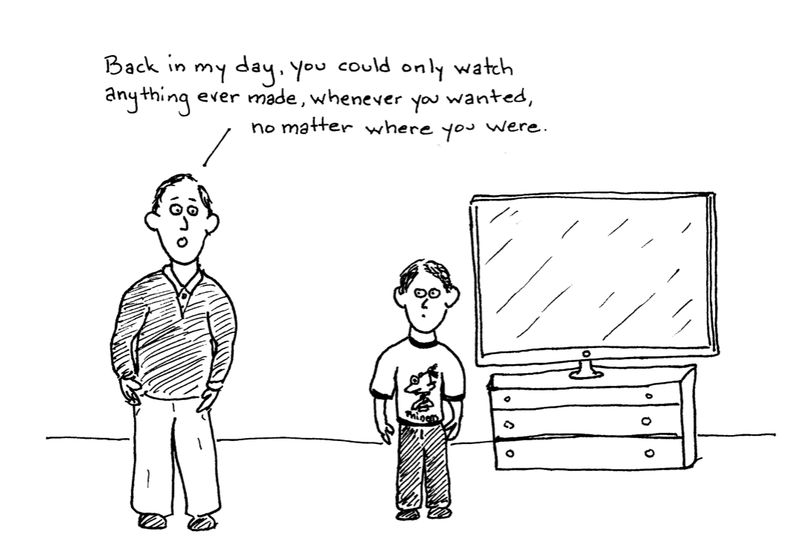
http://tedmccagg.typepad.com/drawings/2012/10/back-in-my-day.html

News:


Ethiopian kids hack OLPCs in 5 months with zero instruction

“We left the boxes in the village. Closed. Taped shut. No instruction, no human being. I thought, the kids will play with the boxes! Within four minutes, one kid not only opened the box, but found the on/off switch. He’d never seen an on/off switch. He powered it up. Within five days, they were using 47 apps per child per day. Within two weeks, they were singing ABC songs [in English] in the village. And within five months, they had hacked Android. Some idiot in our organization or in the Media Lab had disabled the camera! And they figured out it had a camera, and they hacked Android.”

http://dvice.com/archives/2012/10/ethiopian-kids.php

Events & Happenings:

Calendar of Events:

Ohio Middle Level Association:


AMLE Affiliate Conferences:


Classroom 2.0’s Live Calendar.

Classroom 2.0’s Ning Blog: Archived content is available.

MSM 220: Picture This, Space, Books and more.

Jokes You Can Use:

The teacher said; “Take a pencil and paper, and write an essay with the title ‘If I Were a Millionaire.’” Everyone but Joe, who leaned back with arms folded, began to write feverishly.
“What’s the matter,” the teacher asked. “Why don’t you begin?”
“I’m waiting for my secretary,” Joe replied.

Why were all the ink spots crying?
Their father was in the pen.

A fellow bought a new Mercedes and was out on the interstate for a nice evening drive. The top was down, the breeze was blowing through what was left of his hair and he decided to open her up. As the needle jumped up to 80 mph, he suddenly saw flashing red and blue lights behind him. “There’s no way they can catch a Mercedes,” he thought to himself and opened her up further. The needle hit 90, 100…. Then the reality of the situation hit him. “What am I doing?” he thought and pulled over. The cop came up to him, took his license without a word and examined it and the car. “It’s been a long day, this is the end of my shift and it’s Friday the 13th. I don’t feel like more paperwork, so if you can give me an excuse for your driving that I haven’t heard before, you can go.”
The guy thinks for a second and says, “Last week my wife ran off with a cop. I was afraid you were trying to give her back!”
“Have a nice weekend,” said the officer.

Eileen Award:


  • Scoopit:
  • Twitter:   Rovy Branon , Allison Petersen
  • Facebook:  Ella Sherman
  • Google+:
  • iTunes:
  • eMail:

Advisory:

Picture books

Have your students make picture books for elementary students. (This can be done the “old fashioned” way or electronically.
http://www.culturestreet.org.uk/activities/picturebookmaker/

Middle School Science Minute

by Dave Bydlowski (k12science or davidbydlowski@mac.com)

“A Special Assignment from NASA”

This podcast is based on an article from the September, 2012 issue of Science Scope.  A magazine for middle school science teachers, published by the National Science Teachers Association.  The article was entitled “A Special Assignment from NASA” – Understanding Earth’s Atmosphere Through the Integration of Science and Mathematics.  The article was written by Justine E. Fox and Nicole J. Glen.

The purpose of the special assignment was to help students understand the role of NASA scientists, while asking real world questions about the atmosphere.  The unit begins with the reading of “Here’s the Crusher” from the book “Even More Everyday Science Mysteries.”  The mystery is about a boy, Eric, who washes a water bottle under hot water and then observes what happens to the bottle.  This leads students in the classroom to re-enact the mystery and then apply the knowledge to a better understanding of why certain technological items like satellites, airplanes, etc. are found in certain atmospheric levels and not others.  They study the height and the temperatures of the atmospheric levels.

From the Twitterverse:

* Lance Mosier ‏@lmosierhistgkk
RT @B_Berns: Middle School teachers: Consider joining IA, MI, and NE’s Mystery Skype project. #mschat https://docs.google.com/document/d/19bNaKCOgsFnwrpXo_O311uSlju-n5g9DgRayswxrxXM/edit … #nebedu
* Terie Engelbrecht ‏@mrsebiology
Vocabulary Strategies http://goo.gl/nfzgC  #edchat #midleved #elemchat

Inquiry Chart for developing questions and doing research http://goo.gl/86iMd  #edchat #midleved #elemchat  

* Scott McLeod ‏@mcleod
Why Kids Need Schools to Change via @mindshiftkqed #edreform #iaedfuture  

How to Plan a Memorable Parent Night: Classroom Videos | Expat Educator

* Richard Byrne ‏@rmbyrne
7 Good Sources of Creative Writing Prompts http://ow.ly/dTGV4
* russeltarr ‏@russeltarr
Video: If institutional education refuses to adapt to the information age, it WILL die and SHOULD die: http://tinyurl.com/6zd67ov
* Angela Maiers ‏@AngelaMaiers
Twenty Tips for Success for New Teachers http://goo.gl/ak66l  via @teachingwthsoul
* Beth Lisowski ‏@MrsLTech
RT @twhitford: Do Middle Schools Make Sense? | Harvard Graduate School of Education http://shar.es/uOYu2  #cpchat #mschat
* AMLE ‏@AMLEnews
AMLE Best Sellers Now on Kindle and iPadOnly $9.99 (save up to 40% over print editions) #edchat #midleved

When it comes to the common core, librarians can be a school’s secret weapon http://ow.ly/dPSDE  via @educationweek #mschat #edchat  

How will students perform? Depends on teachers’ expectations http://ow.ly/dNuiA  via MindShift KQED #edchat #ntchat #mschat

* Todd Bloch ‏@blocht574
Here is a link for 36 ways to know your class. https://docs.google.com/present/view?id=dhn2vcv5_650dvtj3dgk … #mschat
* Kara Walk ‏@karawalk
Grading blog motivate vs. engagement #cpchat #edchat #mschat http://blogs.edweek.org/teachers/coach_gs_teaching_tips/2012/09/grades.html?utm_source=twitterfeed&utm_medium=twitter …
Don’t forget #mschat on Thursdays at 8:00 pm EST on Twitter!

Resources:

Run for President:
http://adomatic.us/

DIY

“We designed it for ages 7 and up, but parents are encouraged to sign their kids up earlier and help them along until they’re ready to use it themselves. Some reading is required.
DIY is designed for kids as young as 6 years of age, and to comply with the United States Federal Trade Commission’s Children’s Online Privacy Protection Act (COPPA), which was put in effect as of April 21, 2000:
Your kid can create an account and use DIY for free. Many parts of the service will always be free to play. However, DIY will eventually offer paid memberships. Membership will give DIY kids access to extra features.”
https://diy.org/

ISTE:

Interactive, Customizable, Free:
Using Open Source FlexBooks

CK-12 is non-profit organization.

Have free and low cost options. See the about page.

All content is in the STEM. Middle School and High School. Most of it is Math and Science.

Standards correlations is on the About page. Done by Common Core and State.

All material is written by content experts.

Books can be customized. The system is being upgraded.
beta.ck12.org

Create an account. This allows you to save changes.

When editing, you can combine from different books. Click on scrubber icons to add to the Flexbook.

FlexBooks go to My Library when saved.

When editing, you can add images, videos, links to other sites, etc. This can be localized. Videos are streamed. If YouTube is blocked, it won’t show.

When editing, if you are pasting from Word, use Edit | Paste From Word.

License:
Creative Commons – by Attribution, Non-Profit, Share a like.

Anything embedded must match the license.

In order to have multiple people edit a book, you would need to share an account.

How to Share:
Print your book using the Print icon. This will generate
PDF – Video will have a link. You can use a local printer or Amazon or USB sticks.
HTML 5 – Can provide students with a link. Students do NOT need to have an account.
Online
(Beta will add Mobi and ePub)

Beta:
Different paths for Students and Teachers. Will allow to associate students with specific teachers.

Concepts are meant to be 10-15 minute.

Weekly webinars are available. They are on Tuesday or Wednesday. Can be scheduled.

David Wylie (Wiley) put together a cost study.

News:

“Using VAM to evaluate teachers is akin to using Lysol as a mouth wash because it does a good job killing germs on your kitchen counter.  – Principal Carol Burris, in The Answer Sheet “
http://scholasticadministrator.typepad.com/thisweekineducation/2012/09/quotes-no-such-thing-as-good-use-of-vam-data-for-evaluation.html

No Soft Retirement

Last season, he made $3 million as the Cowboys’ backup quarterback. Now, he makes roughly one percent of that to teach at Lincoln High School and coach the Abes.
http://nbcsports.msnbc.com/id/49057206/ns/sports-nfl/#__utma=14933801.30557598.1342395962.1348024023.1348079521.86&__utmb=14933801.1.10.1348079521&__utmc=14933801&__utmx=-&__utmz=14933801.1347886274.81.3.utmcsr=photoblog.nbcnews.com

Quote

Lawrence Baines’s Education Week Commentary, “What If We Brought Education Reform to the Military?,” suggested satirically that, “An infantryman in Afghanistan, outnumbered by well-armed terrorists, who fails to accomplish the mission should receive a deduction in pay. An accountant stationed in Honolulu, who balances the payroll, thereby accomplishing his mission, should get a raise. … There are no excuses.”

Web Spotlight:

The day I quit teaching

Posted by Brad Flickinger on Sep 20, 2012

As it turned out, technology wasn’t the problem, I was.
http://www.schooltechnology.org/2012/09/20/the-day-i-quit-teaching/

iCivics (www.icivics.org)

WebQuests and other online tools to teach the U.S. Constitution and other democratic principles to middle schoolers.

“iCivics prepares young Americans to become knowledgeable, engaged 21st century citizens by creating free and innovative educational materials.
In 2009, Justice Sandra Day O’Connor founded iCivics to reverse Americans’ declining civic knowledge and participation. Securing our democracy, she realized, requires teaching the next generation to understand and respect our system of governance. Today iCivics comprises not just our board and staff, but also a national leadership team of state supreme court justices, secretaries of state, and educational leaders and a network of committed volunteers. Together, we are committed to passing along our legacy of democracy to the next generation.”

Events & Happenings:

Calendar of Events:

Ohio Middle Level Association:


AMLE Affiliate Conferences:


Classroom 2.0’s Live Calendar.


Classroom 2.0’s Ning Blog: Archived content is available.  

MSM 218: 8675309 Common Core and more!

Presented in collaboration with the Association for Middle Level Education.

AMLE Feature:


Grade levels for K–8; grade bands for 9–10 and 11–12

The Standards use individual grade levels in kindergarten through grade 8 to
provide useful specificity; the Standards use two-year bands in grades 9–12 to
allow schools, districts, and states flexibility in high school course design.

An integrated model of literacy

Although the Standards are divided into Reading, Writing, Speaking and
Listening, and Language strands for conceptual clarity, the processes of
communication are closely connected, as reflected throughout this document.
For example, Writing standard 9 requires that students be able to write
about what they read. Likewise, Speaking and Listening standard 4 sets the
expectation that students will share findings from their research.

Shared responsibility for students’ literacy development

The Standards insist that instruction in reading, writing, speaking, listening,
and language be a shared responsibility within the school. The K–5 standards
include expectations for reading, writing, speaking, listening, and language
applicable to a range of subjects, including but not limited to ELA. The grades
6–12 standards are divided into two sections, one for ELA and the other for
history/social studies, science, and technical subjects. This division reflects the
unique, time-honored place of ELA teachers in developing students’ literacy
skills while at the same time recognizing that teachers in other areas must have
a role in this development as well.
Part of the motivation behind the interdisciplinary approach to literacy
promulgated by the Standards is extensive research establishing the need
for college and career ready students to be proficient in reading complex
informational text independently in a variety of content areas. Most of the
required reading in college and workforce training programs is informational
in structure and challenging in content; postsecondary education programs
typically provide students with both a higher volume of such reading than is
generally required in K–12 schools and comparatively little scaffolding.

http://www.corestandards.org/
Common Core Test Sample:  http://www.p12.nysed.gov/assessment/common-core-sample-questions/ela-grade-7.pdf
Common Core Maps:  http://www.commoncore.org/maps/

Jokes You Can Use:

Q: What do you get when you cross a perm with a rabbit?
A: Curly hare.

1. A day without sunshine is like night.
2. On the other hand, you have different fingers.
3. 42.7 percent of all statistics are made up on the spot.
4. 99 percent of lawyers give the rest a bad name.
5. Remember, half the people you know are below average.
6. He who laughs last; thinks slowest.
7. Depression is merely anger without enthusiasm.
8. The early bird may get the worm, but the second mouse gets the cheese in the trap.
9. Support bacteria. They’re the only culture most people have.
10. A clear conscience is usually the sign of a bad memory.
11. Change is inevitable, except from vending machines.
12. If you think nobody cares, try missing a couple of payments.
13. How many of you believe in psycho-kinesis? Raise my hand.
14. OK, so what’s the speed of dark?
15. When everything is coming your way, you’re in the wrong lane.
16. Hard work pays off in the future. Laziness pays off now.
17. How much deeper would the ocean be without sponges?
18. Eagles may soar, but weasels don’t get sucked into jet engines.
19. What happens if you get scared half to death, twice?
20. Why do psychics have to ask you your name?
21. Inside every older person is a younger person wondering, ‘What the heck happened?’
22. Just remember — if the world didn’t suck, we would all fall off.
23. Light travels faster than sound. That’s why some people appear bright until you hear them speak.
24. Life isn’t like a box of chocolates. It’s more like a jar of jalapenos. What you do today, might burn your butt tomorrow.

Eileen Award:

None this week  🙁

Advisory:

Open University 60 second Adventures in Thought

http://www.open.edu/openlearn/history-the-arts/culture/philosophy/60-second-adventures-thought?track=69508b9e11

Middle School Science Minute

by Dave Bydlowski (k12science or davidbydlowski@mac.com)

MIDDLE SCHOOL SCIENCE MINUTE-ICE CUBES, STEM AND 5E
This podcast is based on the article “Should Ice Be Cubed?” written by Richard H. Moyer and Susan A. Everett.  The article can be found in the September 2012 issue of Science Scope magazine, a magazine for middle school science teachers, published by the National Science Teachers Association.

All four STEM areas were integrated throughout the 5E lesson as students were engaged, they explored, they developed explanations, they extended their learning and were evaluated.  Science was represented through heat transfer, cooling rates, and melting.  Technology was integrated through the use of the different types of ice cube trays — novelty, giant cube, household, and student built.  The activity allowed students to become engineers by testing three different ice-cube-tray designs.  Finally, the mathematics was used in measuring the surface-area and volume relationships between the ice cubes.

From the Twitterverse:

* Terie Engelbrecht ‏@mrsebiology
Podcasting Legal Guide http://goo.gl/g3F77  #edchat #edtech
* Pearson ‏@pearson
Infographic: The Gamification of Education http://pear.sn/dxLEt
* Scott McLeod ‏@mcleod
RT @JosePopoff: Thank you for blocking YouTube, now I can teach safely. #saidnoteacherever #edtech
* The Joy and Sorrows ‏@TeachersJourney
I teach. What’s your superpower? #satchat
* Kevin J. Galbraith ‏@KevG
Top Apps for PE Teachers – Part 18http://zite.to/QlPl0b

Apple May Have To Cut E-book Prices Within Three Monthshttp://zite.to/OgYIOd

AppCraft tears down tech barriers to let anyone develop iOS apps (and sell them too) http://zite.to/U1oOlf

* BeckyFisher73 ‏@BeckyFisher73
In my district, I can earn recertification points by participating in #satchat. Can you in yours? We value LEARNING & leverage virtual ops
* Reed Gillespie ‏@rggillespie
We’re having a school-wide unconference #edcamp and offering monthly tech days during planning periods. #satchat
* Carol A. Josel ‏@schoolwise
12 Things Students Should Never Do on Social Media http://mashable.com/2012/09/04/students-social-media-warnings/ … via @mashable
* Sue Waters ‏@suewaters
Hey CT!! Waive good bye to NCLB, Wave hello to SPI —

Love photo comp with QR code & tips being run at #kingspark #perth @ Western Australian Botanic Garden http://instagr.am/p/PTJY0tnA-9/

* Eric Sheninger ‏@NMHS_Principal
Advice to a new teacher – Schools of Thought http://buff.ly/QlY1BB  #edchat #education
11h Terie Engelbrecht ‏@mrsebiology
I wish I knew what to do with all my free time. #saidnoteacherever
11h Dean Shareski ‏@shareski
“Love the smell of middle schoolers after gym class” #saidnoteacherever

11h Dean Shareski ‏@shareski
“I don’t like free stuff” #saidnoteacherever
12h Dean Shareski ‏@shareski
“I sure wish we had one more initiative to implement.” #saidnoteacherever

* Eye On Education ‏@eyeoneducation
Top 5 Resources for Teachers from Last Week #edchat #cpchat #edleadership #satchat
* Smarter Balanced ‏@SmarterBalanced
State ed chiefs to discuss #assessments in public session next week in St. Louis. Learn more: #CCSS
* Monte Tatom ‏@drmmtatom
5 Effective Reading Instruction Strategies For Any Grade http://zite.to/NPjxQY  via @zite #fhuedu508
* eInstruction ‏@eInstruction
A step-by-step guide to using Socratic seminars in the classroom #edchat
Todd Bloch ‏@blocht574
Great #mschat last night about Common Core Check out the archive here for great resources and people to follow http://storify.com/ToddBloch/mschat-9-6-12-common-core-state-standards … #edchat


Resources:

Periodic Chart

Lots of really great information about elements. Don’t miss the navigation bar on the right. Also includes printables.
http://chemreference.com/

Find the Data

Incredible amounts of data.
http://www.findthedata.org/

Events & Happenings:

Calendar of Events:

Ohio Middle Level Association:


AMLE Affiliate Conferences:


Classroom 2.0’s Live Calendar.

Classroom 2.0’s Ning Blog: Archived content is available.

MSM 217: Dr. Kristina Doubet & Formative Assessment.

AMLE Feature:

Interview with Dr. Kristina Doubet

“Dr. Kristina Doubet is an Associate Professor of Middle and Secondary Education at James Madison University in Harrisonburg, Virginia. With over ten years of experience teaching middle and secondary English, she now prepares future middle and high school teachers for careers in the classroom. Dr Doubet completed her M.Ed. and Ph.D. in Curriculum and Instruction at The University of Virginia where she studied the impact of differentiated instruction on student performance in elementary, middle, and high school classrooms. Her publications also focus on assessment and differentiated instruction and include AMLE’s, Smart in the Middle: Classrooms that Work for Bright Middle Schoolers (co-authored with Carol Tomlinson). Dr. Doubet works regularly with practicing teachers from all grade levels and content areas as a staff developer for schools/districts implementing initiatives in the areas of Common Core Standards, formative assessment and differentiated instruction.”

Dr. Doubet is cited here:  Differentiation
You can get more of Dr. Doubet from Amazon.com.
Contact info:  doubetkj@jmu.edu
Some Resources:
https://daretodifferentiate.wikispaces.com/file/view/doubet.pdf

Jokes You Can Use:

“The speed of time is one second per second.” – Monsieur Loach

Kulula Airlines.  Real airplane.  Real paint job.  Real funny.  🙂

Eileen Award:

Eric Huff

  • Scoopit:
  • Twitter:  Todd Bloch, Jennifer McFarlane, #mschat, Deanna @ldgermany312, Brian Tonniges @BTonniges, Stephen Davis.
  • Facebook:
  • Google+:  Ciera Robinson, Jennifer Fox,
  • iTunes:
  • eMail:  Patti Kinney (NASSP), Dr. Monte Tatom,

Advisory:

Dollar Artist Sculptures

Challenge your students.
http://dollarartist.com/sculptures.html

SPARK YOUR FUTURE

Discover a career and find the right education.
http://www.insidejobs.com/

Who’s Reading What?

http://mashable.com/2012/08/26/reading-stats-infographic/

Middle School Science Minute

by Dave Bydlowski (k12science or davidbydlowski@mac.com)

MIDDLE SCHOOL SCIENCE MINUTE-MATH, SCIENCE AND THE NGSS
This podcast is based on the editorial column of Science Scope Magazine, September, 2012, published by the National Science Teachers Association.  The editor of Science Scope is Inez Liftig.  Her column is entitled, “Editor’s Roundtable.”

Her editorial focused on finding the common ground between math and science.  She cited the commonalities between the eight Practices of Science and Engineering, from the Next Generation Science Standards and the eight Practices of Mathematics outlined in the Common Core State Standards for Mathematics.

From the Twitterverse:

* Mary Alise Herrera ‏@maliseherrera
RT @AMLEnews Who Are These Middle School Kids & What Makes Them Tick? via @mmuir #midleved #msadmin, #mschat
* Erin Klein ‏@KleinErin
Student Introduction to ClassDojo (classroom management tool): http://goo.gl/Wemh1  via @youtube cc@ClassDojo
* Angela Maiers ‏@AngelaMaiers
Should My Middle School Student Take Algebra? http://goo.gl/BNjmB  via @SiaKnight
* Scott B. Goldscher ‏@ScottBGoldscher
Ideas For The First Day’s of School – A Resource http://wp.me/p272J7-jr  I kno u started or r startng school.Take a look at these 1st day plns.
* Angela Maiers ‏@AngelaMaiers
Starting a New Gig? Follow the “30-60-90 Plan” http://goo.gl/kHXkg  via @YouTernMark
* Erin Klein ‏@KleinErin
Why Tweet? I was asked by a blog friend why I love Twitter: http://goo.gl/Wg5XD  As an educator, please share your ideas and comments, too.
* Miguel Guhlin ‏@mguhlin
3 Free iPad Timeline Apps for History Students http://dlvr.it/24zBrn
* Maggie Cary ‏@maggiecary
EZ Morning Routines for Heading Back to School:
* Angela Maiers ‏@AngelaMaiers
Teach This! Teaching with lesson plans and ideas that rock 08/27/2012 http://goo.gl/biMHA  via @flatclassroom
* Vicki Davis ‏@coolcatteacher
The Teacher’s Survival Kit for Lesson Planning! Tips & 1000s of Free Lesson Plans via @shellterrell http://vsb.li/MjCAx8
* ABC News ‏@ABC
Harvard Has ‘Culture of Cheating,’ Grad Says http://abcn.ws/TGatKV
* Library of Congress ‏@librarycongress
A new set of historical photos from our collections just added to Flickr: child labor images from the early 1900s. http://blogs.loc.gov/picturethis/2012/08/child-labor-photos-what-do-children-see/ …
* Middle Grades Forum ‏@MGForumSTW
Trimming the Cost of Common-Core Implementation http://www.edweek.org/ew/articles/2012/08/29/02murphy.h32.html?tkn=OYMFOzcBh3q6310AxE22BLHM4VBlYrBqBibv&cmp=ENL-EU-VIEWS1 … #mschat #commoncore
* AMLE ‏@AMLEnews
This article offers a great description of the uses of both formative & summative assessment #mschat
* Teachers.Net ‏@TeachersNet
Motivating The Middle Schooler http://teachers.net/gazette/wordpress/jan-fisher/motivating-middle-schooler-by-jan-fisher/ … #mschat #midleveled #edchat #educoach #edadmin #wcpd
Join #mschat on Thursdays at 8:00 pm EST on Twitter!   Todd Bloch ‏@blocht574
Archive of 8-30-12 #mschat Formative Assessment http://wp.me/p1Jl35-1g Great chat check it out if you need to know more about FA

Resources:


TimeMaps

The TimeMap of World History is an all inclusive look at world history. It combines maps, timelines and chronological narratives that work together to enhance historical understanding.
http://www.timemaps.com/

myHistro

MyHistro is the social memory-bank, created on the same foundation of combining maps and timelines as of the one-of-a-kind history site Histrodamus. myHistro is the place where new folk memories are born and personal stories are told. It is for everyone who wants to be known and remembered.
At myHistro you can take control of your personal history and choose what will be fixed in the memories of your family, friends and everyone. Here you can show important moments of your life in a new, attractive format – perfect for telling stories!
But myHistro is much more than just personal memories. Some myHistro users create stories about their family and ancestors, other people do the same about their idols – singers, actors, sportsmen or even politicians. And many are using myHistro to plan their future – from their next vacation to full-scale life or career planning – and with myHistro, they can share these plans with closest friends.
For sports clubs it is novel fan-channel, for writers it is a great test ground to frame their next novel, for teachers, myHistro is interactive workbook and for journalists, it’s a’-brand new way to map and illustrate their stories.
myHistro is not just another social site, it is a whole new way of telling stories and worth every second of your time!
http://www.myhistro.com/

The Parent Rap

A little fun for teachers who are parents.
http://www.youtube.com/watch?feature=player_embedded&v=N_NspDWssIY#!

For Those Who Want to Lead, Read

by John Coleman  |  10:00 AM August 15, 2012
Even as global literacy rates are high (84%), people are reading less and less deeply.
But deep, broad reading habits are often a defining characteristic of our greatest leaders and can catalyze insight, innovation, empathy, and personal effectiveness.
Note how many business titans are or have been avid readers.
Reading can also make you more effective in leading others. Reading increases verbal intelligence (PDF), making a leader a more adept and articulate communicator. Reading novels can improve empathy and understanding of social cues, allowing a leader to better work with and understand others — traits that author Anne Kreamer persuasively linked to increased organizational effectiveness, and to pay raises and promotions for the leaders who possessed these qualities. And any business person understands that heightened emotional intelligence will improve his or her leadership and management ability.
http://blogs.hbr.org/cs/2012/08/for_those_who_want_to_lead_rea.html

ISTE:

Combining Social Studies and Language Arts

Sandra Wozniak

Share Resources: livebinders.com and search: ISTE 2012
tregoED
Ok, this lady is awesome. She is SOOOOOO middle school! Love her energy and her teaching style.

Who are you?

She is Sandra Wozniak.

She teaches in New Jersey. Who am I?

Not related to Steve (better dancer) 33 years in the classroom

Students help develop the SCAN tool. I’ve been around so long . . . . .

She works with a company that makes decision and analytic tools to large corporations.

The corporation wants to market it to schools. Her colleagues think she’s Yoda. (blabberize.com) Her students think she’s Betty White.

Her children think she’s ridiculous.


Did you hear a click?

Webcam 101 for Seniors. It’s all in your perspective.

Teaching deeper thinking. It’s not about the tools.

It’s about the learning: addressing, integrating and embedding literacy, 21st century skills, and media, info, network, and intercultural literacy in your content area.
Who owns history?

“2.0 tools without content are like coco puffs-kid’s go cuckoo for it , but it doesn’t have much nutritional value.”

Use online dicsussion platforms and tools to build in the nutrition. Y? Why use social media?

1. Kids like them
2. Practice citizenship
3. Promotes Equity.
4. Increase participation
5. Get kids to see other perspectives.

www.tregoED.org

How to construct a SCAN lesson template:  http://www.tregoed.org/dashboard/new-scan-lesson.html

Sample from TregoED:

ISTE-SIGMS Innovative Technology Award Winner:

“Who Owns History”

Integrating Language Arts, Social Studies and Technology by:
Cynthia Cassidy and Michelle Cook, Mt. Olive Middle School, Budd Lake, NJ

Who owns history? This essential question was posed to 6th grade language arts students by media specialist Cynthia Cassidy, and classroom teacher Michelle Cook. Ms. Cook and Ms. Cassidy used technology to build upon a recent social studies unit on ancient civilizations to develop “voice” and “point of view” in writing, while also practicing active reading strategies with non-fiction.

With these objectives in mind, the pair designed a web-based interactive unit requiring students to confront the question: “Who owns history?” To help students tackle this, they spotlighted the debate on whether ancient antiquities should be returned to Egypt. Serendipitously timed with the Egyptian revolution, Egyptian “voices” came alive as students took on the role of four different stakeholders involved in the issue.

The teachers used a variety of online tools to build a weeklong project based around the SCAN tool, which is available at TregoED.org ($45 teacher subscription rate). SCAN incorporates critical thinking strategies in a Facebook-like interface. Each lesson allows students to role-play, discuss, clarify and develop a perspective-based action plan. Ms. Cassidy and Ms. Cook created a SCAN lesson, entitled Egyptian Artifacts: Finders, Keepers? The lesson, complete with links to various international articles and videos, was utilized with five different classes (136 students).

The unit began with a class discussion of the essential question. After the discussion, the teachers motivated students by using an online link organizer at Livebinder.com to show news and video clips that introduced the various issues involved. The teachers also used the clips to review the writing trait of “voice” and “point of view”. Students then visited five “reading centers” where they practiced their active reading strategies with non-fiction texts while completing graphic organizers on the SMART board.

Once students had the necessary background knowledge, the teachers reviewed the rubric on “voice” and directed students to the media center where they worked with the SCAN tool. Once students created a screen name and picked an avatar, they had to select one point of view: U.S. archeologist, Director of Egyptian Antiquities, Egyptian citizen, or U.S. museum director.

Students used reading strategies to review supplemental resources. Once empathetic to their perspective, students joined the interface where they communicated in the voice of their character. Students practiced civil discourse and true collaboration to develop a plan to address the issues.

Following the SCAN sessions, students performed a self-assessment and reflection. To conclude, students used graphic organizers to synthesize the information gathered during the sessions and compose a persuasive essay written from their personal point of view.

STE-SIGMS Innovative Technology Award Winner: 2 “Who Owns History”
Integrating Language Arts, Social Studies and Technology by:
Cynthia Cassidy and Michelle Cook, Mt. Olive Middle School, Budd Lake, NJ

The project meets the following standards:

ISTE.NETS for Students: 1-6

American Association of School Librarians Standards for the 21st Century Learner: 1.1.1, 1.1.7- 1.1.9, 1.3.2, 1.3.4, 1.3.5, 1.4.2, 2.1.1, 2.1.3, 2.1.5-6, 3.1.6, 4.3.1, 4.3.4.

Common Core English/Language Arts Standards:
Writing 6-12: Gr.6.1, 6.2, 6.4, 6.6, 6.9
Reading 6-12:Gr. 6.2, 6.6, 6.7
Reading and Writing for Informational Text 6-12: Gr.6.6 Speaking and Listening Skills: Gr.6.1, 6.2, 6.3, 6.6

21st Century Skills New Jersey Core Curriculum Content Standards: 9.1.8.A.1-4, 9.1.8.B1-2, 9.1.8.D.1, 9.1.8.D.3-4.

STE-SIGMS Innovative Technology Award Winner: 3 “Who Owns History”
Integrating Language Arts, Social Studies and Technology by:
Cynthia Cassidy and Michelle Cook, Mt. Olive Middle School, Budd Lake, NJ

Part 2

Trained in the Understanding by Design framework, teachers at Mount Olive Middle School are encouraged to use instructional strategies and plan learning experiences that bring about enduring understandings. As a result of the common planning time allotted by the district’s administration, meaningful, interdisciplinary units are frequently planned. These units often employ the expertise of the full-time media specialist who is an active participant in team and department meetings. The media specialist’s invaluable expertise and talents are decisive to the integration of various forms of technology and research into unit plans.

By fostering a school culture that embraces innovation, the administration supports teachers as they pilot new, inventive learning experiences. This support makes it possible for teachers to research, assemble resources, and collaborate, ensuring the smooth implementation of authentic learning experiences. As a result, students are excited about learning and prove it through their achievement.

STE-SIGMS Innovative Technology Award Winner: 4 “Who Owns History”
Integrating Language Arts, Social Studies and Technology by:
Cynthia Cassidy and Michelle Cook, Mt. Olive Middle School, Budd Lake, NJ

Part 3

The SCAN tool encourages students to become active and reflective decision makers on various developmental levels. Because of differing cognitive levels, activity modifications were necessary. During the activity, we discovered that students struggled to accurately type the lengthy URL address. Thus, we created a direct link to the activity by using tiny.url.com. This shortened link was particularly helpful for our special needs learners.

To further maximize student learning, teachers could make additional modifications. One modification could address the reading levels of all supplemental articles. Applicable articles of varying reading levels would ensure that students reading below grade level would not toil with comprehension. Conversely, gifted students could be accommodated with articles composed of more advanced arguments. With these varying levels, the supplied graphic organizers could be differentiated to help organize new information.

To help other staff members, we suggest adding an additional day to review the arguments more thoroughly. Students would be more knowledgeable about every point of view, and could make more informed decisions about their stance. To more formally assess students, teachers could incorporate an online poll (www.polleverywhere.com ) before and after the project to see how students’ opinions were influenced by the discussion.

Further, if teaching the writing trait of “voice,” teachers could provide a mini-lesson on using concise language for each point of view. For example, students could create a list of powerful verbs that Dr. Hawass might use when constructing his argument. This list could act as a reference during in the SCAN session.

Moreover, educators could utilize the “Think, Pair, Share” technique during the activity. With this technique, students could brainstorm with other students while still being individually accountable for their own work. Additionally, if a child is absent, he or she could still complete the entire activity.

Members of the global community could also get involved with this project. Since the lesson is web-based, sharing the URL with interested parties at other schools, local senior centers, or related organizations could create a unique experience. By using the SCAN tool, students can truly enter a classroom without walls.

STE-SIGMS Innovative Technology Award Winner: 5 “Who Owns History”
Integrating Language Arts, Social Studies and Technology by:
Cynthia Cassidy and Michelle Cook, Mt. Olive Middle School, Budd Lake, NJ

Part 4:

The impact of this project was astounding. Typically, on traditional projects, Ms. Cook will have approximately 85% of students complete all of the assigned work, sometimes reluctantly. For this unit, however, Ms. Cook had a 99% total completion rate. Unlike an oral class discussion that may be monopolized by a minority of students, the online tool using screen names and avatars elicited full participation. In fact, many students went above and beyond the requirements. Some students wrote fifteen comments instead of the required three, while others came up with four action plans, rather than two.

Additionally, because the SCAN tool provides a “teacher’s view” that gave us a full transcript of student discussion, we were able to use the provided rubric on “voice” to quickly assess and provide feedback to the students. This transcript gave us concrete evidence of the scope and quality of participation of all students during the discussion. The built-in teacher’s view also allowed us to monitor the ongoing discussion in real time for netiquette and content, ensuring that all students were on-task at all times.

Additionally, the students’ self-assessments and reflections (see attached examples) show how students achieved the language arts learning objectives while practicing 21st century skills. The graphic organizers for the final essays constructed by the students prove that the students understood the various points of view, analyzed all of the issues involved in the problem, and were able to construct a valid argument that was substantiated by textual support.

Overall, we found that even our most reluctant students and students with significant disabilities, such as Autism and disgraphia, were active contributors during the SCAN sessions. The SCAN tool gave these students the ability to work at their own pace without the pressure of the attention of their peers.

During the week, students were overheard commenting that they “love SCAN!” and “can’t wait to come back tomorrow to do this again.” Students were fully engaged and had to be prodded to logoff the computers at the end of the class period. As they were gently nudged out the door, many still debated their perspective. Some students even asked if they could access the activity from home because they were afraid they would miss something if they didn’t read all the comments. How often do students ask the teachers for homework? But the most telling comment of all was made by a small group of students who wondered why “Mrs. Cook isn’t making us do any language arts!” They were so engrossed in the activity that they didn’t even realize they were practicing and applying their reading and writing skills!

News:


Limits to Time on Task


http://www.joebower.org/2012/08/limits-of-time-on-task.html

Web Spotlight:

Teacher’s Ultimate Digital Kit

Online PD for teachers who are learning to teach with technology.  There’s a great one on using QR codes in the classroom . . .

Events & Happenings:

Calendar of Events:

Ohio Middle Level Association:


AMLE Affiliate Conferences:


Classroom 2.0’s Live Calendar.


Classroom 2.0’s Ning Blog: Archived content is available.  

MSM 216: 150, Fundies for Student Success & Starting School.

Presented in collaboration with the Association for Middle Level Education.

AMLE Feature:

Fundamentals for Student Success in the Middle Grades

This presentation tool is a free resource appropriate for advocacy work with school boards, parent/family groups, school staff, and community members. The presentation is a 17-minute overview of the characteristics of young adolescents, the national recommendations for their education, and current research on middle level education. Fundamentals for Student Success in the Middle Grades can be viewed in its entirety, or in segments.

http://amle.org/Advocacy/AdvocacyToolstoUse/FundamentalsPresentation/tabid/793/Default.aspx#


Jokes You Can Use:

While getting a checkup, a man tells his doctor that he thinks his wife is losing her hearing. The doctor says, “You should do a simple test. Stand about 15 feet behind your wife and say ‘honey?’ Move 3 feet closer and do it again. Keep moving 3 feet closer until she finally responds.” Remember how close you were when she gives you an answer. That will help me know how bad her hearing loss is.


About a month later the same guy is at the doctor again and the doctor asks, “Well, did you do that experiment with your wife’s hearing?” The man says “yes”. “How close did you get before she answered?” “Well, by the time I got about 3 feet away she just turned around and said “For the FIFTH TIME… WHAT???”


*************

One day, a grandpa and his grandson go golfing. The young one is really good and the old one is just giving him tips. They are on hole 8 and there is a tree in the way and the grandpa says, “When I was your age, I would hit the ball right over that tree.” So, the grandson hits the ball and it bumps against the tree and lands not to far from where it started. “Of course,” added the grandpa, “when I was your age, the tree was only 3 feet tall.”


*************

Bad Dog:  http://dog-shaming.com/

On Our Mind:

Starting of the school year…

Eileen Award:

  • Eric Huff
  • Twitter:  Todd Bloch, Debbra Uttero, Khadigah A.

Advisory:

Classrooms Around the World

http://www.juliangermain.com/projects/classrooms.php

Middle School Science Minute

by Dave Bydlowski (k12science or davidbydlowski@mac.com)


MIDDLE SCHOOL SCIENCE MINUTE-STEM ACROSS MIDDLE GRADES

This podcast is based on the article “STEM Across Middle Grades Curriculum,” written by Chad Pavlekovich, Jenny Benardi, and Jayne Malach.  It was published in the August 2012 edition of “Middle Ground,” a magazine published by the Association for Middle Level Education (AMLE). Salisbury MIddle School in Salisbury, Maryland has had a STEM program for three years.  The program serves 90 students, 30 in each grade level.  The STEM program includes three core subjects (science, ELA, history), technology education, and computer science.


For more information, please visit:

http://www.amle.org/Publications/MiddleGround/Articles/August2012/Article3/tabid/2674/Default.aspx


From the Twitterverse:

Jerry Blumengarten @cybraryman1

A2 My Back to School/Icebreakers page: http://tinyurl.com/6xrv38m #ntchat

Richard Byrne @rmbyrne

Earn Your Digital Passport by Learning Digital Safety
http://www.freetech4teachers.com/2012/08/earn-your-digital-passport-by-learning.
html

Terie Engelbrecht @mrsebiology

Mapping Media to the Curriculum http://goo.gl/alAIz Nice ideas for tech integration
#edchat #edtech #midleved

Elizabeth Calhoon @ecalhoon

We would never say “how can we design this lesson around this pencil…yet we do
this with technology” @web20classroom #npsessions

Sandra Wozniak @sanwoz

Just added a new blog post on Technology Integration in Education
http://ning.it/NNdVq0

Diane Ravitch @DianeRavitch

Is Common Core “Developmentally Appropriate”? http://wp.me/p2odLa-1wM via
@wordpressdotcom
“Everything You’ve Heard about Failing Schools Is Wrong”
http://wp.me/p2odLa-1tX via @wordpressdotcom

Jason @jybuell

Ten Middle Grade Books that Reflect the US Immigration Experience
http://wp.me/p21t9O-Du @CBethM (Added Francisco Jimenez books in comments)

Teachers.Net @TeachersNet

Suggestions for Motivation
http://teachers.net/gazette/wordpress/editor/suggestions-for-motivation/ #mschat
#midleveled #6thchat

Carol Tonhauser @cmt1

LiveBinders Apps Collection http://bit.ly/MY9AfI #edapps #ipaded #LiveBinders
#edtech
Join #mschat on Thursdays at 8:00 pm EST on Twitter!

Resources:

150 Book Report Alternatives:

http://cheekylit.com/75-book-report-alternatives/


How to Turn Your Classroom into an Idea Factory

Here are eight tips to borrow from classrooms where teachers are reinventing yesterday’s schools as tomorrow’s idea factories.

1.   WELCOME AUTHENTIC QUESTIONS.

2.   ENCOURAGE EFFECTIVE TEAMWORK.

3.   BE READY TO GO BIG.

4.   BUILD EMPATHY.

5.   UNCOVER PASSION.

6.   AMPLIFY WORTHY IDEAS.

7.   KNOW WHEN TO SAY NO.

8.   ENCOURAGE BREAKTHROUGHS.

http://blogs.kqed.org/mindshift/2012/08/how-to-turn-your-classroom-into-an-idea-factory/


First Day of School Activity

http://cherraolthof.wordpress.com/2011/09/02/day-1/

ISTE:

New Times, New Solutions:

Strategies to Sustain Professional Development 

by Melinda Kolk, Creative Educator magazine


John Lien Jeanne Imbriale Janene Gorham Diana Freeman


Not talking about PLN’s or social media.

There is a portion to what you know based upon how far you travel.


Successful Strategies: Visioning

What do you want classrooms to look like as a result of professional development? Is your vision relevant?

Can you get others to believe in this vision?

How do you get buy in?

Be Clear on your goals

Include administration and curriculum

Involve Stakeholders

Work for consensus


Begin with end in mind.

They map it physically on the wall.


How will you get there?

Be sure that you:

Have the resources (not necessarily the money) or a way to access them. Think outside the box.

Always have a Plan B.

Consider adult learning principles.

Consider individualized plans as well.

Freeway model is discussed.


Surveys

Observations

Student Growth (Evidence & artifacts)


Personal choice

Needs vs wants

Can we pair with teachers to develop the vision of what PD should be? Too frequently, we have PD that is top down and changeable every year.


ACOT or Loti – Technology development. http://education.apple.com/acot2/ http://education.apple.com/acot2/


Successful Strategies: Personalization One size doesn’t fit all

Cafeteria options

Supporting individual school initiatives Building Collaborative networks


New tools given a context

Become the change that you want to see.


Successful Strategies: Vendor Partnerships

No “drive by” purchases

Hardware, Software and resource vendors agree to teach 20-50 district educators to be experts on tool use, integration and support.

Participants agree to return to schools to mentor and support classroom teachers.


Successful Strategies: Coaching/ Mentoring Modeling, mentoring and peer coaching Support and collaboration

Modeling goo teaching


Sharing experiences

Giving feedback

Providing encouragement

Being Colleagues


School-based, job embedded, non-evaluative


Coaching is to achieve something very specific. Mentoring is to support.


Successful Strategies: Video Capture Mentoring (human capital) is expensive New teachers can capture “lessons” for: Individual reflection


Mentor discussions

Master teachers can capture teaching for: Individual reflection

Mentor discussions


Bank of best practices


Successful Strategies: Evaluation How do you measure success?


Change in teacher practice and student learning.


Money for video cameras. We spend a lot of money on PD. How do we know that it makes it back to the classroom? Video taping helps to build in support and accountability.


Limit the number of new initiatives. Differentiate the PD as well.

Use Podcasts to provide PD in short bursts.


Steps to Success:

Have a clear vision

Needs assessment

Develop a plan

Form partnerships Implementation

Evaluate, evaluate, evaluate Revise


Evaluate again

Vision again.


News:

WizIQ for Free

Create and deliver courses

Create synchronous and asynchronous courses with tools designed specifically for teachers. Add compelling courseware with videos, PowerPoint presentations, Word documents, and PDFs. Deliver courses in the WizIQ Virtual Classroom and connect in real-time with students from anywhere in the world.

Enjoy all the premium features of WizIQ

Use the WizIQ Virtual Classroom to conduct live online classes, flip your classroom, hold office hours, or meet students online for regular discussions and homework help. Take full advantage of every WizIQ feature, including screen-sharing, polling, video-conferencing, shared whiteboards, and more.

Record and archive all your online classes

Your free account includes 15 GB of storage for class recordings, which means approximately 1500 recorded classes that your students can review at their own pace. We host recordings in the cloud, for free.

FAQ’s:

1. Can I use my free account for commercial purposes?

Yes, you can use your free account for commercial purposes. Offer your classes for free or a fee, it’s your choice!

2. For how long is my free account valid?

This free membership is valid for a period of one year.

3. I am a retired teacher. Do I qualify for this offer?

If you still have an email account affiliated with a School or College then you qualify for a free membership. For any query, write to us at support@wiziq.com.

4. I have applied for free membership but it’s still not active?

It is likely that the email address you have used to sign up on WiziQ does not fall into the eligible educational institutions list. We take about 2 business days to review such request. We will contact you as soon as the review is complete.

http://www.wiziq.com/academic/


Web Spotlight:


If Sal Khan Says He’s Teaching, Are Students Learning? [Achievement vs. Learning]

By TeacherSolutions 2030 Team

“For instance, at the Celebration for Teaching and Learning 2012, I got a chance to hear him speak. I came in trying to have a measure of objectivity, just taking in the show I knew I would witness. Sure enough, he had a few jokes, a few highlights, and some success stories. That’s good, fantastic. Upon reflection, I realized that any instructional coach who came with their administrator or superior would immediately get asked the question, “So how do we bring that to our school?”


Teachers, Cheating, and Incentives


In recent years there seems to have been a surge in academic dishonesty in high schools.

To think about the effects of these measurements, let’s first think about corporate America, where measurement of performance has a much longer history.

So how does this story of mis-measurements in corporate America relate to teaching? I suspect that any teachers reading this see the parallels. The mission of teaching, and its evaluation, is incredibly intricate and complex.

Interestingly, the outrage over teachers cheating seems to be much greater than the outrage over the damage of mis-measurement in the educational system and over the No Child Left Behind Act more generally.

Maybe it is time to think more carefully about how we want to educate in the first place, and stop worrying so much about tests.

http://danariely.com/2012/07/07/teachers-cheating-and-incentives-2/


A running theme that the only thing that matters is test scores

BY SCOTT MCLEOD

Notice the running theme throughout all these — that just about the only indicator of childrens wellbeing that matters anymore is how well they score on standardized tests? Hard to remember now that once upon a time, when Americans talked about children, healthy “hearts and lungs” were thought to be a pretty important condition for their own sake. Yet now that test scores have become the holy grail of education, other really important indicators of children’s well being — their health, their opportunities to learn about the arts, their intrinsic love of learning — seem passé.

http://dangerouslyirrelevant.org/2012/08/a-running-theme-that-the-only-thing-that-matters-is-test-scores.html

Events & Happenings:

Calendar of Events:

Ohio Middle Level Association:  


AMLE Affiliate Conferences:  


Classroom 2.0’s Live Calendar.


Classroom 2.0’s Ning Blog: Archived content is available.

MSM 215 This We Believe: Characteristics and Going for a Walk with Dave.

Presented in collaboration with the Association for Middle Level Education.

AMLE Feature:

Characteristics

To comprehend their breadth and focus, the characteristics are grouped in three general categories:
Curriculum, Instruction, and Assessment Characteristics
●Educators value young adolescents and are prepared to teach them.
●Students and teachers are engaged in active, purposeful learning.
●Curriculum is challenging, exploratory, integrative, and relevant.
●Educators use multiple learning and teaching approaches.
●Varied and ongoing assessments advance learning as well as measure it.
 Leadership and Organization Characteristics
●A shared vision developed by all stakeholders guides every decision.
●Leaders are committed to and knowledgeable about this age group, educational research, and
best practices.
●Leaders demonstrate courage and collaboration.
●Ongoing professional development reflects best educational practices.
●Organizational structures foster purposeful learning and meaningful relationships.
 Culture and Community Characteristics
●The school environment is inviting, safe, inclusive, and supportive of all.
●Every student’s academic and personal development is guided by an adult advocate.
●Comprehensive guidance and support services meet the needs of young adolescents.
●Health and wellness are supported in curricula, school-wide programs, and related policies.
●The school actively involves families in the education of their children.
●The school includes community and business partners.
You can find the This We Believe

Jokes You Can Use:

 A famous lawyer, who had been a public defender for years, dies. He finds himself standing at the back
of an enormous queue outside the gates of Heaven. The queue before him is enormous. The number of
people who die in a single day appalls him. He can barely see St. Peter sitting up on a podium outside the
gates with a large book. Every now and then St. Peter glances down the queue to see how he is going.
Suddenly he catches the eye of the lawyer. He looks very surprised. He jumps down from the podium
and comes running along the line until slightly out of breath he arrives beside the lawyer. He embraces
him. He pulls him out of the queue and motions for him to come to the front of the queue. Another person
questions what is happening and another angel speaks to the person. Word is passed along the queue
and the lawyer is surprised, as people start nodding and clapping. He becomes embarrassed by all the
attention and asks St. Peter why he is getting the special attention.
St. Peter stops suddenly and looks concerned.
“You are a lawyer aren’t you?’
“Yes” the lawyer replies. “Does this happen to all lawyers in heaven?”
“Oh, no, “Said St. Peter. “It’s just you are the first one to ever get here.”

Eileen Award:

●Charles G. Timm
●Jennifer Johnson
●Marianne Mangels
●Jenifer Fox
●Mark Wills

Advisory:

Ten Rules for Class

Middle School Science Minute
by Dave Bydlowski (k12science or davidbydlowski@mac.com)
Josh Fullan wrote an article entitled, “Pedestrian City,” for the magazine Green Teacher, summer edition
2012.  The purpose of the article was to present a way that middle school students could investigate the
walkability of their urban neighborhoods.  He presented three activities:
Learning Activity 1:  Introduction to walking as a mode of transportation.
Learning Activity 2:  Experiential lesson on walking in which the teacher leads the students on a
neighborhood walk.
Learning Activity 3:  Culminates the unit with a creative hands-on activity on walking in which students
create a hand-drawn map of a walk they do regularly.
For more information, please visit:
From the Twitterverse:

Russel Tarr @historynews

[History: 1066-1500]: ‘Medieval village’ remains found http://bbc.in/NMuaju
#historyteacher

Scott McLeod @mcleod

RT @ransomtech: School leaders, pls read. MT @mcleod: 26 Internet safety
talking points!  #edtech #cpchat #edchat

Rich Kiker @rkiker

Your Deleted Facebook Photos Will Now Be Gone Forever 

Terie Engelbrecht @mrsebiology

Schoolnotes http://goo.gl/IVaUu Place where teachers can make pages for parent
& student viewing #edchat #edtech

Sandy Kendell @EdTechSandyK

iPad Classroom Next Term? – 10 Things to Consider | #mlearning #edtech

Sue Waters @suewaters

50 things to do during Connected Educators Month

russeltarr @russeltarr

Geographers! New on iBooks – great new book by @richardallaway and @GeoBlogs http://j.mp/NtRcel #geographyteacher

russeltarr @russeltarr

How to Address Multiple Intelligences in the Classroom: http://tinyurl.com/3jdczxt

Britt Michaelian @MamaBritt

🙂 “@awakeningaimee: Opportunity may knock only once, but temptation leans on the
doorbell”

russeltarr @russeltarr

Why study History? How to do it? How to write for History? http://tinyurl.com/3tmysml

Kyle Calderwood @kcalderw

5 Edmodo Activities for the First Day of School http://zite.to/RXDnIv #mlearning
#edtech #njed
Join #mschat on Fridays at 8:00 pm EST on Twitter!
Resources:
5 Video Projects to Try With Your Students
Richard Byrne
Here are five ideas and tools for video projects that you can try with your students this year.

ISTE:

Digital Historians

Making History Local, Digital, and Relevant:  The GeoHistorian Project
Kent State University  affliated project.
Mark van’t Hooft and Thomas McNeal
The GeoHistorian Project
    QR Codes and a Mobile Phone
    Funded by the National Endowment for the Humanities
Origins
    We started investigating the use of cell phones for video conferencing in 2005 as an alternative to
something . . .
The Geo Historian Project
    Give students the opportunity to become local historians and create digital resources for their
communities;
    Demonstrate how resource sites near and far (in this case a local historical society and historical sites)
can be valuable learning resources;
    Investigate cell phones as an educational tool outside of the classroom;
    Demonstrate how digital content can be used to amplify learning on location.
Partnerships
    Kent Historical Society
    Research Center for Educational Technology
    Kent City Schools
    Kent State Honors College
    National Endowment for the Humanities
    Kent Parks and Recreation
Creating Digital Stories about Local History
    4 week project, one week for each item listed below:
    1.  The Importance of Stories
    2.  Historical Research
    3.  Story Writing
 Storyboard their research.
    4.  Audio/Video Editing
 Photostory used for story production
 Videos uploaded to YouTube
    5.  Take their digital stories and then create the QR codes for each site.
 The QR codes are machined in aluminum markers.
    Setup as a blog.
    Curriculum Page
 Online and free, but do let them know if you use it.  They’d like to know.
QR or 2D Code is a matrix barcode with embedded information such as text, an email address or phone
number, or a URL (multimedia!!).  The codes can be read by camera phones with a camera
Bar codes come in many shapes and sizes:
    Aztec, QR Code, Sema Code (data matrix), EZ code
    They can come in pictures.
 Mickey mouse, Zebra shape,
QR code generator
    Digital content and a place to upload it to somewhere.
Digital Content Considerations
    Link to existing content or make your own.
    Smart phones from different carries all have different operating systems and require different videos
and audio formats
    Formats for video and audio clips
 Windows mobile
 iPhone/Quicktime
 Android MPeg4
QR Code Generators
    delivr
    3GVision
    snap.vu  www.snap.vu  Requires a registration, but you can track how many views.
Try it Out!
    Any of the QR codes you see here can be scanned.
    Download a QR Code Reader to your phone if you haven’t done so yet:
 Go to www.i-nigma.mobi on your mobile phone.
 i-nigma will automatically identify your handset type.
    Use your phone or iPod Touch to scan the codes to see the embedded content.
The Historical Society made a coloring book of each place and put the QR Code in the book with the
picture for the kids to color.
There are times that audio is better than video for upload/download.  They can make the QR code for text
only/audio only so that it doesn’t require internet access.

Events & Happenings:

Calendar of Events:

Ohio Middle Level Association:
●The Ohio Middle Level Association will hold their annual conference.
○OMLA Registration Form
○OMLA Presentation Proposal Form
AMLE Affiliate Conferences:
●The Michigan Association of Middle School Educators Annual Conference is coming up March
2012 in Warren Woods, MI.
○MAMSE Exhibitor Form
○MAMSE Registration Form
○MAMSE Presentation Form
○MAMSE Conference Program Book (2011)
●The North Carolina Middle School Association’s Annual Conference March 13-15, 2012
○Conference Brochure
○Presenter’s Application
○Who They Are . . .
○This year’s sessions . . .
Classroom 2.0’s Live Calendar.
○Classroom 2.0’s Ning Blog: Archived content is available.

MSM 214: This We Believe to the Stratosphere!

Presented in collaboration with the Association for Middle Level Education.

AMLE Feature:

This We Believe:

In This We Believe: Keys to Educating Young Adolescents, the Association for Middle Level Education, formerly National Middle School Association, describes the nature of an educational program that reflects what research and vast experience have demonstrated to be best for 10- to 15-year-olds.

Major Goals of Middle Level Educators
To become a fully functioning, self-actualized person, each young adolescent should

  • Become actively aware of the larger world, asking significant and relevant questions about that world and wrestling with big ideas and questions for which there may not be one right answer.
  • Be able to think rationally and critically and express thoughts clearly.
  • Read deeply to independently gather, assess, and interpret information from a variety of sources and read avidly for enjoyment and lifelong learning.
  • Use digital tools to explore, communicate, and collaborate with the world and learn from the rich and varied resources available.
  • Be a good steward of the earth and its resources and a wise and intelligent consumer of the wide array of goods and services available.
  • Understand and use the major concepts, skills, and tools of inquiry in the areas of health and physical education, language arts, world languages, mathematics, natural and physical sciences, and the social sciences.
  • Explore music, art, and careers, and recognize their importance to personal growth and learning.
  • Develop his or her strengths, particular skills, talents, or interests and have an emerging understanding of his or her potential contributions to society and to personal fulfillment.
  • Recognize, articulate, and make responsible, ethical decisions concerning his or her own health and wellness needs.
  • Respect and value the diverse ways people look, speak, think, and act within the immediate community and around the world.
  • Develop the interpersonal and social skills needed to learn, work, and play with others harmoniously and confidently.
  • Assume responsibility for his or her own actions and be cognizant of and ready to accept obligations for the welfare of others.
  • Understand local, national, and global civic responsibilities and demonstrate active citizenship through participation in endeavors that serve and benefit those larger communities.

This I Believe Poster:  http://www.amle.org/AboutAMLE/ThisWeBelieve/ThisIBelieve/tabid/2320/Default.aspx

Jokes You Can Use:

Hear about the gymnast that was disqualified at the Olympics?

On Our Mind:


Eileen Award:


  • Scoopit:  Jennifer Mangler
  • Twitter:  CAMLE,
  • Facebook:  Jennifer Johnson, Marianne Mangels
  • Google+: Zahid Hassan, Andy Winchester
  • iTunes:

Advisory:

Presidential Birthday Gifts:  http://www.mentalfloss.com/blogs/archives/62717
Why grammar is important- http://blogs.hbr.org/cs/2012/07/i_wont_hire_people_who_use_poo.html
Build a Meerkat http://education.nationalgeographic.com/education/activity/build-meerkat/?ar_a=1

Middle School Science Minute

by Dave Bydlowski (k12science or davidbydlowski@mac.com)

Summer Reading — Back to School
The Summer, 2012 edition of Science Scope, a magazine for middle school science teachers produced by the National Science Teachers Association, featured an article entitled “Book Your Summer Vacation.”  The article was written by Juliana Texley.  In this podcast, the third and final installment in this series, three books are featured.  They include:

  • Snap by Katherine Ramsland


  • The Failure of Environmental Education by Charles Saylan and Daniel Blumstein


  • Uncovering Student Ideas in Astronomy: 45 New Formative Assessment Probes by Page Keeley

All of these books are available in the NSTA Store:
http://nsta.org/store

From the Twitterverse:

* Erin Klein ‏@KleinErin
Free audio recorder & editor: http://audacity.sourceforge.net/ great for podcasting and screen casting #screencastcamp

PLN, check out the Google Doc that #screencastcamp is sharing! Some new tools, that I’ve not seen. 🙂 #edtech #ntchat

Screencasting without worrying about other stuff #fromEvernote https://www.evernote.com/shard/s204/sh/0fac3947-3b80-427d-8b96-a7d3ecf1f666/58959aa559e41416b2e10a4deae85b9c @techsavvyed #screencastcamp

http://www.freesound.org “Flickr for Audio” #screencastcamp

@ScreencastCamp: Good morning screencasters! Watch our feed of sessions today: live from #screencastcamp #ntchat

* Scott McLeod ‏@mcleod
DangIrrel: The complete teacher vs. what we often have instead #edtech #edtechlead
* RUTH BUZZI ‏@Ruth_A_Buzzi
The disqualified gymnast was asked why she had strapped cats to her feet. She muttered something about purr-fect landings. #HappyCATurday!
* Mental Floss ‏@mental_floss
Today is President Obama’s 51st birthday. Here are some of the strangest gifts presidents have received — http://goo.gl/H5zVd
* Scott McLeod ‏@mcleod
MT @tomwhitby Snapshot of a modern learner #edtech
* Terie Engelbrecht ‏@mrsebiology
mySchoolNotebook: http://goo.gl/ElUdl Note-taking tool; can include drawings in notes #edchat #edtech #midleved
* Edmodo ‏@edmodo
RT @mrsebiology: An idea I had about using Edmodo for ePortfolios http://goo.gl/fBbrv #edchat #midleved #elemchat
* AMLE ‏@AMLEnews
Help ease their anxiety: Make school logistics easier for your student who is new to middle school #midleved #mschat
* Todd Bloch ‏@blocht574
#Mschat Helps us pick the topic for Aug. 9, 8 pm EST http://twtpoll.com/nhkze6 @AMLEnews @MSMatters #midleveled
* Ron King ‏@mthman
MT@occam98: Nice advice letter from Pixar animator Pete Docter to Middle School Students: http://j.mp/N6Virt #midleved
l AMLE ‏@AMLEnews
Film as a Great Motivator via @edutopia. Also great in #midleved advisory programs

Study shows texting affects grammar skills of middle school students via @educationweek #midleved

* Steven W. Anderson ‏@web20classroom
Looking to try @edmodo? Here are 15 more ideas:
* Brenda Dyck ‏@bdyck
@eyeoneducation: Teach Your Students to Use Social Media: 10 Kids Transforming their World Through Social Media http://bit.ly/OBuD7z
Join #mschat on Fridays at 8:00 pm EST on Twitter!

ISTE:

Stratosphere

Integrating Technology, Pedagogy and Change Knowledge.
By Michael Fullan

Spotlight Speaker.

Orienting Ideas:
• Real examples
• Whole system reform – this is large scale. Minimum is a district.
• Simple. – Simplexity. Small number of things that you need to focus on – less than 10. Complex part is how to make them gel. How to move individuals, groups. Belief, motivation, skills is clarified by doing it.

Focus on capacity building linked to results.

www.michaelfullan.com mfullan@me.com

Debrief:
What is the best insight or idea you got from the session? What question/puzzle is foremost on your mind about the stratosphere agenda?

Stratosphere Defined:
Whole system Reform Opportunities to learn differently – Learning how to learn. Expanding warehouse of information.

Outline:
• Problem
• Solution
• Timeliness
• Innovation Cycle

Intrinsic motivation. What kind of strategies help develop that intrinsic motivation.

Specificity
Clarity
21st century skills. Have been around for a while, but aren’t clearly defined. They film things. Emphasis on FILM.

We need regular schools that get results.

Results:
Writing 44% -78% (Boys (32-74)
Students know what they are doing and why. The students provide consistent responses.

Technology has dramatically affected virtually every sector in society that you can think of except education.

The average performance of systems is not the most important factor; rather the gap between low and high performance is.

Loss of enthusiasm by Grade Level

Worse than being bored is teaching the bored.

There is also a decline in Teacher Satisfaction:
2008- 57
2010 – 44

More teachers are also considering leaving the Profession. Now almost 1 in 3. 55% leave the profession within the first 5 years. Higher in some urban areas. Years of experience = 1 for mode of experience. In other words, most teachers have 1 year of experiences.

Professional capital Human Capital

PISA results:
Even in countries doing well have leveled off in performance.

Technology can help us move forward even more.

Explicit Connection:
• Technology
• Pedagogy
• Change Knowledge

New Learning
• Irresistibly engaging for both students and teachers • Elegantly efficient and easy to use.
• Technologically ubiquitous – 24/7
• Steeped in real-life problem solving

There are some examples, but nothing large scale yet. ITL – Innovative Teaching and Learning
Breakthroughs work from a small number of goals. Technology must be combined with Pedagogy.

Pedagogy and Change
• Roles of the Teacher
• Student Engagement
• Pedagogical Precision

Digital Savvy is NOT Pedagogy.
• Making digital devices available is not necessarily learning.

Effect Size on Student learning
• Teacher as Activator .84
• Teacher as Facilitator .17

Lots of technology wants to bypass the teacher. This is a huge mistake. John Hattie – meta-research. Visible Learning is the book.
Is this a result of training? Are the facilitations being done poorly?

Expert Teachers:
• Know the material
• guide learning
• monitor learning
• attitudinal attributes of learning
• Defensible assessments

A small amount of intervention can have a great difference.
20-30 minutes of supportive adult attention can move a student from the wrong path to the right one. Ben Levin.

Pedagogical
• Treating students as learning partners
• Employing students’ own tools
• Peer to Peer teacher.
• Offering student more choices and fewer mandates.

Technology:
It is time to define the learning game as racing with technology.

What does tech want:
• Efficiency
• Opportunity
• emergence
• complexity
• diversity
• specialization • ubiquity
• freedom
• mutualism
• beauty
• sentience
• structure

The Dark Side: Books as reference:

Net Delusion – The Dark Side of Internet Freedom (Evgency Morozov)
The Filter Bubble (Eli Pariser)
The Shallows

Cyber-utopiaism

If you live in a poor neighborhood, you are far more likely to see a trade school ad than a college ad.

• 8% of teachers fully integrate tech into the classroom.
• 43% of students feel unprepared.
• 23% of teacher feel they could integrate.

Innovative Teaching Practices ITL

• Student centered
• Park Manor Senor Public School – see web site for examples.
• Change knowlege
• Focus
• Innovation
• Empathy
• Give respect before it is earned
• Build relationships
• Capacity Building
• Contagion
• Transparency
• Elimination of non-essentials • Leadership

Strong practice of non-judgementalism.

Events & Happenings:

Calendar of Events:

Ohio Middle Level Association:


AMLE Affiliate Conferences:


Classroom 2.0’s Live Calendar.


MSM 213 More ISTE, Scheduling and Let’s Chat

AMLE Feature:  Scheduling

More on scheduling:


Master Time Schedule

6th Grade 7th Grade 8th Grade
A2 8:00-8:15 A2 8:00-8:15 A2  8:00- 8:15
Core 1 (Block) 8:19-9:48  Core 1/ Elective  8:19-9:16  Block 1 (Core) 8:19- 9:50
Core 2  9:52-10:48  Core 1/ Elective  9:20-10:17  (Core)  9:54- 10:48 
Lunch 10:52-11:22 Block 1 (Core 2) 10:21-11:50 Core 3/ Elective  10:52-11:50 
Core 3 (Block) 11:26-12:53  Lunch  11:54-12:24 Core 3/ Elective 11:54-12:52
Core 4 or Elective 12:57-1:54 Block 2 (Core 3)  12:28-1:48 Lunch 12:56-1:21
Core 4 or Elective 1:58-2:55 Core 4 1:52-2:55 Block 2(Core 4) 1:25- 2:55


2 day Cycle (6th Grade)

Team 6A & 6B

A B
8:00-8:15 A2
8:19-9:48 Core 1 (Block) Core 2 (Block)
9:52-10:48 Core 2 Core 1
10:52-11:22 Lunch
11:26-12:53 Core 3 (Block) Core 4
12:57-1:54 Core 4 Core 3
1:58-2:55 Elective


2 day Cycle (6th Grade)

Team 6C & 6D

A B
8:00-8:15 A2
8:19-9:48 Core1 (Block) Core 2 (Block)
9:52-10:48 Core 2 Core 1
10:52-11:22 Lunch
11:26-12:53 Core 3 (Block) Core 4 (Block)
12:57-1:54 Elective
1:58-2:55 Core 4 Core 3


2 day Cycle (7th Grade)

Team 7A

A B
8:00-8:15 A2
8:19-9:16 Elective
9:20-10:17 Core 1 Core 2
10:21-11:50 Block 1 (Core 2) Block 3 (Core 1)
11:54-12:24 Lunch
12:28-1:48 Block 2 (Core 3) Block 4 (Core 4) 
1:52-2:55 Core 4 Core 3

Team 7B

A B
8:00-8:15 A2
8:19-9:16 Core 1 Core 2
9:20-10:17 Elective
10:21-11:50 Block 1 (Core 2) Block 3 (Core 1)
11:54-12:24 Lunch
12:28-1:48       Block 2 (Core 3) Block 4 (Core 4) 
1:52-2:55 Core 4 Core 3

Team 8A

A B
8:00-8:15 A2
8:19-9:50 Block 1 (Core 1) Block 3 (Core 2)
9:54-10:48 Core 2 Core 1
10:52-11:50 Elective
11:54-12:52 Core 3 Core 4
12:56-1:21 Lunch
1:25-2:55 Block 2 (Core 4) Block 4 (Core 3)

Team 8B

 A B
8:00-8:15 A2
8:19-9:50 Block 1 (Core 1) Block 3 (Core 2)
9:54-10:48 Core 2 Core 1
10:52-11:50 Core 3 Core 4
11:54-12:52 Elective
12:56-1:21 Lunch
1:25-2:55 Block 2 (Core 4) Core 3

Electives are semester based

Electives
8:00-8:15 A2
8:19-9:16 7th A
9:20-10:17 7B
10:21-10:51 Lunch
10:55-11:52 8A
11:56-12:53 8B
12:57-1:54 6A
1:58-2:55 6B


Lunch
Elective Teachers 10:21-10:51 
6th Grade 10:52-11:22
7th Grade 11:57-12:27 
8th Grade  12:57-1:27

6th Grade Example by Teacher (*Note that there usually is a first column containing teacher names.)

8:00-8:15 8:19-9:48 9:52-11:21 11:25-11:50 11:54-12:52 12:56-1:54 1:58-2:55
Room # 6th Grade A2 Core Core Lunch Core Core 4 or Elective Core 4 or Elective
Team Day A2 Block 1 Block 2 Core 3
103 A A 999600-01 Western Hem. 200600-01 Sci 300600-01 Sci 300600-02 Sci 300600-03 Prep
B Sci 300600-02 Sci 300600-03 Western Hem. 200600-01 Sci 300600-01
101 A A 999600-02 Western Hem. 200600-02 LA 100600-01 LA 100600-02 LA 100600-03 Prep
B LA 100600-02 LA 100600-03 Western Hem. 200600-02 LA 100600-01
100 A A Western Hem. 200600-03 Math 400600-01 Math 400600-02 Math 400600-03
B Math 400600-02 Math 400600-03 Western Hem. 200600-03 Math 400600-01
102 A A 999600-03 SS-ELL ELL-Math –  LA-ELL ELL-Sci-
B LA-ELL ELL-Sci- SS-ELL ELL-Math 
107 B A 999600-06 Math 400600-03 Math 400600-04 Sci 300600-03 Sci 300600-04 Prep
B Sci 300600-03 Sci 300600-04 Math 400600-03 Math 400600-04
106 B A 999600-07 Western Hem. 200600-07 Western Hem. 200600-08 LA 100600-04 LA 100600-05 Prep
B LA 100600-04 LA 100600-05 Western Hem. 200600-07 Western Hem. 200600-08
105 C A 999600-08 LA 100600-04 Sci 300600-XX Sci 300600-04 Prep Sci 300600-05
B Sci 300600-04 Sci 300600-05 LA 100600-04 Sci 300600-XX
104 C A 999600-09 Western Hem. 200600-04 Math 400600-xx Math 400600-04 Prep Math 400600-05
B Math 400600-04 Math 400600-05 Western Hem. 200600-04 Math 400600-xx
108 C A Western Hem. 200600-XX Western Hem. 200600-XX LA 100600-XX LA 100600-XX
B LA 100600-XX LA 100600-XX Western Hem. 200600-XX Western Hem. 200600-XX
113 D A 999600-04 LA 100600-XX LA 100600-XX Math 400600-XX Prep Math 400600-XX
B Math 400600-XX Math 400600-XX LA 100600-XX LA 100600-XX
112 D A 999600-05 Sci 300600-09 Western Hem. 200600-07 Sci 300600-06 Prep Sci 300600-07
B Sci 300600-06 Sci 300600-07 Sci 300600-09 Western Hem. 200600-07


Jokes You Can Use: 

This girl said she recognized me from the vegetarian club, but I’d never met herbivore.

What do you call a dinosaur with an extensive vocabulary? A thesaurus.

On Our Mind:  

#mschat restart on Twitter August 9 – 8:00 pm EST  (Todd Bloch)


Eileen Award:


  • Scoopit:  Jennifer Mangler
  • Twitter:  National History Bee, Electric Eggplant, Toshiba Innovation, Scott Newcomb, Bethany Beaudrie, Professor Michael Mills, the Doceri Team, Sandra Wozniak, Ellie Dix, Haikuary, Round Lake Middle, Scott Ziegler, Present Me, and Kyle Pekurney.
  • Facebook:  Stacy Nichols Belson,
  • iTunes:  No new follows this week.

Advisory:

Fictitious Dishes:


http://www.dinahfried.com/fictitious-dishes/


Middle School Science Minute  

by Dave Bydlowski (k12science or davidbydlowski@mac.com)


Summer Reading Through Time and Space


The Summer, 2012 edition of Science Scope, a magazine for middle school science teachers produced by the National Science Teachers Association, featured an article entitled “Book Your Summer Vacation.”  The article was written by Juliana Texley. This is the second in a three part series of podcasts, on this article.  In this podcast, three  more books are featured.  They include:


Billions of Years, Amazing Changes: The Sory of Evorution, by Laurence Pringle


Mission Control: This is Apollo, by Andrew Chalkin


Space, Stars, and the Beginning of Time, by Elaine Scott


All of these books are available in the NSTA Store:

http://nsta.org/store


From the Twitterverse:

Miss Noor ㋡ @missnoor28

RT @BrunoELT: “@tomwhitby: This has been RTed many times “The Hierarchy of
Professional Development Needs” http://vsb.li/BG3DBd#Edchat”

Mark Barnes @markbarnes19

Today’s Resources On The Olympics – I’m not anticipating posting daily updates now
on the Olympics, since The Best S…  ow.ly/1lHalS

Vicki Davis @coolcatteacher

*** Announcing! Flat Classroom Certified Teacher Course – 2012-2013 schedule
vsb.li/RYJMpg

Terie Engelbrecht @mrsebiology

Turn “Grading” into “Analysis and Reaction”
Can Kids Be Taught Persistence? http://goo.gl/tyv9Z #edchat

Eye On Education @eyeoneducation

5 Ways Apple’s Culture Can Improve YOUR Classroomhttp://bit.ly/Nrxu6I
@edudemic #edchat #teaching #ntchat

Diane Ravitch @DianeRavitch

What Michelle Rhee Told the British Education Ministerhttp://wp.me/p2odLa-13z via
@wordpressdotcom

David Andrade @daveandcori

Free Project Based Learning Resources from Edutopiahttp://bit.ly/GzFqLN #BYOTchat
#PBL #edchat

Chris ONeal @onealchris

I will begin playing these sound effects, as appropriate, during future meetings
www.instantchan.com

Erin Klein @KleinErin

Back to School Tech Gadgets!
http://www.kleinspiration.com/2012/07/back-to-school-tech-gadgets.html

Sabrina Stevens @TeacherSabrina

NOOOOOO!!!!! “Say Goodbye to ‘Weekly Reader'” (children’s magazine closes) – via
@TheAtlanticWire http://bit.ly/NGFxtv #edchat#journchat

Ian Jukes @ijukes

4 Online Infographics Generators bit.ly/SxZMeR

Miss Noor ㋡ @missnoor28

RT @enginstructor: 10 Free Text to Speech Tools for Educatorshttp://vsb.li/LSGZ3f
#edchat #edtech #tools

Scott McLeod @mcleod

@mcleodreads: A Submarine Captain On The Power Of Leadership Language
http://bit.ly/PILGHD  #suptchat #edadmin #satchat
August 9th is the restart for #midleved (now #mschat) on Twitter.  Join up starting at 8:00
pm Eastern Standard Time.


ISTE:

Social Media

See mightybell link.

https://mightybell.com/spaces/3e577dc0c5b498a7


Positive emotions prior to a test increase cognitive performance.


Provide students with opportunities to communicate.


We need to teach this to students from the get go.


Making connections with real world.


Show and Tell. This is the most advanced presentation that you can do.

  • Defines the
  • Unwritten rules in Show/Tell.
  • Until we’ve mastered Show/Tell, we can’t be very effective on-line.


Take happiness as seriously as we take test scores. Zappos. They don’t sell shoes, they deliver happiness.


How many of your teachers do you remember?

Which ones do you remember?


Touchy feely is not a nicety. Brain research shows that you don’t get learning without it.


Social-Emotional is about performance. It is about energy.


Misiko Ito did research on social context.


What does in “feel” like for students in your school?

Do teachers know?

Can we do something about this?


ISTE 2012

Using iPads in the Classroom Edubloggercon/SocialEdCon session.  

Brad Flickinger hosting.


What are people using in their classrooms>

Open mic time

Wanted the iPads as a tool not as a thing to learn in itself.

App Craft:  Kids creating apps and animations for other kids to use.

The free version has a lot of Japanese commercials.


Penguin Palooza on wikispaces.com

apps were the tacky/techie? books.

Smithsonian institute book on penguins.

Penguin app that hooks up with an aquarium in Calif.

Consumer apps:  used apps.

Producer apps:  created content with the app.

Comic Creator, etc.  Digital Storytelling.


Use teleprompter software and sandwich two iPads together.

Use it with English Language Learners.

Prompterous:  teleprompter software.

Collabaracam: combine 4 different iphones or ipads to one.

One person becomes the director and then combine the feeds on one device.

http://collabracam.com/


Animation

Puppet pals

Animate on the fly.  Use it with kids to do digital storytelling.

Toontastic

Animating in real time.

Facejack:  Does the same thing as Blabberize.

Stopmotion Animation

iStopmotion

Stopmotion Pro

Smoovie

Scott Meech

Stopmotion Studio


QR Code Scavenger Hunts.

Putting QR codes next to teacher names as a way to connect with teachers and content.


Green Screens

Action Movie app.


Music creation with the iPad

Google easy chords for the song.

iPad Band . . . hehehe

Give the kids a chance and they’ll go for it like nobody’s business.

Kids learn on the virtual instrument and it leads to the real instrument.


Assessories

iRig


Teaching with one

App:  Reflection

reflectionapp.com

Air Parrot:  mirror your MacBook.

Use Reflections and put an iPEVO next to the computer and then you can show your fingers touching the screen.

Stylus:  Just mobile

An allupen . . . ?


Events & Happenings:

Calendar of Events:

Ohio Middle Level Association:  


AMLE Affiliate Conferences:  


Classroom 2.0’s Live Calendar.

MSM 212: ISTE Redux, Redux (or Take 2!)

AMLE Feature: Scheduling

Scheduling:
Key Principles:

  • There are two drivers to the schedule: bus and lunch.
  • Everything else can be adjusted. Don’t be locked into “this is how we’ve always done it”.
  • Decide what you want to “solve”. There is no perfect schedule.
  • Look at multiple days.

Prep for teachers to move to a new schedule?
Routine?

AMLE Resource:

  1. http://www.amle.org/Publications/OnTarget/BlockScheduling/tabid/296/Default.aspx
  2. http://www.amle.org/portals/0/pdf/publications/On_Target/scheduling/scheduling_5.pdf
  3. Research Rationale:  http://www.amle.org/Research/ResearchSummaries/FlexibleScheduling/tabid/1140/Default.aspx

Can’t access some of the articles on AMLE?  Become a member!
Contact:  middleschooleducators@gmail.com

Jokes You Can Use:

Puns:

  • How does Moses make his tea? Hebrews it.
  • I changed my iPod’s name to Titanic. It’s syncing now.
  • I know a guy who’s addicted to brake fluid. He says he can stop any time.

Middle School Chemistry Theme Song (this one’s for Dave):

  • Sodium-Sodium-Sodium-Sodium-Sodium-Sodium-Sodium-Sodium-Batman!

On Our Mind:

Highland Park Public Schools Sued:  

http://t.co/UylIRygp

81,904 4th graders (note: number is the entire state of MI, not just Highland Park) still not proficient in Reading.  (Bureau of Labor Statistics, 2012)


David Gornto- Nice work. Let us know how the kids react.

Thought about using Google Docs for your script then copy/paste into your blog as a transcript?  Up for screencasting like Camtasia?  Me either.  Not yet.


Eileen Award:


  • Scoopit:  Jennifer Mangler
  • Twitter:  Valia Reinsalu, Pora Ora,
  • Facebook:  Jennifer McAvoy-Anteau (liked a link on FB)
  • iTunes:

Advisory:

The 11 Ways That Consumers Are Hopeless at Math

This is your brain on shopping, and it’s not very smart.
http://www.theatlantic.com/business/archive/2012/07/the-11-ways-that-consumers-are-hopeless-at-math/259479/

Middle School Science Minute

by Dave Bydlowski (k12science or davidbydlowski@mac.com)

The Summer, 2012 edition of Science Scope, a magazine for middle school science teachers produced by the National Science Teachers Association, featured an article entitled “Book Your Summer Vacation.”  The article was written by Juliana Texley.  In this podcast, three books from the article are featured.  They include:
Stories in Stone: Travels Through Urban Geology, by David B. Williams
The Visitor’s Guide to American Gardens, by Jo Ellen Meyers Sharp
Concrete Planet, by Robert Courland
All of the books can be found at:
http://nsta.org/store

From the Twitterverse:

* Scott McLeod ‏@mcleod
Two Thirds of New Mobile Buyers Now Opting For Smartphones | Nielsen Wire Implications for #edtech!
* Stephanie Sandifer ‏@ssandifer
Lecture As Content Delivery Is Dead | The Thinking Stick | @scoopit
* HP Teacher Exchange ‏@HPTeachExchange
Is the Cell Phone the New Pencil? #k12 #education
* Miguel Guhlin ‏@mguhlin
How I’m Using My iPad in a Classroom of 30 StudentSample http://dlvr.it/1rVbxm
* Cheryl Lykowski ‏@CLykowski
Web 2.0 for the Under 13s crowd http://zite.to/KVBztA via @zite
* Tim Wilhelmus ‏@twilhelmus
Tools for Building your PLN http://www.livebinders.com/play/play_or_edit/207036 #EVSCREV12
* Will Richardson ‏@willrich45
Thinking: The central question is no longer “Why do we need schools?” It’s “Why do we WANT schools?”
* Vicki Davis ‏@coolcatteacher
URGENT: Check to see if your email was leaked here, if so change password NOW! http://vsb.li/Gl2KAX #edchat
* CAMLE ‏@camlecolorado
Persuasive Writing is a Key Focus in Common Core Standards http://www.edutopia.org/blog/common-core-standards-persuasive-writing-heather-wolpert-gawron #midleved
* TeacherVision ‏@TeacherVision
Did you get today’s FREE creative writing printable about time travel and ancient Rome? Happy #FreebieFriday. #midleved
5 Jul Terie Engelbrecht ‏@mrsebiology
Curriculum Applications for Podcasting: http://goo.gl/EMshO #edchat #edtech #midleved #elemchat

Ideas for Podcasting in the Classroom: http://goo.gl/v9oyX #edchat #edtech #midleved #elemchat

* Kris Nielsen ‏@klnielsen74
This series is complete, albeit out of order. Whatcha think? What Middle School Students Need From Us http://mgmfocus.com/category/what-they-need-from-us-series/ #midleved #edchat
* Scott McLeod ‏@mcleod
New bookmark: Differentiating Instruction Through Interactive Games

DangIrrel: Want students to be more creative and innovative? Give them the gift of time. [VIDEO] #edtech #edtechlead

* Ginger Lewman ‏@GingerLewman
My newest livebinder: Apps for the PBL Classroom http://www.livebinders.com/play/play_or_edit/444394 #PBLchat #nagc #confratute
* P. F. Anderson ‏@pfanderson
SecondLife competitor Blue Mars drops PC development for Apple’s iOS http://massively.joystiq.com/2011/01/16/second-life-competitor-blue-mars-drops-pc-development-for-apple/ #vw

ISTE:

iPad Flipped Classroom:
Troy’s notes from ISTE.

Half-Baked Idea:

A “school only” cell phone
Ingredients:
1.  Cheap cell phone (www.pandawill.com & cheapest available at this posting:  F8 Quad Band Phone Dual SIM)
2.  Google phone number and app
3.  Optional:  Pay-As-You-Go card (H20)  

Web Spotlight:


Homograph/Homophone Venn Diagram

If, like me, you have difficulty remembering the difference between homophones,homographs, homonyms, heterographs, and heteronyms, you should find this WikipediaVenn diagram useful.
http://www.englishblog.com/2012/07/homographhomophone-venn-diagram.html

Events & Happenings:

Calendar of Events:

Ohio Middle Level Association:


AMLE Affiliate Conferences:


Classroom 2.0’s Live Calendar.