MSM 288:  Search, Forms, Images, PhotoMath- Your Life on Earth.

Jokes You Can Use:

What is the difference between a cat and a comma?

One has the paws before the claws and the other has the clause before the pause.


What’s the best or fastest way to tune a banjo?

With wirecutters.


What could you call the small rivers that flow into the Nile?

Juveniles.


Heard about the math teacher with constipation?  Worked it out with a pencil.


A chicken walks into a library, goes up to a librarian and says, “Book book book.” The librarian decides that the chicken wants a book so he gives the chicken a book and the chicken walks away. About ten minutes later the chicken comes back with the book, looking a bit agitated, saying, “Book book book.” The librarian decides the chicken wants another book so he takes the old book back and gives the chicken another book. The chicken walks out the door. Ten minutes later the chicken comes back again, very agitated, saying, “Book book book!” so quickly it almost sounds like one word. The chicken puts the book on the librarian’s desk and looks up – waiting for another book. This time the librarian gives the chicken another book and decides that something weird is happening. He follows the chicken out the door and into the park, all the way to the pond. In the pond is a frog sitting on a lily pad. The chicken gives the book to the the frog, who then says, “Reddit, reddit.”


Q: Why did the pig leave the costume party?

A: Because everyone thought he was a boar.


Q: How do astronomers organize a party?

A: They planet.


Q: What do you call a Filipino contortionist?

A: A Manila folder.


Eileen Award:

  • Twitter: Trevor Mattea


Advisory:


Reader


Star College athlete’s take on reading.

https://www.youtube.com/watch?v=uPLwQm2y83E#t=132

FROM: http://www.teachingquality.org/content/blogs/bill-ferriter/what-growth-mindset-looks-action


How to do nothing

…being alone with a screen is not quite being alone at all, so the art of taking joy in one’s own company slips further and further out of reach.

http://www.brainpickings.org/2014/10/24/how-to-do-nothing-with-nobody-all-alone-by-yourself/


Your Life on Earth

Enter some data to see how the person and the world has changed. This could be done with students or with historical figures.

http://www.bbc.com/earth/story/20141016-your-life-on-earth

Middle School Science Minute

by Dave Bydlowski (k12science or davidbydlowski@mac.com)


MIDDLE SCHOOL SCIENCE MINUTE-CAUSE AND EFFECT


I was recently reading the September, 2014 issue of “Science Scope,” a magazine written for middle school science teachers, published by the National Science Teachers Association.


In this issue, I read the “Editor’s Roundtable: Cause and Effect,” written by Inez Liftig, Editor of Science Scope. In the roundtable, she shares her thoughts and the research which supports that the teaching of cause and effect cannot be an afterthought in instruction; it must be considered an integral part of lesson planning integrated seamlessly with other dimensions of a lesson.


From the Twitterverse:

Tracie Cain ‏@TracieGCainRT @skimbriel: Use Aurasma to create presentation on historical figure in lieu of living wax museum #edcampdallas #leapesc11
Russel Tarr ‏@russeltarrCSI Web Adventures – Lessons in Forensic Science: http://tinyurl.com/4xrgc5u
Dr. Justin Tarte ‏@justintarteHow to make that redo/retake policy actually work! http://goo.gl/JYHlHD  #edchat #unionrxi #sblchat
Susie Highley ‏@shighleyMy fav resource from #sljsummit so far: @livebinders by @jlgdeborahford Booktalks to go http://www.livebinders.com/play/play?id=1198808 … #tlchat
Paul Bogush ‏@paulbogushDoc for “Assessments that don’t stink” http://goo.gl/l9FsOf  #edcampseacoast
Clay Shirky ‏@cshirkyI just heard little Chinese girls belting Let It Go. It’s their London Calling, a signal flare of rebellion, the global punk of girlhood.
Karen Bosch ‏@karlyb30 Techniques to Quiet a Noisy Class | Edutopia http://www.edutopia.org/blog/30-techniques-quiet-noisy-class-todd-finley …
Real Life English ‏@RealLifeEng[New Podcast] Learn how to express all of your favorite body noises with the newest episode of RealLife Radio. http://ow.ly/Dj8Mg
Jennifer Dorman ‏@cliotechCheck out TED-Ed’s awesome interactive periodic table, with videos for every one of the 118 elements! http://ed.ted.com/periodic-videos  via @TED_ED
Brenda Dyck ‏@bdyck@millerg6: Technology And Video Games Make Kids Think Differently About Old Questions #educ23253 #eder679 http://zite.to/1nROWkF
Sue Waters ‏@suewaters Sep 3For more free image sources check out The Ultimate Directory of Free Image Sources http://www.theedublogger.com/2014/07/09/the-ultimate-directory-of-free-image-sources/ …
#mschat every Thursday at 8:00 pm Eastern Standard Time.  And as Troy says, “The Twitter never stops!”


Strategies:

Google Search Tips

Can be useful for students and you.

http://static.googleusercontent.com/media/www.google.com/en//educators/downloads/Tips_Tricks_85x11.pdf


Resources:

Try the New Add-ons for Google Forms

Applications for Education

The Form Limiter Add-on mentioned above is useful for delivering timed assessments. Form Limiter can also be used to close the form when you a designated number of submissions have been made. That option is useful when you’re using Google Forms to create capped registration lists.


gMath for Google Forms is another that teachers will find useful. gMath allows you create and insert graphs and mathematical expressions into your Google Forms. That feature is one that math teachers have wanted for years.

http://www.freetech4teachers.com/2014/10/try-new-add-ons-for-google-forms.html#.VEmfD5PF_5k


PhotoMath

PhotoMath reads and solves mathematical expressions by using the camera of your mobile device in real time. It makes math easy and simple by educating users how to solve math problems.

https://photomath.net/


ReadWorks

Contains lessons and units K-6. This also includes Standards alignment. Additionally, they have resources that are aligned to grade level/strategy. These can be printed.

http://www.readworks.org/


Random Thoughts . . .

Personal Web Site


MSM 287:  If Siri can answer, don’t take the bet or the bribe!

Jokes You Can Use:


Everybody should pay their taxes with a smile, said Bob. “I tried it but they wanted cash.”


Wife: “There’s trouble with the car. It has water in the carburetor.”

Husband: “Water in the carburetor? That’s ridiculous.”

Wife: “I tell you the car has water in the carburetor.”

Husband: “You don’t even know what a carburetor is. Where’s the car?”

Wife: “In the swimming pool.”


A girl walks into a supermarket and asks the clerk,” Can I have a turkey for my grandma?” the clerk responds,” Sorry. We don’t do exchanges.”


CHICAGO CUBS VIRUS: Your PC makes frequent mistakes and comes in last in the reviews, but you still love it.

AT&T VIRUS: Every three minutes it tells you what great service you are getting.

MCI VIRUS: Every three minutes it reminds you that you’re paying too much for the AT&T virus.

PBS VIRUS: Your programs stop every few minutes to ask for money.

ELVIS VIRUS: Your computer gets fat, slow and lazy, then self destructs; only to resurface at shopping malls and service stations across rural America.

PAUL REVERE VIRUS: This revolutionary virus does not horse around. It warns you of impending hard disk attack—once if by LAN, twice if by C:>


A butcher saw a Lawyer passing by his shop one day, and asked him: Atty., what would you do if a dog came in and stole your meat? Lawyer replied: why? of course, I’ll make the owner pay for it! The butcher said: If that is so, now you owe me $15 because it is your dog. The Lawyer replied: very well, just deduct the $15 from the $25 you owe me for the advice, I’ll collect the remaining $10 the next time I pass by here.


Eileen Award:

  • Twitter: Jenny Lee, Amy Rugg


Advisory:


10 Amazing Bets


https://www.youtube.com/watch?v=A4sapsEXKpQ#t=92


Middle School Science Minute

by Dave Bydlowski (k12science or davidbydlowski@mac.com)


MIDDLE SCHOOL SCIENCE MINUTE-CUSTODIAL SCIENCE TRAINING


I was recently reading the September, 2014 issue of “Science Scope,” a magazine written for middle school science teachers, published by the National Science Teachers Association.


In this issue, I read an article entitled “Scope on Safety,” written by Ken Roy, Director of Environmental Health and Safety for the Glastonbury Public Schools in Glastonbury, CT. Within this article is the “Question of the Month.”  This month’s question is, “Do custodians need safety training prior to cleaning the floors in a science lab?”


http://k12science.net/Podcast/Podcast/Entries/2014/10/10_Middle_School_Science_Minute-Custodial_Science_Training.html


From the Twitterverse:

Lucy Gray ‏@elemenous  12m12 minutes ago

American Schools Are Training Kids for a World That Doesn’t Exist | WIRED http://www.wired.com/2014/10/on-learning-by-doing/ …

juandoming ‏@juandoming  26m26 minutes ago

List of 20+ #Apps and Extensions for Chromebookers – #EdTechReview™ (ETR) via @jtoufi http://sco.lt/845uFt

HP Storage@HPStorage  Oct 15

Add highly available shared storage to virtualized #Intel servers. Get your free 1TB of HP #storage to get going.

Ms. Diem ‏@GetTeaching  33m33 minutes ago

Homework conversation in full swing! #edcampou (Hint: if Siri can answer all your HW questions, it’s not good HW!)

Todd Bloch ‏@blocht574  46m46 minutes ago

Want to know more about #michED https://docs.google.com/presentation/d/1tfeVBvTSQwzza8SwQVbR3rX1qcPsqrwGESt0-FDWqI8/edit?usp=sharing … This might help! #edcampAMI #edcampNoMI  #edcampou

Scott McLeod ‏@mcleod  1h1 hour ago

The State of Educational Blogging 2014 | @edublogs #edtech

Jennifer L. Scheffer ‏@jlscheffer  42m42 minutes ago

5 key elements of effective PD via @MaineSchoolTech #edscape

http://images.pearsonassessments.com/images/NES_Publications/2002_08Dunne_475_1.pdf

Erin Klein ‏@KleinErin  10m10 minutes ago

Why It Is So Important to Visit Other Schools (and how to do it right) via @ajjuliani

Monte Tatom @drmmtatom · 20h20 hours ago

Here’s the link for the #K12online14 Conference: http://k12onlineconference.org/  / #fhuedu642 Advanced Technology http://moi.st/6897c01

#mschat every Thursday at 8:00 pm Eastern Standard Time.  And as Troy says, “The Twitter never stops!”


Strategies:

BoomWriter

http://www.freetech4teachers.com/2014/10/halloween-themed-writing-lessons-from.html#.VEJ-_JPF_Kg


A veteran teacher turned coach shadows 2 students for 2 days – a sobering lesson learned


http://grantwiggins.wordpress.com/2014/10/10/a-veteran-teacher-turned-coach-shadows-2-students-for-2-days-a-sobering-lesson-learned


Resources:


Schools told: cash bribes ‘fail to improve GCSE grades’


Schools are wasting thousands of pounds each year attempting to bribe pupils to try harder in exams, according to government-funded research.

In the biggest study of its kind, it was claimed that promising children cash rewards in exchange for higher levels of attendance, behaviour and homework led to increased effort in the classroom.

But the use of incentives had little “direct impact” on pupils’ ability to learn and failed to actually improve their GCSE scores in core academic subjects, it emerged.

The conclusions raise serious questions over tactics employed by schools across Britain that spend tens of thousands of pounds each year on elaborate reward schemes.

One popular scheme – Vivo Miles – allows pupils to accumulate points for good work and behaviour before cashing them in for rewards such as iPods, iTunes vouchers, digital watches, bike equipment and clothes.

It is used by around 500 secondary schools in the UK, with more than nine-in-10 saying it has aided academic performance and improved student motivation and behaviour.

Many parents also make similar promises, with a survey this summer suggesting that 38 per cent of pupils were offered cash incentives by mothers and fathers. This includes those promised laptops, holidays and even cars.

“The study suggests that while incentives can increase effort in the classroom, their direct impact on learning is low. “


http://www.telegraph.co.uk/education/educationnews/11135444/Schools-told-cash-bribes-fail-to-improve-GCSE-grades.html


Web Spotlight:


Online Conference

The Pre-Conference Keynote is up today, Monday, 10/13/2014.

This online conference is a little different in that the sessions have already been taped and will be opened on the day of the presentation.

Here is the link to today’s Keynote and introductions to upcoming sessions: http://k12onlineconference.org/

Here is the link to the various topics being presented over the two week period: http://k12onlineconference.org/?page_id=2480

Dr. Tatom’s Presentation:

My presentation is scheduled for Friday, 10/24/2014.  It will be available at 8:00 AM, EDT.


Why I now Friend Student via Social Media

I tell my students that if they choose to friend me, I will friend them back but they need to know that I’m relating to them as a teacher. Anything they communicate to me is as if I am at school.

They can unfriend me at any time and refriend me — just as they wish, no questions asked. If they communicate anything to me, I keep screenshots (with time and date stamps.)

http://www.coolcatteacher.com/videos/now-friend-students-social-media/


8th-grader Writes Hilariously Epic Algebra Problem. JJ Abrams Would Be Proud…

When Cody Swanek was told by his math teacher to take a certain algebra problem and convert it into a story, the 8th-grader dug deep into his knowledge of the Star Wars universe and wrote the most epic possible math question.

http://twentytwowords.com/8th-grader-writes-hilariously-epic-algebra-problem-jj-abrams-would-be-proud/


A surprising new argument against using kids’ test scores to grade their teachers

When a teacher whose students do well on tests moves to a school where test scores were improving the previous year, and average scores continue improving after that teacher arrives, it is hard to know how much of that continued improvement is due to the new teacher and how much to other factors.

This dispute is just one example of the mathematical acrobatics required to isolate the effect of one teacher on their students’ test scores, when so many other factors inside and outside the school’s walls affect how students perform.

http://www.washingtonpost.com/blogs/wonkblog/wp/2014/10/13/a-new-argument-against-using-kids-test-scores-to-grade-their-teachers/


Random Thoughts . . . 

Personal Web Site

MSM 286:  It’s International Day of the Girl, Homework, and Muting the Messenger . . .

Jokes You Can Use:


Little Johnny was at football practice one day and the coach said

“Who here thinks they can jump higher than the goal posts”

Immediately little Johnny said, “Ooh me sir me”

The coach then said, “But Johnny you are the worst in the team!”

Then Johnny said, “I know, but goalposts can’t jump!”


A school teacher asked her primary six class to construct sentences with the words: defeat, detail, defense.

There was a pause before a pupil raised his hand and said he could make a sentence with them; “The cow jumped over defense and detail went over defeat.”


A distraught older woman is looking at herself in the mirror and crying. Her voice shakes as she says to her husband, “I’m so old. I’m so fat. I look horrible. I really need a compliment.”

Her husband, determined to quickly give his beloved the comfort she needs, exclaims, “Well, you have good eyesight!”


I intend to live forever – so far, so good.


In Australia, a race was proclaimed, with a huge payoff for the winner. The one stipulation was that only ostriches were allowed to run the race. A fellow decided to enter, but not having an ostrich, and hearing that the fastest ostrich in the world was the mascot of the local police department, he stole the bird and entered the race. As luck would have it, when the pistol shot went off to start the race, the ostrich buried its head in the sand and the fellow lost the race.

Moral:

Eileen Award:

  • Twitter: Julie Tanner (@julietanner07), Vocab Sushi, That School App,

Advisory:

Radiooooo

http://beta.radiooooo.com/


Does My Voice Really Sound Like That?

Take it from an expert: It’s weird to hear how your voice really sounds. But why does it sound different to you than everyone else. Hank explains — in a deep, resonant voice.

https://www.youtube.com/watch?v=L2wThQljxcY&feature=youtu.be


16 Shakespearean Insults

*Warning the *H* word is used.

https://www.youtube.com/watch?v=P_Uej8LJ48Q#t=49


Breakfast

Children all over the world eat cornflakes and drink chocolate milk, of course, but in many places they also eat things that would strike the average American palate as strange, or worse.

“The idea that children should have bland, sweet food is a very industrial presumption,” says Krishnendu Ray, a professor of food studies at New York University who grew up in India. “In many parts of the world, breakfast is tepid, sour, fermented and savory.”

http://www.nytimes.com/interactive/2014/10/08/magazine/eaters-all-over.html

Middle School Science Minute

by Dave Bydlowski (k12science or davidbydlowski@mac.com)


I was recently reading the September, 2014 issue of “Science Scope,” a magazine written for middle school science teachers, published by the National Science Teachers Association.


In this issue, I read an article entitled “Moving Ahead With Alternate Conceptions,” written by Aaron Isabelle, Rosemary Millham, and Thais da Cunha. In the article, they explain how alternate conceptions are also referred to as misconceptions, which are deeply ingrained, scientifically inappropriate ideas about something in the physical or natural world.  In the article, they state 11 alternate conceptions correlated with the NGSS.  An example of an alternate conception is that dinosaurs and cavemen lived at the same time.


http://k12science.net/Podcast/Podcast/Entries/2014/10/1_Middle_School_Science_Minute-Alternate_Conceptions.html


From the Twitterverse:

+AnibalPachecoIT ‏@AnibalPachecoIT  2m2 minutes ago8 Tips to Create a Twitter-Driven School Culture – via @edutopia  #NT2t
Sheryl NussbaumBeach ‏@snbeach  42m42 minutes agoConsider joining #plpnetwork team for #ce14. Help us reach the unconnected in your school. https://www.crowdrise.com/plp2014/
Emily Vickery ‏@ehvickery  48m48 minutes agoPay Attention: Breaking Down Learning Barriers Through the Better Use of Time http://ow.ly/CAzQV  #leadership #edchat #ADEchat
Larry Ferlazzo ‏@Larryferlazzo  1h1 hour ago: Part 3 in my @educationweek series “7 Strategies For Working With Student Teachers” http://blogs.edweek.org/teachers/classroom_qa_with_larry_ferlazzo/2014/10/response_seven_strategies_for_working_with_student_teachers.html …
William Chamberlain ‏@wmchamberlain  2h2 hours agoThe next time you condemn a teacher for not getting kids to love their subject remember how many subjects you don’t love. #schoolishard
Kyle Pace ‏@kylepace  19h19 hours agoWhy the Growth Mindset is the Only Way to Learn http://www.edudemic.com/growth-mindset-way-learn/ … #r7efa
MiddleWeb ‏@middleweb  2h2 hours agoRT @ElizabethLStein: Educator shares 7 principles for co-teacher collaboration http://sbne.ws/r/qtKZ  #mschat @amle #elemchat
Pilar Pamblanco ‏@englishteach8  12m12 minutes agoTop story: How To Burn Yourself Out As A Teacher http://www.teachthought.com/teaching/signs-of-teacher-burnout …, see more http://tweetedtimes.com/englishteach8?s=tnp …
Monte Tatom @drmmtatom · Oct 1Need More Storage Space? Google Drive for Education Has You Covered http://feedly.com/e/LLY4evZ4  ~ #fhuedu642 #tn_teta #ISTEAPLN @MSMatters
julietanner07 @julietanner07 · 16h16 hours agoAmerican Proverb~ A tree never hits an automobile except in self defense.
#mschat every Thursday at 8:00 pm Eastern Standard Time.  And as Troy says, “The Twitter never stops!”


Strategies:

Homework


  • A brand-new study on the academic effects of homework offers not only some intriguing results but also a lesson on how to read a study — and a reminder of the importance of doing just that:  reading studies (carefully) rather than relying on summaries by journalists or even by the researchers themselves.
  • First, no research has ever found a benefit to assigning homework (of any kind or in any amount) in elementary school.  In fact, there isn’t even a positive correlation between, on the one hand, having younger children do some homework (vs. none), or more (vs. less), and, on the other hand, any measure of achievement.  If we’re making 12-year-olds, much less five-year-olds, do homework, it’s either because we’re misinformed about what the evidence says or because we think kids ought to have to do homework despite what the evidence says.
  • Second, even at the high school level, the research supporting homework hasn’t been particularly persuasive.
  • It’s easy to miss one interesting result in this study that appears in a one-sentence aside.  When kids in these two similar datasets were asked how much time they spent on math homework each day, those in the NELS study said 37 minutes, whereas those in the ELS study said 60 minutes.
  • it was statistically significant but “very modest”:  Even assuming the existence of a causal relationship, which is by no means clear, one or two hours’ worth of homework every day buys you two or three points on a test.
  • There was no relationship whatsoever between time spent on homework and course grade, and “no substantive difference in grades between students who complete homework and those who do not.”
  • The better the research, the less likely one is to find any benefits from homework.
  • you’ll find that there’s not much to prop up the belief that students must be made to work a second shift after they get home from school.  The assumption that teachers are just assigning homework badly, that we’d start to see meaningful results if only it were improved, is harder and harder to justify with each study that’s published.
  • many people will respond to these results by repeating platitudes about the importance of practice[8], or by complaining that anyone who doesn’t think kids need homework is coddling them and failing to prepare them for the “real world” (read:  the pointless tasks they’ll be forced to do after they leave school).

http://www.washingtonpost.com/blogs/answer-sheet/wp/2012/11/26/homework-an-unnecessary-evil-surprising-findings-from-new-research/


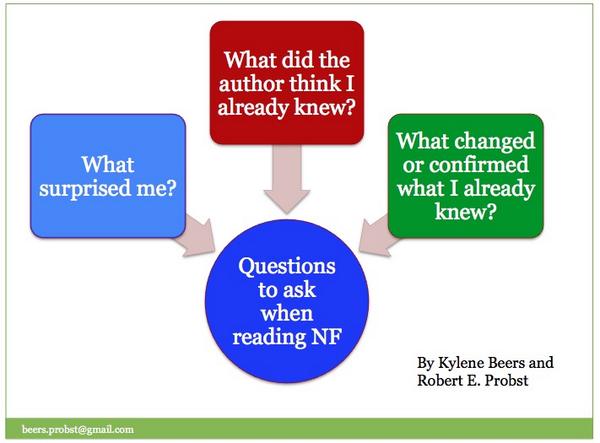
Three critical questions students should keep in mind–any subject, any grade–when reading NF:

3 Questions for reading Non-fiction


https://twitter.com/KyleneBeers/status/515988759171829760/photo/1

Resources:

How Teacher’s Learn

How Teachers Like to Learn Their Tech


http://thelearningcounsel.com/repository/teachers-as-tech-learners.jpeg

http://thelearningcounsel.com/archives/How-Teachers-Learn


National Cyber Safety Month

National Security Awareness Month

https://plus.google.com/photos/+google/albums/5940699556055522273


ScratchJR

Coding is the new literacy! With ScratchJr, young children (ages 5-7) can program their own interactive stories and games. In the process, they learn to solve problems, design projects, and express themselves creatively on the computer.

Download for the iPad.

http://www.scratchjr.org/index.html

Web Spotlight:


Mute the Messenger

When Dr. Walter Stroup showed that Texas’ standardized testing regime is flawed, the testing company struck back.by Jason Stanford Published on Wednesday, September 3, 2014, at 8:00 CST

  • “Rigor” was the new watchword in education policy.
  • Testing advocates believed that more rigorous curricula and tests would boost student achievement—the “rising tide lifts all boats” theory. But that’s not how it worked out.
  • Texas Education Commissioner Robert Scott, long an advocate of using tests to hold schools accountable, broke from orthodoxy when he called the STAAR test a “perversion of its original intent.”
  • To his credit, Committee Chair Rob Eissler began the hearing by posing a question that someone should have asked a generation ago: What exactly are we getting from these tests?
  • Stroup sat down at the witness table and offered the scientific basis behind the widely held suspicion that what the tests measured was not what students have learned but how well students take tests.
  • his testimony to the committee broke through the usual assumption that equated standardized testing with high standards. He reframed the debate over accountability by questioning whether the tests were the right tool for the job. The question wasn’t whether to test or not to test, but whether the tests measured what we thought they did.
  • Stroup argued that the tests were working exactly as designed
  • Stroup had caught the government using a bathroom scale to measure a student’s height.
  • The scale wasn’t broken or badly made. The scale was working exactly as designed. It was just the wrong tool for the job. The tests, Stroup said, simply couldn’t measure how much students learned in school.
  • Rep. Jimmie Don Aycock (R-Killeen) brought Stroup’s testimony to a close with a joke that made it perfectly clear. “I’d like to have you and someone from Pearson have a little debate,” Aycock said. “Would you be willing to come back?”
  • “Sure,” Stroup said. “I’ll come back and mud wrestle.”
  • Stroup had picked a fight with a special interest in front of politicians. The winner wouldn’t be determined by reason and science but by politics and power.
  • Pearson’s real counterattack took place largely out of public view, where the company attempted to discredit Stroup’s research. Instead of a public debate, Pearson used its money and influence to engage in the time-honored academic tradition of trashing its rival’s work and career behind his back.
  • standardized tests have become the pre-eminent yardstick of classroom learning in America, and Pearson is selling the most yardsticks.
  • Stroup started asking after he thought he found a way to use cloud computing to expose poor, minority children to basic math concepts using calculus.
  • The same kids branded as failures by the state tests embraced the project, using the cloud technology collaboratively to learn basic math concepts. This was the breakthrough that everybody—Kress, Perot and lawmakers in Austin—had been looking for.
  • However, the students’ scores rose only 10 percent, a statistically valid variance but hardly the change that he had observed in the classroom.
  • Using UT’s computing power, Stroup investigated. He entered the state test scores for every child in Texas, and out came the same minor variances he had gotten in Dallas. What he noticed was that most students’ test scores remained the same no matter what grade the students were in, or what subject was being tested. According to Stroup’s initial calculations, that constancy accounted for about 72 percent of everyone’s test score. Regardless of a teacher’s experience or training, class size, or any other classroom-based factor Stroup could identify, student test scores changed within a relatively narrow window of about 10 to 15 percent.
  • Stroup knew from his experience teaching impoverished students in inner-city Boston, Mexico City and North Texas that students could improve their mastery of a subject by more than 15 percent in a school year, but the tests couldn’t measure that change. Stroup came to believe that the biggest portion of the test scores that hardly changed—that 72 percent—simply measured test-taking ability. For almost $100 million a year, Texas taxpayers were sold these tests as a gauge of whether schools are doing a good job. Lawmakers were using the wrong tool.
  • The paradox of Texas’ grand experiment with standardized testing is that the tests are working exactly as designed from a psychometric (the term for the science of testing) perspective, but their results don’t show what policymakers think they show.
  • Stroup concluded that the tests were 72 percent “insensitive to instruction,” a graduate- school way of saying that the tests don’t measure what students learn in the classroom.
  • After correcting what Pearson interpreted as the mislabeled column, Way wrote, the tests were “only 50 percent” insensitive to instruction.
  • This alone was a startling admission. Even if you accepted Pearson’s argument that Stroup had erred, here was the company selling Texas millions of dollars’ worth of tests admitting that its product couldn’t measure half of what happens in a classroom.
  • A student in the third grade did as well on a math test as that same student did in the eighth grade on a language arts test as the same student did in the 10th grade on a different test. Regardless of changes in school, subject and teacher, a student could count on a test result remaining 50 to 72 percent unchanged no matter what. Stroup hypothesized that the tests were so insensitive to instruction that a test could switch out a science question for a math question without having any effect on how that student would score.
  • “teachers account for about 1% to 14% of the variability in test scores,” largely confirming Stroup’s apparently controversial conclusion.
  • If it’s true that the test measured primarily students’ ability to take a test, then, Stroup reasoned to the House Public Education Committee in June 2012, “it is rational game theory strategy to target the 72 percent.” That means more Pearson worksheets and fewer field trips, more multiple-choice literary analysis and fewer book reports, and weeks devoted to practice tests and less classroom time devoted to learning new things. In other words, logic explained exactly what was going on in Texas’ public schools.
  • we end up with adults and professionals spending most of their time gaming the system.”
  • Rep. Eissler never called another hearing to have the debate between Stroup and a Pearson representative as Rep. Aycock had suggested. Eissler retired from the Legislature and now lobbies for Pearson.
  • Tax law allows corporations to establish charitable foundations. What tax law doesn’t allow is endowing a nonprofit to supplement the parent corporation’s profit-driven mission. Last December, Pearson paid a $7.7 million fine in New York state to settle charges that the Pearson Foundation “had helped develop products for its corporate parent, including course materials and software,” reported The New York Times.


http://www.texasobserver.org/walter-stroup-standardized-testing-pearson/


Random Thoughts . . .


Personal Web Site


Book

deliberate [sic] Optimism:  reclaiming the JOY in education by Dr. Debbie Silver, Jack C Berckemeyer, and Judith Baenen.


“Recharge the optimism that made you an educator in the first place!  School is where students and staff should feel safe, engaged, and productive – and choosing optimism is the first step toward restoring healthy interactions necessary for enacting real change.”


MSM 285: Dancing Queen in Sonnet or Jeopardy Rocks the Green Pennies . . . From Heaven.

 Jokes You Can Use:


A small 1 SEATER plane crashed into a cemetery. Police have recovered 102 bodies so far and will continue to dig throughout the night.


There was a student who was desirous of taking admission for a study course.


He was smart enough to get through the written test, a GD and was to appear for the personal interview. Later, as the interview progressed, the interviewer found this boy to be bright since he could answer all the questions correctly. The interviewer got impatient and decided to corner the boy.


“Tell me your choice;” said he to the boy, “What’s your choice: I shall either ask you ten easy questions or ONE real difficult. Think well before you make up your mind.”


The boy thought for a while and said, “My choice is ONE real difficult question.”


“Well, good luck to you, you have made your own choice!” said the man on the opposite side. Tell me: What comes first, Day or Night?”


The boy was jolted first but he waited for a while and said: “It’s the DAY, sir.”


“How???????” the interviewer was smiling (“At last, I got you!” he said to himself.)


“Sorry sir, you promised me that you will not ask me a SECOND difficult question!”


Admission for the course was thus secured.


Eileen Award:  


Advisory:

Chukchuk is in a Quiz Contest trying to win Prize money of Rs.1 Million US$

The questions are as follows:

1) How long was the 100 yr war?

  1. A) 116
  2. B) 99
  3. C) 100
  4. D) 150

Chukchuk says, “I will skip this”


2) In which country are the Panama hats made?

  1. A) BRASIL
  2. B) CHILE
  3. C) PANAMA
  4. D) ECUADOR

Chukchuk asks for help from the University students


3) In which month do the Russians celebrate the October Revolution?

  1. A) JANUARY
  2. B) SEPTEMBER
  3. C) OCTOBER
  4. D) NOVEMBER

Sardar asks for help from general public


4) Which of these was King George VI first name?

  1. A) EDER
  2. B) ALBERT
  3. C) GEORGE
  4. D) MANOEL

Chukchuk asks for lucky cards


5) The Canary Islands, in the Pacific Ocean, Has its name x-udd on which animal:

  1. A) CANARY BIRD
  2. B) KANGAROO
  3. C) PUPPY
  4. D) RAT!

Chukchuk gives up.

SCROLL DOWN…….


If you think you are indeed clever and laughed at Chukchuk ‘s replies, then please check the answers below:

1) The 100-year war lasted 116 years from 1337-1453

2) The Panama hat is made in Ecuador

3) The October revolution is celebrated in November

4) King George’s first name was Albert. In 1936 He changed his name.

5) Puppy. The Latin name is INSULARIA CANARI This means islands of the puppies. Now tell me who’s the dumb one…Don’ Ever Laugh at a Chukchuk again.

(ChukChuk community lives somewhere in Siberia)


Middle School Science Minute

by Dave Bydlowski (k12science or davidbydlowski@mac.com)


New Middle School Science Minute Podcast on “Green Pennies”    

I was recently reading the Summer, 2014 issue of “Science Scope,” a magazine written for middle school science teachers, published by the National Science Teachers Association.


In this issue, I read an article entitled “Why the Statue of Liberty is Green: Coatings, Corrosion and Patina,” written by Richard H. Moyer and Susan A. Everett. In this 5E-learning-cycle lesson, students test different types of coatings on pennies to observe how the coatings affect the amount of corrosion produced when the penny is placed in a moist environment and a moist, acidic environment.


http://k12science.net/Podcast/Podcast/Entries/2014/9/26_Middle_School_Science_Minute-Green_Pennies.html


From the Twitterverse:

Lise Galuga ‏@lisegaluga What is the biggest game changer in education? It is not technology. It is an educator that’s an innovator. @gcouros #gafesummit
Neil Sandham ‏@scienceg33k A Professional Learning Teacher Toolkit http://sco.lt/8OXFPF  #satchat #rvsed
Patti Kinney@pckinney  8 Things About Middle School Kids | @scoopit http://sco.lt/9AEgPB
Dr. Justin Tarte ‏@justintarte 53 Ways To Check For Understanding:  #edchat #unionrxi via @edutopia  https://www.google.com/url?sa=t&rct=j&q=&esrc=s&source=web&cd=1&cad=rja&uact=8&ved=0CCAQFjAA&url=http%3A%2F%2Fwww.edutopia.org%2Fpdfs%2Fblogs%2Fedutopia-finley-53ways-check-for-understanding.pdf&ei=MhAwVKvuHIyxyATrsILgAg&usg=AFQjCNFhVcWMgOOQcI_-ZzLg6gdmBqcgUA&sig2=un3x3tg3Wc-voG-gY3eUuA&bvm=bv.76802529,d.aWw  
Kevin CumminsMassive collection of maths ideas and lesson plans. Fractions, Algebra, Space, measurement, and more http://brev.is/b8j2
Erin Young ‏@EdMagsEditor RT @sjunkins: The Periodic Table of iPad Apps. #ISTE2014http://sjunkins.wordpress.com/2014/06/16/the-periodic-table-of-ipad-apps/
McGrawHill Education ‏@MHEducation 45 Fun Animations & Cartoons Introducing Key Literacy Skills: http://ow.ly/ChaNL  #reading #edchat
Kelly Dumont ‏@kdumont 8 Characteristics of the Innovative Leader – love this from @gcouros http://zite.to/1oHgRll
Brent Csutoras ‏@brentcsutoras Why Did China Block Duck Duck Go? by @albertcostill: Of all the search engines in the world, one of the most i…
Laura Briggs ‏@LauraBTRT  1h1 hour agoRT @pammoran you can’t expect teachers to embrace and own their connected learning if admins don’t #satchat #edleader21
Teacher@Primary_Ed  2h2 hours ago8 Ways Teachers Can Talk Less & Get Kids Talking More http://thecornerstoneforteachers.com/2014/09/8-ways-teachers-can-talk-less-get-kids-talking.html?crlt.pid=camp.JqhtKjmWesjP #edchat #pypchat  #satchat #gafesummit
Get your #mschat Twitter gear here:  http://teespring.com/mschat#pid=222&cid=5491&sid=back  
#mschat every Thursday at 8:00 pm Eastern Standard Time.  And as Troy says, “The Twitter never stops!”


Strategies:

Jeopardy Rocks!

Really easy to create and save Jeopardy style board. You just give them a Title for the board (end of the URL),  email address and create a password. Then click and type. Easy peasy. Note that you must complete the entire board before the “Publish” button is available. There are six columns. Each column needs five questions. You also need a Final Jeopardy question.

http://www.jeopardy.rocks/

http://www.jeopardy.rocks/msm-2453fbd1-b63f-461a-b530-1e71302129f2/ (Only the Hosts category has real questions.)


Google Forms

Google has updated Google Forms to include a couple of nice options. First of all, you can now limit respondents to one response. Secondly, you can now shuffle question order. Thirdly, you can now customize the images and fonts in a form. You can do a lot of good stuff with Forms.

http://blog.gcflearnfree.org/2014/09/11/use-google-forms-to-create-quizzes-surveys-and-more/

http://googledrive.blogspot.com/2014/09/custom-forms-themes.html


PopSonnet

What happens when you take a pop song and rewrite it as a sonnet?

http://popsonnet.tumblr.com/

Resources:

Inside the Brain of a Struggling Reader [Infographic]

When a student struggles to learn to read, we often look to social or economic factors, access to books, or the home environment for an explanation. While each of these factors can play a part, treatable brain differences are often part of the equation.

http://www.scilearn.com/blog/inside-the-brain-of-a-struggling-reader-infographic

Inside the Brain of a Struggling Reader:  infographic

See the original infographic at http://www.scilearn.com/blog.


Richard Byrne Google Docs Resources

27 (and growing) video tutorials by Richard Byrne on using Google.

https://www.youtube.com/playlist?list=PLtx-qUNKJwDz6b_3NaGTkGXaTPrLCpacY


Sources of Free Sound Effects and Music for Multimedia Projects

Just as with images, it is important to have students use music and sound effects that they have permission to use. The following resources offer music and sound effects that students can use for free in multimedia projects.

http://www.freetech4teachers.com/2014/09/sources-of-free-sound-effects-and-music.html

Web Spotlight:


Random Thoughts . . .


Personal Web Site


MSM 283:  A Love Letter. Dipsticks. Images. and Memory.

 Jokes You Can Use:


Eileen Award:

  • Twitter: Marc Clark, Deborah Kenny, Crystal Davids, Jeff Emerson


Advisory:

Cryptic Writing

http://www.brainpickings.org/2014/09/01/victorian-cryptographic-love-letter/


Middle School Science Minute

by Dave Bydlowski (k12science or davidbydlowski@mac.com)


MIDDLE SCHOOL SCIENCE MINUTE-LAB SAFETY SPEC ED PARAPROS


I was recently reading the Summer, 2014 issue of “Science Scope,” a magazine written for middle school science teachers, published by the National Science Teachers Association.

In this issue, I read an article entitled “Scope on Safety: Question of the Month” written by Ken Roy, director of environmental health and safety for Glastonbury Public Schools in Glastonbury, Connecticut.  The question of the month, that he responds to, is “Do special education paraprofessionals in my science lab need to have formal training in handling hazardous chemicals?”


From the Twitterverse:

Kyle Calderwood ‏@kcalderw  28mAll That Teachers Need to Know about Remind (101) #ptchat #njed #edtech http://goo.gl/NcxfJ0
juandoming ‏@juandoming  10mClassJump – Free web sites for #teachers via @McfeetersM http://sco.lt/5zDLRh
principalaim@principalaim  6hPay Attention to Attendance this New School Year: http://bit.ly/1trjHBo
Jenna Dixon ‏@JennaVDixon  Aug 21For those of us overwhelmed by the idea of Genius Hour w/ little ones- “Why I Abandoned Genius Hour” http://www.mrswideen.com/2014/06/why-i-abandoned-genius-hour.html?spref=tw … via @mrswideen
Kyle Pace ‏@kylepace  49mEducator’s Guide to LiveBinders http://www.theedublogger.com/2014/08/28/livebinders/ …
Derek McCoy ‏@mccoyderek  53mThree Ways Blended Learning Makes Teachers More Efficient http://ow.ly/B5rYQ
Emily Vickery ‏@ehvickery  1hSchools use Apple’s Swift and other coding langs 2 create several apps http://ow.ly/3q8Hv3  Intense PD preps teachers #edchat #edtech
William Jenkins ‏@EdTech_Stories  5h@E_Sheninger Check out @ChrisTienken study on the lack of relationship between PISA/TIMSS & creativity, innov, entrap http://tinyurl.com/m5bl3tf
Eric H. Roth ‏@compellingtalks  8hThe Best Sites For Learning About The #Constitution Of The United States http://larryferlazzo.edublogs.org/2010/08/10/the-best-sites-for-learning-about-the-constitution-of-the-united-states/ … via @Larryferlazzo #UShistory #USIH #civics
Susan Connelly ‏@ConnellySue  1h@BevLadd: Dipsticks: Efficient Ways to Check for Understanding | @edutopia http://edut.to/1oKIDjT ” great resource! #NT2t  #leadership #tlap
Andrew Miller@betamiller  2hTop 5 Tips For A Blended Classrooms http://bit.ly/1rjrb3e  #edchat #edtech
Sarah Ressler Wright@vocabgal  Sep 4RT @SadlierSchool: Free Teacher Organization Printables: http://ow.ly/B3a6i   What a handy download! #Edchat #Engchat #K12 #Freebie
McGraw-Hill School@McGrawHillK12  Sep 4$20,000 Back-To-School sweepstakes – prizes for parents AND teachers. Enter free by 9/9 at http://www.volunteerspot.com/enter
Rui Guimarães Lima@rguimaslima Protected Tweets  46m15 Lesson Plans For Making Students Better Online Researchers via @PinkSalmonG2P http://sco.lt/52Eu7l
David Truss@datruss  47m@mathrabbit1: The declining economic value of routine cognitive work http://dangerouslyirrelevant.org/2014/09/the-declining-economic-value-of-routine-cognitive-work.html #edchat #edreform #cpchat @mcleod
#mschat every Thursday at 8:00 pm Eastern Standard Time.  And as Troy says, “The Twitter never stops!”


Strategies:

13 Tricks to Help You Remember What You’ve Learned

Memory is fallible. If you forget everything in this article, remember this fact: Researchers estimate that we lose 90% of everything we learn immediately after learning it. Ninety percent. Have I got your attention now?

http://www.lifehack.org/articles/productivity/13-tricks-help-you-remember-what-youve-learned.html


21 Cool Anchor Charts To Teach Close-Reading Skills

Close reading is a hot topic that’s just getting hotter! Here are 21 anchor charts, bulletin board ideas and other resources that you can bring into your classroom to turn your readers into even closer readers.

http://www.buzzfeed.com/weareteachers/21-cool-anchor-charts-to-teach-close-reading-skill-h0xt

Resources:

Image Resources

https://www.flickr.com/photos/internetarchivebookimages


Free PowToon Account

We believe in the importance of education so to celebrate 5 million PowToons created we have over 50,000 FREE Classroom Accounts to give away! Each account gives one teacher + 60 students access (normally $96/yr per account). Offer Expires October 31st, 2014. Accounts are valid for one year.

http://www.powtoon.com/lp/toonup/

Web Spotlight:


Random Thoughts . . .

Google Classroom

Personal Web Site


MSM 282: Own your own stuff, just don’t call a plumber.

Presented in collaboration with the Association for Middle Level Education.   


Jokes You Can Use:

A pipe burst in a doctor’s house. He called a plumber. The plumber arrived, unpacked his tools, did mysterious plumber-type things for a while, and handed the doctor a bill for $600.

The doctor exclaimed, “This is ridiculous! I don’t even make that much as a doctor!.”

The plumber quietly answered, “Neither did I when I was a doctor.”


Ham and eggs: a day’s work for a chicken, a lifetime commitment for a pig.


Three men were sitting on a park bench. The one in the middle was reading a newspaper; the others were pretending to fish. They baited imaginary hooks, cast lines, and reeled in their catch.

A passing policeman stopped to watch the spectacle and asked the man in the middle if he knew the other two.

“Oh yes” he said. “They‘re my friends.”

“In that case,” warned the officer, “you’d better get them out of here!”

“Yes, sir” the man replied, and he began rowing furiously

New student in my classroom

Got a new student this week.  Mr. Invisible married Mrs. Invisible and had children.  They’re not much to look at either.

Eileen Award:


  • Twitter: André Sprang, Joseph Kenney, KJ Wari, Jochen Horst

Advisory:

Humans Need Not Apply

The video below is long (15 minutes), but thoughtful and riveting. It make the case that just as horses have been replaced by technology, humans are next. If that sounds like silly logic, invest one minute, just to see what you think.

www.loopinsight.com/2014/08/16/humans-need-not-apply

Getting Over Procrastination


http://www.newyorker.com/science/maria-konnikova/a-procrastination-gene

Middle School Science Minute

byDave Bydlowski (k12science or davidbydlowski@mac.com)


Middle School Science Minute — Think Apps


I was recently reading the Summer, 2014 issue of “Science Scope,” a magazine written for middle school science teachers, published by the National Science Teachers Association.  In this issue, I read an article entitled “Think Instruments, Think Apps: Using App-Based Technology in the Science Classroom” written by Nancy H. Heilbronner.  In the article, Nancy describes 10 apps that would be helpful to use in the science classroom.  All 10 of the apps could take the place of costly scientific instruments.

From the Twitterverse:

George Couros ‏@gcouros 35s

Seems to be a trend all over – Tablets fall out of favour in NSW classroomshttp://www.smh.com.au/nsw/tablets-fall-out-of-favour-in-nsw-classrooms-20140820-103nsl.html …

Tom Grissom ‏@tomgrissom now

Digital textbooks in OneNote stay updated, save money   http://blogs.office.com/2014/07/01/administrators-help-teachers-students-reach-learning-objectives-with-onenote/ …#onenote#off365#crossplatform

Derek McCoy@mccoyderek 12m

ClassDojo’s Messenger App Now Supports Voice Messageshttp://ow.ly/APnpY

Scott McLeod ‏@mcleod 33m

When is the last time you saw a “Using Office 365 in Your Classroom” session at an#edtech conference?

Gary G. Abud, Jr. ‏@MR_ABUD 50m

Looking for recommendations of apps and websites to use in your classroom this year? Look no further than@Graphite!http://j.mp/1CcTgSC

Lisa Dabbs ‏@teachingwthsoul 1h

Excited! New Teacher Chat class#ntchat@RemindHQ is launching! Sign up to connect! 12 subscribers so far!http://www.lisadabbs.com/p9qq #satchat

Brian Aspinall ‏@mraspinall 1h

Just blogged…Seven Back to School Week Activities to Get to Know Your Students via@mraspinallhttp://brianaspinall.com/?p=361 @dougpete#lkdsb

Derek McCoy ‏@mccoyderek 1h

Why middle-schoolers need to take risks –http://ow.ly/3pi9nm

MichaelSmithSupt ‏@principalspage 2h

A map of every device in the world that’s connected to the internet.

Brian Aspinall ‏@mraspinall 2h

“Four Things I’ll Do Differently This School Year”http://zite.to/1zUBkrK

Brian Aspinall@mraspinall 2h

25 Ways To Ask Your Kids ‘So How Was School Today?’ Without Asking Them ‘So How Was School Today?’http://zite.to/XZKckz

Richard Byrne@rmbyrne 3h

Three Android Apps for Creating Flipped Video Lessonshttp://ow.ly/ASxxO

Ryan Bretag@ryanbretag 3h

RT”@ChromebookInst: Get Your Preso Proposal Submitted Quickly for CBI Great Lakes in Ohio. Deadline is nearing!http://www.chromebookinstitute.com/call-for-proposals/

Diane Ravitch@DianeRavitch 3h

Register your vote for or against Common Core:http://intelligencesquaredus.org/debates/upcoming-debates/item/1154-embrace-the-common-core&tab=2

Monte Tatom@drmmtatom · Aug 28

Google Slides for#iPad is Finally Out  http://feedly.com/k/1q83izk ~#fhuedu320#fhucid#tn_teta#edwebchat =>@MSMatters

Monte Tatom@drmmtatom · Aug 28

LibrAdventures – A Map of Writers & Their Stories  http://feedly.com/k/1q83NJJ ~#fhueng102#engchat#fhuedu320 =>@MSMatters

#mschat every Thursday at 8:00 pm Eastern Standard Time.  And as Troy says, “The Twitter never stops!”

Podcast 282 - This Week - Google Docs 2014-08-30 12-45-37 2014-08-30 12-45-43

Strategies:

Who’s a Math Nerd? *raising hand*

Ok so I didn’t come up with this idea out of nowhere.  I was reading this awesome book–>Number Sense Routines by Jessice Shumway and I had this awesome class of students who were lacking in number sense.

I came up with this idea.  You can read about ithere (THE BLAME GAME) and read through my #TMC13 presentationhere.  In a nutshell, I am unable to live with myself if I allow students to graduate high school (pass my class) without having  mental math strategies.

So I start this idea with my high school class of 12 students who’s only relationship with mathematics was very negative.  To be completely honest, these students’ relationship with school was very negative and they were kind of ready to give up on school all together.

http://iamamathnerd.wordpress.com/2014/01/04/countingcircles/

4 Big Things Transformational Teachers Do

Transformational teachers don’t react. They anticipate and prepare. Lee Shulman, asreported by Marge Scherer, suggests that expert teachers demonstrate the following, despite enormous challenges:

Cognitive understanding of how students learn; emotional preparation to relate to many students whose varied needs are not always evident; content knowledge from which to draw different ways to present a concept; and, finally, the ability to make teaching decisions quickly and act on them.

So how do they do that? Let’s break it down.

http://www.edutopia.org/blog/big-things-transformational-teachers-do-todd-finley

Resources:


27 Ways To Promote Intrinsic Motivation In The Classroom

by TeachThought Staff

We’ve talked about thedefinition of intrinsic motivation in the past. We’ve also talked about some basicways to improve student motivation.

This time, it’s Mia MacMeekin‘s turn to speak to you about the same, but through gridded, blocked, and easy to read infographics. The graphic starts with a definition for both intrinsic motivation and extrinsic motivation, then offers 27 verbs that can help promote that magic stuff that is characterized by curiosity, effort, engagement, and academic success.

Some were a little iffy–”praise” and “milestones” seemed a little closer to extrinsic motivation. But the vast majority are useful to consider as you design units, lessons, and activities this school year.

Our favorites?

5. Create a grade free lesson

7. Challenge students to come up with new solutions to old problems

8. Encourage creative ways to accomplish the same task

22. Create a trusting atmosphere

23. Create a class vision

24. Engage in community service


http://www.teachthought.com/teaching/27-ways-promote-intrinsic-motivation-classroom/


Web Spotlight:


4 Steps Towards A More Personal Classroom

by Linda Pruett

Personalized learning is a key to transforming education. What is personalized learning? It is meeting the kids where they are – and then helping them grow in their strengths, and better see themselves. It’s finding out where each student’s interests lie, challenging them to grow in their individual interests, and then celebrating their growth! It is student-centered, student-driven, and student-celebrated.

4 Steps Towards A More Personal Classroom

1. Really, truly get to know your students

2. Tailor student learning

3. Help them to set their own goals

4. Use technology to help students interact


http://www.teachthought.com/learning/getting-started-personalized-learning/


5 Ways to Assess Learning without Giving a Test

I ran into a little push-back about assessment.  The chief complaint was that increasing the number of assessments requires teachers to give up more instructional time to test kids.  I couldn’t agree more with. We don’t need more tests. We need more instruction.


But here’s the deal. Assessment is not testing.  Assessment is determining if learning is actually taking place.  In fact, assessment is a vital component on excellent instruction, and without assessment, you’re not delivering instruction.  You’re disseminating information and opportunities to learn.

http://leadlearner2012.blogspot.com/2014/07/5-ways-to-assess-learning-without.html

Why All Students Should Write: A Neurological Explanation

by Judy Willis M.D., M.Ed., radteach.com

In terms of writing and the brain, there are multiple reasons for embedding writing throughout STEM courses. Writing promotes the brain’s attentive focus to class work and homework, promotes long-term memory, illuminates patterns (possibly even “aha” moment insight!), includes all students as participants, gives the brain time for reflection, and when well-guided, is a source of conceptual development and stimulus of the brain’s highest cognition.

http://www.teachthought.com/literacy-2/why-all-students-should-write-a-neurological-explanation-for-literacy/


A strange definition of a ‘bad’ teacher

Whatever you think of job protections for teachers, Wright inadvertently raised a separate issue during an interview he did with Campbell on NY1′s “Inside City Hall with Errol Louis”: What exactly is a “bad” teacher? Some answers are obvious, others less so.

…the suggestion being that a teacher who assigns kindergartners homework routinely is better than one who doesn’t.

But in this interview Wright rested his claims about the value of his children’s teachers on the fact that one was spending personal money for supplies and that the same teacher assigned homework routinely.

But it is troubling when the lead plaintiff in an important lawsuit describes a “good” teacher as one who spends personal money to buy school supplies for kids and who gives young kids homework. In this definitional exercise, that means a”bad” teacher is someone who doesn’t do either thing. That’s beyond wrong. It’s scary.

http://www.washingtonpost.com/blogs/answer-sheet/wp/2014/08/09/a-strange-definition-of-a-bad-teacher/

Ideas Of The Mind (Wandering, Divergent And Flipped)

In many organizations, we are so intent on the problems and walls that stand before us, that we never allow ourselves the time necessary to think past, around or beyond them.  We spend our waking time and mental capacity being now-focused.  Completely immersed in plodding forward…and pushing those walls and obstacles with us.  Never realizing that taking a step back will not only improve our perspective, but unveil a variety of routes forward that may have not been noticeable, previously.

http://dculberh.wordpress.com/2014/07/15/ideas-of-the-mind-wandering-divergent-and-flipped/

Random Thoughts . . .

Own your information.

Personal Web Site

MSM 281:  We’re Rusty. Shut off the Internet to test.

Presented in collaboration with the Association for Middle Level Education.


Jokes You Can Use:


During a dinner party, the hosts’ two little children entered the dining room totally nude and walked slowly around the table. The parents were so embarrassed that they pretended nothing was happening and kept the conversation going. The guests cooperated and also continued as if nothing extraordinary was happening.

After going all the way around the room, the children left, and there was a moment of silence at the table, during which one child was heard to say, “You see, it is vanishing cream!”


Two explorers, camped in the heart of the African jungle, were discussing their expedition. “I came here,” said one, “because the urge to travel was in my blood. City life bored me, and the smell of exhaust fumes on the highways made me sick. I wanted to see the sunrise over new horizons and hear the flutter of birds that never had been seen by man. I wanted to leave my footprints on sand unmarked before I came. In short, I wanted to see nature in the raw. What about you?” “I came,” the second man replied, “because my son was taking saxophone lessons.”


A dentist and a doctor fell in love with the same girl. The dentist had to go out of town for a week. He gave the girl 7 apples and asked her to eat one a day. Why?


Two gold fish are in a tank one says to the other “Do you know how to drive this thing?”


Eileen Award:

  • iTunes:
  • Twitter:  Holly Berchet-Hall, Brian Marks, Andre Spang, Torsten Larbig, MEEMIC, Kyle Stalzer, @sarahdateechur, Kit Hard, Yong Park, Dr. Phil Metzger, Secondary Principals (MASSP),
  • Google+: Ryan Easton, Sandra Wozniak
  • Facebook:
  • Email:


Advisory:

Too Obvious to share

Middle School Science Minute

byDave Bydlowski (k12science or davidbydlowski@mac.com)


WE GET LETTERS


I was recently reading the Summer, 2014 issue of “Science Scope,” a magazine written for middle school science teachers, published by the National Science Teachers Association.

In this issue, I read an article entitled “Letters! We Get Letters” written by Joanna Shubin.  In the article, Joanna describes how she has her students write letters to scientists.  It is a great way to integrate science and English Language Arts and to generate enthusiasm in all of the students.  She suggests that you try having your own students write to scientists, because you will get letters!


http://k12science.net/Podcast/Podcast/Entries/2014/8/7_Middle_School_Science_Minute-We_Get_Letters.html

From the Twitterverse:

Cheryl Murphy Savage ‏@CherylMSavage 57s

“I strongly believe that you can read without writing, but you cannot write without reading.”@LindaMRief#HeinemannTour

Arne Duncan ‏@arneduncan 7m

Imagine yourself going back to school abroad next fall!@PeaceCorps is looking for educatorshttp://1.usa.gov/1k9ltnp #ApplyPC#teaching

Karen McMillan@McTeach 10m

Sending Students on Learning Missionshttp://ow.ly/A8NOq

Dan McCabe ‏@danieldmccabe 21m

This is what education should be for students and teachers.
Jobs Quote
#satchat#nt2t pic.twitter.com/GABFT3bi6m

Jessica Johnson ‏@PrincipalJ 17m

“6 Basketball Tips For School Leadership”http://feedly.com/e/G2MyafK- great post by@williamdp#cpchat#educoach#principalpln

ClassThink ‏@ClassThink 40m

Google Classroom release date announced — and it’s sooner than we were expecting!http://ow.ly/A4rPN #gafe#edchat#edtech#googleapps

Suzanne Perlis ‏@SuzannePerlis 53m

The 6 Levels Of Bloom’s Taxonomy, Explained With Active Verbshttp://www.edudemic.com/the-6-levels-of-blooms-taxonomy/ … via@edudemic

The Atlantic ‏@TheAtlantic Aug 5

To stop cheating in a national standardized test, Uzbekistan shut down the entire country’s Internethttp://theatln.tc/1pBhqj1

Kyle Calderwood ‏@kcalderw 1h

You can start off with analog Twitter wall to teach students appropriate ways to tweet and#digicit practiceshttp://goo.gl/CZoe4h #nt2t

Charles Fishman ‏@cfishman 1h

In 2013, in US, we spent:
• $25 billion buying bottled water
• $29 billion maintaining the entire water system
#stateofwater2014

Todd Bloch@blocht574 2h

#MSchat and@AMLE Twitter event 8-14-14 8 pm ET  http://ln.is/wp.me/nGrA0 Join the discussion on Ss motivation!#satchat#edchat

juandoming@juandoming 3h

Inventing Infographics: Visual Literacy Meets Written Contenthttp://lnkd.in/dZ2wYSi

Sue Gorman @sjgorman 3h

Use Class Dojo and Remind to communicate with parents.http://simply2ndresources.blogspot.com/2014/08/parent-communication.html?spref=tw #edtech#edchat#wiedu#wischat

Holly Berchet-Hall@msmathcms Aug 6

Shout out to@MSMatters for introducing me to Edmodo and to@mthman for introducing me to MSMatters. Just finished#EdmodoCon so psyched!

Monte Tatom@drmmtatom Jul 30

4 Ideas To Have A Successful First Year as Principal  http://feedly.com/k/1qmcUDJ ~#ISTEAPLN#fhuedu610#tn_teta#edchat =>@MSMatters

#mschat every Thursday at 8:00 pm Eastern Standard Time.  And as Troy says, “The Twitter never stops!”


Stick Pick Twitter Giveaway:  So recently I won a copy of Stick Pick.  I already have a copy of Stick Pick from back when I reviewed it for the Podcast.  If you’d like my copy of Stick Pick, send us an email at middleschooleducators@gmail.com with a short statement on how you use differentiation in your classroom and we’ll throw your name in a random name selector (called Stick Pick) and announce a winner two weeks from the recording of this show.  Stick Pick will be making an important product announcement soon and we’ll bring you the news when it happens.

Strategies:

Random Name Generators

Need a way to select students to “volunteer”?

http://www.classtools.net/education-games-php/fruit_machine

http://primaryschoolict.com/random-name-selector/

http://www.classtools.net/random-name-picker/


* Note that these can also be used for vocabulary words, important terms, etc.


Classroom Games


http://www.teachhub.com/classroom-games-other-creative-ways-start-day

What works in teaching Math


http://ies.ed.gov/ncee/wwc/MathHome.aspx

Resources:

Fluency Tutor

Fluency Tutor™ for Google is designed to increase the fluency and comprehension skills of emerging readers. It can be used with individual students or whole classrooms. It helps to identify students needing additional support, and is often used with students in older grade levels who have specific reading difficulties.

The teacher dashboard and student interaction area are all free.

Premium features such as useful analytics and progress tracking are also available for $99 per teacher, per year.

http://www.fluencytutorforgoogle.com/


Web Spotlight:

Making Connections with Advisory

Relationships are among the most important elements of student success.

By: Ellen D’Amore


…research has shown that the more teachers foster relationships with their students and focus on their social and emotional needs, the more academic performance, motivation, and attendance improve.

Our advisory program includes activities that take approximately one to two hours a week for the first semester, gradually moving the focus from social/emotional awareness to academics. The advisory program involves a series of seamless steps.

The results of our advisory program include higher overall GPAs, increased attendance rates, and fewer behavior referrals.

In the two years since we implemented the program, my students have commented that they feel like our advisory class is a little family, and they wish we could do more activities together. I feel the same way.

http://www.amle.org/BrowsebyTopic/WhatsHot/WHDet/TabId/271/ArtMID/889/ArticleID/297/Making-Connections-with-Advisory.aspx

Random Thoughts . . .


Personal Web Site


IFTTT

Badges


MSM 279:  A test of random facts and Weird Al makes the show this week on Middle School Matters!  

Presented in collaboration with the Association for Middle Level Education.


Jokes You Can Use:

Test Questions:

Johnny’s mother had three children. The first child was named April. The second child was named May. What was the third child’s name?


There is a clerk at the butcher shop, he is five feet ten inches tall and he wears size 13 sneakers. What does he weigh?

Source:  http://blog.ivman.com/easy-tests/#more-7571


Random Facts

  1. An octopus has three hearts.
  2. There’s enough water in Lake Superior to cover all of North and South America in 1 foot of water.
  3. You can spell the word “upside down” upside down by using other letters of the alphabet: umop apisdn.
  4. The name Jessica was created by Shakespeare in the play Merchant of Venice.
  5. The YKK on your zipper stands for “Yoshida Kogyo Kabushikigaisha.”
  6. Every two minutes, we take more pictures than all of humanity did in the 19th century.


Eileen Award:

  • Twitter: Aaron Duff,  Adnan Iftekhar, Kelly Lippard

Advisory:

Chat out of context

https://www.youtube.com/watch?v=H-qpvjjNfLA#t=33


Perceptions

https://www.youtube.com/watch?v=XfZFuw7a13E


Middle School Science Minute

byDave Bydlowski (k12science or davidbydlowski@mac.com)


MIDDLE SCHOOL SCIENCE MINUTE-SCIENTIFIC MODELING


I was recently reading the Summer, 2014 issue of “Science Scope,” a magazine written for middle school science teachers, published by the National Science Teachers Association.

In this issue, I read an article entitled “Modeling What We Can’t Sense – Using Evidence We Can” written by Juliana Texley.  In her article she challenges the thinking that as we look at the history of science, we often imply that ideas were chronologically wrong, then less wrong, culminating with modern scientific theory.


From the Twitterverse:

Derek McCoy ‏@mccoyderek 21m

5 Apps Every Teacher Should Havehttp://ow.ly/3nhwTe

Richard Byrne ‏@rmbyrne 23m

How to Use B-Roll Footage In Videoshttp://ow.ly/zkiX6

Miguel Guhlin@mguhlin 24m

“28 Tips to Turbo Charge Your Leadership with@Evernotehttp://www.mguhlin.org/2014/07/25-tips-to-turbo-charge-your-leadership.html?m=1 #NT2T

Mike Paul ‏@mikepaul 29m

Public Domain Photos For You To Use – British Library Publishes 1 Million+ Photos To Flickrhttp://pmte.ch/1qQKkuF

Kathy Ishizuka ‏@kishizuka 31m

Pleased to Meet You: Web apps for getting to know your students before fall | Cool Tools  http://ow.ly/zlphu By@rmbyrne

Dru Tomlin ‏@DruTomlin_AMLE 35m

Ten Ideas for Managing Blended Learning in Middle Schoolhttp://pocket.co/sFKm3 #mschat@AMLE @middleweb

WalkMe ‏@WalkMeInc May 28

Check out how to make@Moodle easy to use for free –http://tinyurl.com/pjsffcw

Karen McMillan ‏@McTeach 39m

Why The Future Of Education Involves Badgeshttp://zite.to/1pnJdlp

Melany Stowe ‏@MelanyStowe 1h

EdCamps & UnConferences: The person doing the work is the person doing the learning.#satchat

ReadWriteThink.org ‏@RWTnow 55m

Children’s publisher John Newbery was born on this day in 1713. Create your own book awards in the classroom:http://ow.ly/yDPlB

Monte Tatom@drmmtatom · 17h

Use Video Camera Like a Pencil – A Blog Like a Textbook  http://feedly.com/k/Ugn7HD  via@wfryer#fhuedu642#tn_teta#edwebchat =>@MSMatters

Monte Tatom@drmmtatom · 22h

Useful Tools & Apps to Help You Assemble Your Classroom Curriculumhttp://feedly.com/k/WieeyI  ~#fhuedu642#tn_teta#edwebchat =>@MSMatters

Monte Tatom@drmmtatom · Jul 17

6 ways to leverage social media in school  http://feedly.com/k/1qiBdXY  ~#fhuedu642#tn_teta#edwebchat =>@MSMatters

#mschat every Thursday at 8:00 pm Eastern Standard Time.  And as Troy says, “The Twitter never stops!”


Resources:

Why Reading Matters

Why Reading Matters is an hour-long BBC program did a couple of years ago on how reading — and writing — impact the brain.

I wouldn’t show the entire show to students, but there are several very good segments.

The entire show is available on Vimeo, which I’ve embedded below, and it’s also available on YouTube, though it’s in six separate ten minute segments. I’ve also embedded the first segment below.

http://larryferlazzo.edublogs.org/2014/07/18/nice-bbc-video-why-reading-matters/

The Seven A’s of Successful High Schools

Defining what it means to have a “successful” high school is quite the challenge, with stakeholders often disagreeing on the approach to take.

Following, I’ve outlined each of the seven attributes I consider essential in a successful H.S., as well as my rationale for selecting each.

http://connectedprincipals.com/archives/10620

Weird Al

“Tacky”

https://www.youtube.com/watch?v=XsWo8apgLys

“Word Crimes”

https://www.youtube.com/watch?v=8Gv0H-vPoDc


Leonard Cohen on Creativity, Hard Work, and Why You Should Never Quit Before You Know What It Is You’re Quitting

before we quit, we have to have invested all of ourselves in order for the full picture to reveal itself and justify the quitting, which applies equally to everything from work to love

http://www.brainpickings.org/index.php/2014/07/15/leonard-cohen-paul-zollo-creativity/


Summer Learning Loss

So, if all the research says most of the achievement gap is due to summer learning loss, it boggles my mind even more that we are spending huge amounts of resources on countless school reform boondoggles like Race To The Top, Value Added Measurements (VAM), the “next generation” of standardized testing, etc…

http://larryferlazzo.edublogs.org/2014/07/19/is-summer-learning-the-silver-bullet-for-narrowing-the-achievement-gap/

Web Spotlight:

Flowboard

Presentation software that looks like a magazine layout, functions like HyperCard stacks and is more interactive than Slideshare.  It’s an app and until the first 10,000 downloads it’s $9.99.

https://flowboard.com/


emaze

Think Prezi.  With 3D effects.  And a translation tool.  Basic version is free, the Education version is $2.90/month.

http://www.emaze.com/

Random Thoughts . . .

ISTE 2014

Personal Web Site


MSM 278:  Random Facts, Write about Maths.

Presented in collaboration with the Association for Middle Level Education.


Jokes You Can Use:


http://www.buzzfeed.com/patricksmith/really-really-bad-puns


Random Facts

  1. You can’t hum while pinching your nose.
  2. Russia has a larger surface area than Pluto.
  3. Anne Frank and Martin Luther King Jr. were born in the same year.
  4. People currently graduating college have never been alive while The Simpsons wasn’t on TV.
  5. Oxford University is older than the Aztec Empire.
  6. There are more fake flamingos in the world than real flamingos.
  7. The fax machine was invented the same year people were traveling the Oregon Trail.
  8. 1998 is as far away as 2030.
  9. France was still executing people with a guillotine when the first Star Wars film came out.
  10. There are more public libraries than McDonald’s in the U.S.

Eileen Award:

  • Twitter: Adnan Iftekhar, Kyle S., Mike Paul
  • Google+: Patrick Brule


Advisory:

Spread of Baby Names

Enter a gender (Male or Female) and a name and watch the prevalence of the name spread across the country (or not). Watch the statistics at the bottom for total number of babies with that name. Hold your mouse over a state to get the numbers for that state.

http://www.theguardian.com/news/datablog/interactive/2014/mar/03/how-baby-names-spread-across-the-us-interactive-map

http://www.freetech4teachers.com/2014/07/an-interactive-look-at-history-and.html?m=1


Jobs Charted by State and Salary

The chart below shows what people do and what they get paid. These vary depending on where you live. Select a state in the drop-down menu, and use the slider to adjust the median annual salary.


http://flowingdata.com/2014/07/02/jobs-charted-by-state-and-salary/


Middle School Science Minute

byDave Bydlowski (k12science or davidbydlowski@mac.com)


Neuroscience-Career Opportunites


This is the fourth in a four part series on neuroscience with special guest Aneesha Badrinarayan, Outreach Programs Manager with the Ann Arbor Hands-On Museum, in Ann Arbor, MI. You can visit the Ann Arbor Hands-On Museum online at:

http://www.aahom.org


In this podcast, we look at the question of “How do you prepare for a degree in neuroscience and what are the career opportunities?”


http://k12science.net/Podcast/Podcast/Entries/2014/7/3_Middle_School_Science_Minute-Neuroscience_Career_Opportunities.html

From the Twitterverse:

Lisa Dabbs ‏@teachingwthsoul 33mRT@connect2jamie: MT@ShellTerrell: Join NOW! Keynote:RemixED: The Power of Remix with@amyburvall   #RSCON5#TLChat
Todd Bloch ‏@blocht574 36mHow can we make middle school kids think Wow! School!?#mschat 5yo daughter brought awesome book home from librarypic.twitter.com/ddGNoTo4NK
Kevin Cummins@edgalaxy_com 51mHundreds of creative writing ideas for teachershttp://brev.is/Xom3
Kevin Cummins ‏@edgalaxy_com 1hTop 5 iPad apps for busy educatorshttp://brev.is/59j2
cbeyerle ‏@cbeyerle 2hEducators Are Ditching Traditional Conferences for Blogs and Twitter#satchathttp://www.opencolleges.edu.au/informed/news/why-educators-are-ditching-traditional-conferences-for-blogs-and-twitter/?utm_content=buffer60aef&utm_medium=social&utm_source=facebook.com&utm_campaign=buffer …
VoiceThread ‏@voicethread 4m#VoiceThread is getting a NEW look and feel. Join us for a demo on 7/23 to see for yourself: #edchat#edtech
Monte Tatom@drmmtatom · Jul 2Video compilation for#ISTE2014#ISTEAPLN &#OLI14http://youtu.be/J2SFJvYxG_4?a
Monte Tatom@drmmtatom · Jul 10Teachers’ Ultimate Directory of Free Image Sources  http://feedly.com/k/1q1w32s ~#edwebchat#tn_teta#fhuedu642#fhuedu320 =>@MSMatters
Monte Tatom@drmmtatom · Jul 107 PD tips for your instructional technology integration plan  http://feedly.com/k/TUNl2a ~#ISTEAPLN#tn_teta#fhuedu642 =>@MSMatters
Monte Tatom@drmmtatom · Jul 915-Year-Old explains the key to developing a#PLN http://feedly.com/k/TSvxol ~#fhuedu642#ISTEAPLN#tn_teta =>@MSMatters
#mschat every Thursday at 8:00 pm Eastern Standard Time.  And as Troy says, “The Twitter never stops!”


Strategies:

Using Writing in Mathematics to Deepen Student Learning

“Writing in mathematics gives me a window into my students’ thoughts that I don’t normally get when they just compute problems. It shows me their roadblocks, and it also gives me, as a teacher, a road map.”

Section One gives a brief background that answers the question you may be wondering: Why write in mathematics? Section Two describes the existing role of writing in the mathematics curriculum, and Section Three provides strategies and ideas to put into practice right away.


http://files.eric.ed.gov/fulltext/ED544239.pdf

Anchor Charts

Useful or just pretty?

http://teachingexperiment.com/2013/11/anchor-charts-all-levels/

School-Wide Twitter Chats

Have you ever had a student say to you, “Wow, this is so much fun, do we have to stop?” This is the kind of excitement that children have shared with teachers after participating in the New Zealand school-wide Twitter chat called Kidsedchatnz.

Kidsedchatnz is a weekly Twitter chat between New Zealand classes and students, every Thursday at 2:00-3:00PM. It is organised by seven New Zealand teachers via Twitter, each taking a turn to run the chats.

These chats give students an authentic audience for sharing and reflecting on their learning. They connect with other classes and students throughout the country, sharing ideas and thoughts while developing their reading, writing, and thinking skills.

http://www.edutopia.org/blog/school-wide-twitter-chats-stephen-baker

http://www.worldtimebuddy.com/new-zealand-wellington-to-est


Resources:

daFont

Tons of fonts. (Look just above the download button for licensing information. Some are free, some are not.)

The Stencil, Army one could be useful and is donationware.

There are several “School” fonts available as well. Many of these are Free for Personal Use.

The fonts presented on this website are their authors’ property, and are either freeware, shareware, demo versions or public domain. The licence mentioned above the download button is just an indication. Please look at the readme-files in the archives or check the indicated author’s website for details, and contact him if in doubt.

If no author/licence is indicated that’s because we don’t have information, that doesn’t mean it’s free.

http://www.dafont.com


Shooloo

Large repository of Common Core Math Word Problems.

https://fun.shooloo.org/


Classroom Icebreakers

http://www.worksheetlibrary.com/teachingtips/icebreakers.html

What was there

Ties historical photos to Google Maps.

http://www.whatwasthere.com/

Web Spotlight:

The Secret of Effective Motivation

By AMY WRZESNIEWSKI and BARRY SCHWARTZ


THERE are two kinds of motive for engaging in any activity: internal and instrumental. If a scientist conducts research because she wants to discover important facts about the world, that’s an internal motive, since discovering facts is inherently related to the activity of research. If she conducts research because she wants to achieve scholarly renown, that’s an instrumental motive, since the relation between fame and research is not so inherent.


There is a temptation among educators and instructors to use whatever motivational tools are available to recruit participants or improve performance.

…for students uninterested in learning, financial incentives for good attendance or pizza parties for high performance may prompt them to participate, but it may result in less well-educated students.


The same goes for motivating teachers themselves. We wring our hands when they “teach to the test” because we fear that it detracts from actual educating. It is possible that teachers do this because of an over reliance on accountability that transforms the instrumental consequences of good teaching (things like salary bonuses) into instrumental motives. Accountability is important, but structured crudely, it can create the very behavior (such as poor teaching) that it is designed to prevent.

http://mobile.nytimes.com/2014/07/06/opinion/sunday/the-secret-of-effective-motivation.html?referrer=&_r=0

Death of expertise

Today, any assertion of expertise produces an explosion of anger from certain quarters of the American public, who immediately complain that such claims are nothing more than fallacious “appeals to authority,” sure signs of dreadful “elitism,” and an obvious effort to use credentials to stifle the dialogue required by a “real” democracy.


I fear we are witnessing the “death of expertise”: a Google-fueled, Wikipedia-based, blog-sodden collapse of any division between professionals and laymen, students and teachers, knowers and wonderers – in other words, between those of any achievement in an area and those with none at all.


To take but one horrifying example, we live today in an advanced post-industrial country that is now fighting a resurgence of whooping cough — a scourge nearly eliminated a century ago — merely because otherwise intelligent people have been second-guessing their doctors and refusing to vaccinate their kids after reading stuff written by people who know exactly zip about medicine.


There’s also that immutable problem known as “human nature.” It has a name now: it’s called the Dunning-Kruger effect, which says, in sum, that the dumber you are, the more confident you are that you’re not actually dumb.


Expertise is necessary, and it’s not going away. Unless we return it to a healthy role in public policy, we’re going to have stupider and less productive arguments every day.


http://thefederalist.com/2014/01/17/the-death-of-expertise/

Random Thoughts . . .


Personal Web Site


MSM 277:  eHe’s got eSkeletons in e’s Closet!  

Presented in collaboration with the Association for Middle Level Education.


Jokes You Can Use:


How much does a pirate pay for corn?

A buccaneer


What do Eskimos get from sitting on the ice too long?

Polaroids


Why did the pirate go to the Caribbean?

He wanted some arr and arr.


What’s it called when you loan money to a bison?

A buffaloan.


Two atoms are walking down the street together. The first atom turns and says, “Hey, you just stole an electron from me!”

“Are you sure?” asks the second atom.

To which the first atom replies, “Yeah, I’m positive!”


What do you do with epileptic lettuce?

Seizure salad

What kind of guns do Bees use?

BeeBee Guns


Advisory:

A few minutes with … a kid who helps the homeless

Robby Eimers spends his Saturdays like a lot of 12-year-olds, heading to baseball games or handing out meals to 150 homeless people.

Whoa. Wait. Say what?


http://www.freep.com/article/20140615/NEWS/306150058/1001/news


Middle School Science Minute

byDave Bydlowski (k12science or davidbydlowski@mac.com)


Neuroscience for MS Teachers


This is the third in a four part series on neuroscience with special guest Aneesha Badrinarayan, Outreach Programs Manager with the Ann Arbor Hands-On Museum, in Ann Arbor, MI. You can visit the Ann Arbor Hands-On Museum online at:

http://www.aahom.org


In this podcast, we look at the question of “Why is neuroscience important for middle school science teachers?”

From the Twitterverse:

Richard Byrne ‏@rmbyrne 26m

DayBoard is my new favorite Chrome extension.http://www.freetech4teachers.com/2014/06/use-this-extension-to-see-your-to-do.html …

Conrad Hackett ‏@conradhackett 6h

Most commonly spoken language in U.S. after English & Spanish 1980: Italian
Today: Chinese
http://pewrsr.ch/1ew3jaw

Picard Tips@PicardTips 2h

Picard management tip: Stirring up competition between crew members is the opposite of your job.

Joshua Starr ‏@mcpssuper 2h

D.C. Dumping Test Scores From Its Teacher Evaluationshttp://huff.to/1kT3wmP via@HuffPostEdu I have the same question as@rweingarten

Joy Kirr ‏@JoyKirr 3h

There are schools trying#geniushour for Teachers… 🙂http://www.livebinders.com/play/play/829279?tabid=c8f80340-fdc2-a6a9-3d08-2d47b465259c … WIN!#satchat@cjracek

Scott McLeod ‏@mcleod 3h

DI: Countdown to ISTE 12: Drama / theater education blogs (aka THE PUSH 2014) #edtech

Shawn Storm ‏@sstorm01 3h

90% of engagement occurs when the Ss know you care, the other 10% are the Ss that want to know you care#satchat

Sue Gorman ‏@sjgorman 3h

Google Gesture App Translates Sign Language Into Spoken Languagehttp://mashable.com/2014/06/20/google-gesture-app/#:eyJzIjoidCIsImkiOiJfdm52MmlpMmFpd2R0Z3VraCJ9 … via@mashable#udl

Shelley Rolston ‏@shelleyrolston1 14h

The Art of Teaching is the Art of Assisting Discovery
http://explore.noodle.org/post/34653845769/mark-van-doren-in-liberal-education …#GeniusHour#bced

Pilar Pamblanco ‏@englishteach8 4h

Top story: Google Is Putting $50 Million Toward Getting Girls to Codehttp://mashable.com/2014/06/20/google-made-with-code …, see morehttp://tweetedtimes.com/englishteach8

Scott McLeod@mcleod 8m

Online Education Has Become a Joke |@rogerschankhttp://bit.ly/1rj6M09

Monte Tatom@drmmtatom · Jun 18

Watch Google Classroom in Action | EdTech Magazine  http://feedly.com/k/1lDBgcd ~#fhuedu642#tn_teta#ISTEAPLN#edwebchat =>@MSMatters

#mschat every Thursday at 8:00 pm Eastern Standard Time.  And as Troy says, “The Twitter never stops!”


Strategies:

20 WORDS THAT ONCE MEANT SOMETHING VERY DIFFERENT


Words change meaning over time in ways that might surprise you. We sometimes notice words changing meaning under our noses (e.g., unique coming to mean “very unusual” rather than “one of a kind”) — and it can be disconcerting. How in the world are we all going to communicate effectively if we allow words to shift in meaning like that?

The good news: History tells us that we’ll be fine. Words have been changing meaning — sometimes radically — as long as there have been words and speakers to speak them. Here is just a small sampling of words you may not have realized didn’t always mean what they mean today.

http://ideas.ted.com/2014/06/18/20-words-that-once-meant-something-very-different/


Visual Note Taking

Visual notetaking is a process of representing ideas non-linguistically. (That’s a fancy of way of saying, “drawing pictures.”) Visual notetaking can include concept mapping, but also more artistic ways of visually capturing and representing ideas. On the simpler side of the visual notetaking continuum, visual notes can be used to create narrated art. On the complex end of the spectrum, some visual notetaking applications support the creation of whiteboard animation videos which include audio narration synchronized to screencasts of drawings. Visual or graphic facilitation can be used at meetings to summarize presentations and guide discussions. Whether simple or complex, visual notes can be used to more deeply process information as well as communicate it to others with images.

http://www.speedofcreativity.org/2014/06/19/inspired-by-ipadpalooza-2014-visual-notetaking/

http://www.slideshare.net/wfryer/visual-notetaking-with-ipads-june-2014


Resources:

Etymonline

This is a map of the wheel-ruts of modern English. Etymologies are not definitions; they’re explanations of what our words meant and how they sounded 600 or 2,000 years ago.

The dates beside a word indicate the earliest year for which there is a surviving written record of that word (in English, unless otherwise indicated). This should be taken as approximate, especially before about 1700, since a word may have been used in conversation for hundreds of years before it turns up in a manuscript that has had the good fortune to survive the centuries.

The basic sources of this work are Weekley’s “An Etymological Dictionary of Modern English,” Klein’s “A Comprehensive Etymological Dictionary of the English Language,” “Oxford English Dictionary” (second edition), “Barnhart Dictionary of Etymology,” Holthausen’s “Etymologisches Wörterbuch der Englischen Sprache,” and Kipfer and Chapman’s “Dictionary of American Slang.” A full list of print sources used in this compilation can be found here.

Since this dictionary went up, it has benefited from the suggestions of dozens of people I have never met, from around the world. Tremendous thanks and appreciation to all of you.


http://www.etymonline.com/


eSkeletons

eSkeletons provides an interactive environment in which to examine and learn about skeletal anatomy. The purpose of this site is to enable you to view the bones of both human and non-human primates and to gather information about them from our osteology database.


Tips for viewing the eSkeletons website:

  • Your screen resolution should be set to at least 800 x 600 pixels and color quality set at “highest.” For best results, set the screen resolution to 1024 x 768 or greater.
  • eSkeletons is compatible with the following internet browsers: Firefox 2.0 or higher, Internet Explorer 7.0 or higher, and Safari. For the best viewing experience, we recommend using web standards compliant browsers.
  • Make sure JavaScript is enabled. You can check this setting in the Preferences dialog box under the Edit menu.
  • Some functions of eSkeletons require QuickTime 3.0 or higher.


http://www.eskeletons.org/


Invasion of America

Between 1776 and the present, the United States seized roughly one eighth of the habitable world by treaty and executive order. Explore how it acquired North America in this interactive map of every Native American land cession since the birth of the nation.

http://invasionofamerica.ehistory.org/

http://www.ehistory.org/


Library of Congress

The Library of Congress offers classroom materials and professional development to help teachers effectively use primary sources from the Library’s vast digital collections in their teaching.

Find Library of Congress lesson plans and more that meet Common Core standards, state content standards, and the standards of national organizations.

http://www.loc.gov/teachers/

Web Spotlight:

No one can credibly argue that teachers are trained well enough to be effective and efficient in today’s classrooms


http://dangerouslyirrelevant.org/2014/06/no-one-can-credibly-argue-that-teachers-are-trained-well-enough-to-be-effective-and-efficient-in-todays-classrooms.html

40 Before and After Shots That Demonstrate the Power of Visual Effects


http://twistedsifter.com/2014/06/before-and-after-shots-of-visual-effects-in-film/

11 facts about US teachers and schools that put the education reform debate in context

The debate over teacher compensation and job security and its relationship to student performance is incredibly bitter and divisive, featuring two competing sides with drastically competing narratives and visions of education. One good place to start with the issue, however, is with some basic facts. Here are eleven.

http://www.vox.com/2014/6/16/5810438/11-facts-about-americas-teachers-and-schools


Blog? Wiki? Website?

One of the questions that I am asked on a fairly frequent basis is, “should I create a blog, a wiki, or a website for my classroom?” Each platform serves a slightly different purpose. Years ago I created a small set of slides to outline the features of each platform. Yesterday, I rediscovered those slides and found that they are still useful.

http://www.freetech4teachers.com/2014/06/blog-wiki-or-website-key-points-to.html#.U6WanY1dXSd

Random Thoughts . . .

eCommunity for Moodle


Personal Web Site