MSM 705: Teaching AI Literacy

MSM 705: Teaching AI Literacy

Summary:

Shawn and Troy talk about AI (again), pedagogy, Moodle, owning your own stuff, and more. Dave journeys to curiosity. 

Jokes:

My driving instructor told me to wear a seatbelt or the force could throw me out of the car.

  • I can’t believe he thinks Star Wars is real.

I don’t like it when people use the same word twice in a sentence. 

  • Enough is enough.

What did the comedian say when robbing a bank?

  • This is a stand up

My friend recently got crushed by a pile of books.

He’s only got his shelf to blame.


When I was a kid, we lived in a 3-level house. My bedroom was on the 4th floor.

  • But that’s a different story

I’m so afraid of negative numbers, I will stop at nothing to avoid them.


Have YOU had to walk 500 miles?

Were you advised to walk 500 more?

You could be entitled to compensation.

Call the Pro Claimers now!


Top tip: If a telemarketer calls you, give the phone to your 3-year-old and tell them it’s Santa Claus.


What did the skeleton order at the restaurant?

  • Spare ribs.

Technically, the borders of Finland are

Finnish lines.


Is a Nun in heaven called Nun of the above?


I never said I was interesting.

I said I was into resting.


What do you say to comfort a friend struggling with grammar? 

-There, they’re, their…


If you are being chased by a pack of taxidermists,

do not…

I repeat… DO NOT…

play dead!


I’m really overdrawn at the bank, and they keep calling and leaving voicemails.

I wish they’d just leave me a loan.


I grilled a chicken for 2 hours

  • Still wouldn’t tell me why it crossed the road

Middle School Science Minute  

by Dave Bydlowski (k12science or davidbydlowski@mac.com)

K12Science Podcast: Journey to Curiosity

I was recently reading the May 20, 2026, blog from the National Science Teaching Association.

The blog was entitled, “Teaching Students to Think in Science: Where Curiosity Meets Cognitive Strategy” written by Kristen Barnes. 

Science instruction leans heavily on synchronous learning, individual work, note-taking and getting the ‘right answer.” However, the true goal of science education isn’t completion. Science education should focus on cultivating the lifelong journey of curiosity.

https://k12science.net/journey-to-curiosity/

Reports from the Front Lines

The Social Web

‪Dublin City University‬   ‪@dublincityuni.bsky.social‬

How is #AI already affecting our lives? DCU’s Prof Alan Smeaton joined RTÉ‘s Drivetime RTÉ radio 1

to chat about how AI has actually underpinned our daily routines for over a decade. Listen now: launch.dcu.ie/4aU5ypX

‪Keep Indiana Learning‬ ‪@keepinlearning.bsky.social‬

Stop searching and start discovering! 💡 Get edtech tips, book studies, fast teacher tips, and monthly shows – all on our YouTube channel! PD that fits your schedule & interests! Check it out! youtube.com/KeepIndianaL…

‪AMLE‬ ‪@amleorg.bsky.social‬

AMLE is excited to announce Christopher Woodside as our next Chief Executive Officer! Chris brings nearly two decades of nonprofit and association leadership experience, with a strong record in advocacy and member engagement. www.amle.org/amle-announc…

Edutopia 

rpsotonSed22f224hli6lf3ui1789123gt8ah51848lum2i08tgma11cifli

3 high-energy review games: https://edut.to/4epEilH

David Njoku@davidnjoku@mastodon.world

Here’s a thing.

Ask any child what noise a train makes and they’ll probably say “chugga chugga choo choo.”

Funny thing is that pretty much no one alive today was around in the days when trains – powered by steam – made that sound.

The stories we’re told are powerful, often even more powerful than the evidence of our senses. We think trains sound like that cos we’re told they sound like that.

Stories are powerful; be careful with the stories you tell.

Strategies:  

Using AI to Enhance Project-Based Learning Units

https://www.trevormuir.com/blog/AI-project-based-learning

Resources:  

The Chaos

https://thechaos.page

Which Came First?

Wikipedia Game on iOS and Android.

https://apps.apple.com/us/app/wikipedia/id324715238

Drawsplat Tools

https://drawsplat.org/pages/tools

Web Spotlight: 

Shohei Ohtani used this goal-setting method when he was a freshman in high school

During Shohei Ohtani’s first two years at Hanamaki Higashi High School in Japan, his baseball coach, Hiroshi Sasaki, introduced him to the Harada Method.

Takashi Harada, a renowned track and field coach who developed a goal-setting system to help his athletes find motivation. He built it around an idea: Lofty goals could be achieved by breaking them down into daily, repeatable habits.

At its essence, the method involves taking one goal, writing it down, then deconstructing it into 64 smaller habits and actions to achieve that goal.

Ohtani, for example, drew a single square in the center of a piece of paper and wrote his goal of becoming the top draft pick inside it. Around that, he drew eight more squares, each one filled with one skill that he believed a No. 1 draft pick would need to master: control, physical conditioning, sharpness, pitching speed, mental strength, trickery, character and karma.

Ohtani’s 8 pillars were:

• Body

• Control

• Sharpness

• Speed

• Pitch Variance

• Personality

• Karma/Luck

• Mental Toughness

You then break down each of those 8 pillars into 8 smaller, actionable tasks or daily routines.

To improve his karma, he listed tangible actions like:

• Showing Respect to Umpires

• Picking up trash

• Being positive

• Being someone people want to support
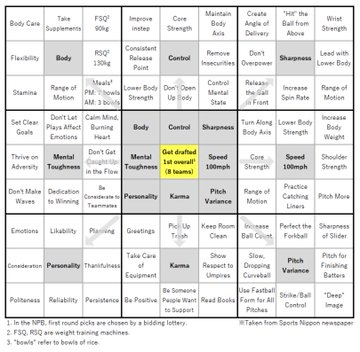
When Ohtani came up with the eight boxes that would surround his central dream of being the No. 1 pick, some were tied directly to performance (speed, conditioning, sharpness), while others were tied to the type of person he needed to become (mental strength, character, karma).

…when Frei teaches the method, she encourages students to start with the center square and fill out only a few surrounding categories at first. That way they really take the time to mean what they’re writing down, rather than just trying to fill the boxes.

In the documentary “Shohei Ohtani: Beyond the Dream,” Ohtani said he was embarrassed when his goal chart was made public. He wanted to keep it hidden away. Then he explained that he “wasn’t trying to think too hard” when he wrote down his goals and subgoals. He just thought about what was important to him and what he “saw as necessary.”

“In the early stage, it helps to put in writing,” Ohtani said. “People have a tendency to forget. And as you continue what you’ve written, the things you do will eventually become second nature.”

https://www.nytimes.com/athletic/7369165/2026/06/18/shohei-ohtani-goals-harada-method-dodgers

Is AI ruining our skills? Early results are in — and they’re not good

Seventy per cent of nurses and 77% of physicians, for example, are worried about losing their skills because of over-reliance on AI systems, according to a survey of US health-care workers published earlier this month1.

Evidence suggests that AI-driven ‘deskilling’ is starting to happen in medicine, computer science and other fields. Researchers are now discussing how to preserve important human expertise in the age of AI.

Once physicians began using it, their performance dropped significantly whenever the system was unavailable.

https://www.nature.com/articles/d41586-026-01947-1

Random Thoughts . . .  

Click the Play button below to listen to the show!

MSM 704: Click & Play PD

Cartoon characters of Troy and Shawn sitting at a desk with flowers around and trees in the background.

Summary:

Shawn and Troy talk about AI policies, summer plans, and more. Dave explains why the experts don’t always agree. 

Jokes:

My wife said that quilts are better than duvets. 

  • I told her to be careful making blanket statements like that. 

What do you call a mute owl?

  • Anything that you want, doesn’t give a hoot.

Someone called me, sneezed and hung up.  

  • I’m tired of these cold calls.

I’m worried about the genetics experiments involving crabs and cheetahs.

  • That could go sideways fast.

Someone asked me what the ninth letter of the alphabet was.

  • It was a complete guess, but I was right.

Name a place that you’ve visited that you don’t want to go back to.

  • Microsoft Teams Meeting

My post about rice cakes was removed.

  • It was ruled as tasteless

Did you know that Stefi Graf has a sister and a brother?

  • Polly
  • Litho

Middle School Science Minute  

by Dave Bydlowski (k12science or davidbydlowski@mac.com)

K12Science Podcast: Why Experts Disagree

I was recently reading the March – April 2026, issue of The Science Teacher, a publication of the National Science Teaching Association.

In this issue I read an article written by Douglas Allchin. He wrote an article entitled “When Experts Disagree.” 

Respect the consensus of the relevant scientific experts. That’s the benchmark for reliable science in informing public policy or personal decision-making. But what if the experts disagree? What if there is no genuine consensus? If we cannot confidently sort fact from fiction, what are we to do?

https://k12science.net/why-experts-disagree/

Reports from the Front Lines

  • End of the year
    • Closing the room 
    • Emptying the office
  • Moodle Prep
  • Summer Plans
    • ISTE Conference
    • Matt Miller’s AI Literacy
      • Classroom Policies
      • Syllabus
      • Co-editing
    • Music for when you’re on a Deadline

The Social Web

‪Irish Learning Technology Association‬ ‪@iltasky.bsky.social‬

Thanks to all our amazing keynotes at #edtech26 – relisten to the conversation on youtube.com/playlist?lis… #edtech #sotl #academicsky #edusky

‪MiddleWeb‬ ‪@middleweb.bsky.social‬

Review: STRATEGIES TO NURTURE CREATIVE THINKING Creativity for Learning provides all teachers with the support they need to build engaging, thought-provoking activities that encourage creative thinking. #edusky  @routledgebooks.bsky.social  #teachersky #creativity  www.middleweb.com/53499/strate…

New: HELPING STUDENTS BECOME SKILLFUL PUBLIC SPEAKERS. All public speaking has two parts: building a talk and performing a talk. In a digital world it’s vital for students to learn how to communicate with impact. #edusky #speech #literacy @erik-palmer.bsky.social www.middleweb.com/53485/helpin…  

‪AMLE‬ ‪@amleorg.bsky.social‬

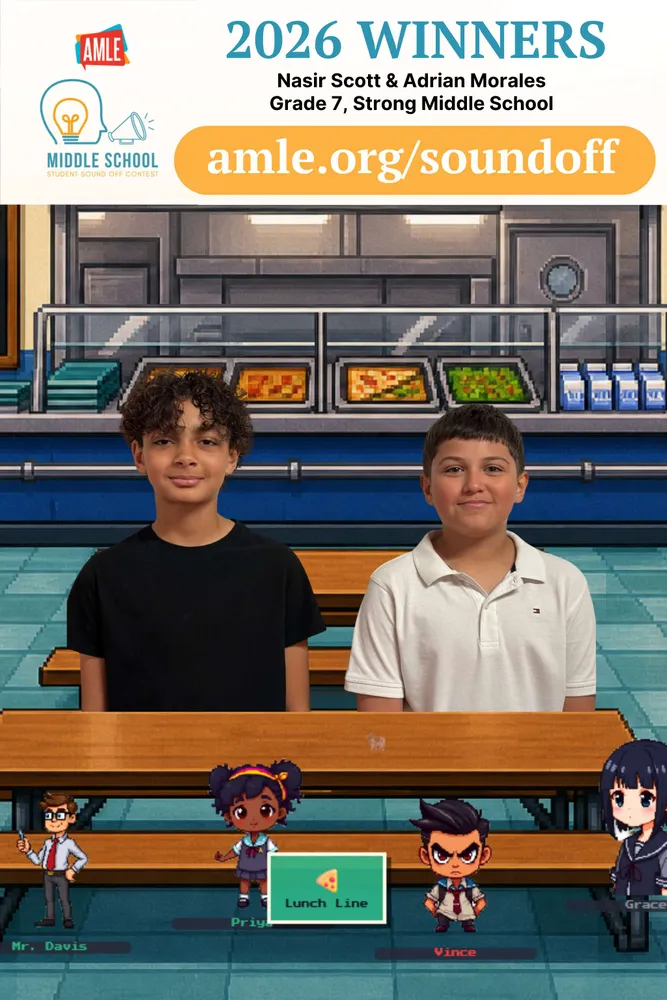
Our 2026 Middle School Student Sound Off winners remind us what happens when we invite young adolescents into real dialogue and decision‑making: they rise with creativity, courage, and insight. 🏆🗣️ Join us in celebrating all our winners, finalists, and honorable mentions: amle.org/soundoff

‪Eric Curts‬ ‪@ericcurts.bsky.social‬

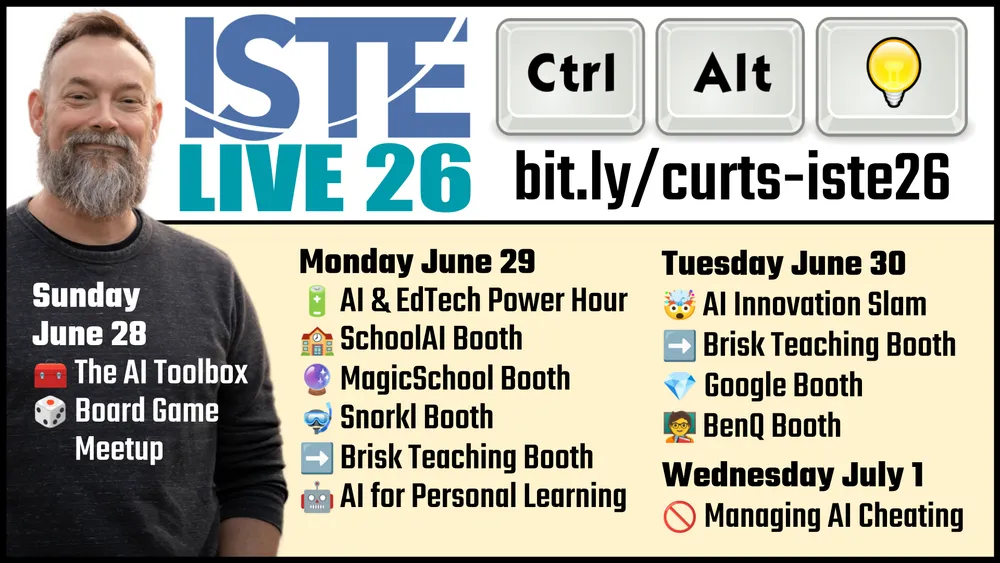
Join me at #ISTELive in Orlando! 🗣️ 12 sessions – bit.ly/curts-iste26 🎲 Board Game Night – bit.ly/iste26bgm 📝 Sharing Doc – bit.ly/iste26-share #EduSky #EdTech #GoogleEDU  

Resources:  

AXIS:  The Culture Translator

Under the Desk

What it is: The world’s leading social media companies are strategically trying to steal kids’ attention during the school day, as evidenced by documents in a class action lawsuit against the tech giants, reports The New York Times.  

Why it’s hurting teens: Snapchat sent phone alerts during school hours, prompting teens to “show off your classroom.” Meta created a program to incentivize teens to promote Instagram and hand out merch. TikTok opted not to disable its notifications during the school day, despite recommendations from its own safety team. Even with ongoing conversations about the negative impact that phones have on learning environments, the NYT’s review of documents revealed that the companies purposefully targeted teenagers during school hours. More than 1,400 school districts have now filed lawsuits against Meta, Snap, TikTok, and YouTube in a rising backlash against social media. One of the lead lawyers in the class action suit said, “It is so constantly tempting to these kids to be on a platform that promises endless, infinite, varied entertainment rather than actually focusing on what they should be at school to do.”

Spin the Wheel

Plethora of wheels (pre select to ensure safe for work). 

​​https://spinthewheel.app/wheels 

Animated GIF Maker

Add image frames, set per-frame delay and loop count, preview the animation, and download a ready-to-share GIF. Everything runs in your browser — nothing is uploaded.

https://drawsplat.org/solutions/animated-gif

Web Spotlight:

We Have a Distraction Problem. But We’ve Been Solving the Wrong Half of It.

The average time spent on any single screen before switching has dropped from 2.5 minutes in 2004 to around 47 seconds today.

Distraction is not just something that happens to learners from the outside. It is also something that learning environments create from the inside.

If we only talk about the phones and devices, we let schools, workplaces, and learning systems off the hook for their own role in the problem. We also miss the more hopeful argument that the antidote to distraction isn’t restriction. It’s actually engagement.

Research on media multitasking during learning is consistent: when students toggle between academic tasks and devices, learning becomes shallower and spottier. They understand less, retain less, and often don’t realize it’s happening because the feeling of multitasking can mimic the feeling of productivity. I often feel the same way as an adult!

A 2009 study across 27 states found that 49% of students reported feeling bored every day. 17% of those students said they were bored in every single class. More recent Gallup data suggests 74% of students report feeling bored in school regularly. The OECD found that over half of students in developed countries feel bored in at least one class daily.

This is the part of the distraction conversation that makes people uncomfortable, because it asks us to look at learning environments themselves. The compliance-based learning environments with predictable tasks and rigid curricula disconnected from students’ lives and questions fail to engage learners. They actively train learners to zone out, to wait for class to end, to find the path of least cognitive resistance.

The tech companies bear responsibility for engineering products that exploit our cognitive vulnerabilities for profit. That’s real, and it deserves real policy and design responses.

Policy makers and politicians aren’t off the hook here either. They allow tech companies to continually exploit our youth by not regulated safeguards on so many of these devices, platforms, and applications.

But schools, and workplaces, and families also bear responsibility for building learning environments where disengagement is the rational response.

Both things are true. The attention economy preys on disengaged learners, and our learning systems have been producing disengaged learners for a long time.

https://ajjuliani.beehiiv.com/p/we-have-a-distraction-problem-but-we-ve-been-solving-the-wrong-half-of-it

The High Cost of Silent Classrooms

Last year, I visited a seventh-grade math classroom in a public school in the Bronx. Twenty students sat bent over laptops, working with an A.I. tutor on story problems about converting fractions to decimals. A teacher moved around the room, checking a dashboard that tracked how many tries each student needed to reach the right answer.

On the surface, the classroom was working. Students were engaged, and most of them, eventually, were getting to the right answers.

https://archive.is/ZXueW

Screen Time Bans and Limits Are Really A Search for a Healthy Relationship to Technology

It is a quest for a healthy relationship to technology instead of the almost worshipful stance currently held by so many in Ed Tech.

Finally, a healthy relationship to technology is one where devices are not a constant intrusion and distraction; they are simply a toaster sitting in the background and used when needed  and not a device constantly beeping like a little child, demanding our attention.

https://the21stcenturyprincipal.blogspot.com/2026/06/screen-time-bans-and-limits-are-really.html

When AI Is Said to Be “Here to Stay” It is Perfectly Right to Question the Fictional Narrative

https://the21stcenturyprincipal.blogspot.com/2026/06/when-ai-is-said-to-be-here-to-stay-it.html

AI in the Classroom: Why There Are No Best Practices Yet

…we’re in such a rush to find “best practices” that research studies that haven’t been published, haven’t been peer reviewed, and haven’t even really been well read (can you say AI summaries?) are going viral. And then, in some cases, they are being retracted. The clearest example: a viral MIT paper claiming AI supercharged scientific discovery drew praise from a Nobel laureate — until MIT itself said it had “no confidence” in the data and asked for it to be pulled from arXiv. 

https://www.coolcatteacher.com/e939

Random Thoughts . . .  

Click the Play button below to listen to the show!

MSM 703: Improv, Sense of Play, Fun

Troy and Shawn as cartoons. Screens in the back.

Summary:

Shawn and Troy talk about AI, screen limits, end of year and more. Dave invites us outside to learn.  

Jokes:  

I asked the surgeon, ‘Can I administer my own anesthetic?’

The surgeon said, ‘Go ahead, knock yourself out.’


Archaeologists have discovered an oil stain that might be more than a thousand years old.

  • It is Ancient Grease.

Did a little mechanic work today.

  • Put a rear end in a recliner!

In a knot contest, is the score always tied?


Video games are great, they let you try your craziest fantasies.

For example, on The Sims, you can have a job and own your own house.


Hearing reports that Sting has been kidnapped.

  • The police haven’t got a lead.

Might wake up early and go for a jog.

Might also win the lottery… odds are about the same.


I’ve dedicated my whole life to finding a cure for insomnia. I won’t rest until I find it.


A lamb, a drum, and a snake fell off a cliff.

Baa, dum, sss.


Marry a zombie.

They always make you dinner.


My cat knocked over my grandmother’s ashes. The Roomba got to them before I did, and now it beeps at me until I give it a Virginia Slim.


My wife asked me to take out a spider instead of killing it. Took him out for coffee. Nice guy, web designer.


Middle School Science Minute  

by Dave Bydlowski (k12science or davidbydlowski@mac.com)

K12Science Podcast: Why Learn Outdoors?

I was recently reading the March – April 2026, issue of Science and Children, a publication of the National Science Teaching Association.

In this issue I read an article written by Mary Starr, Jordan Sherry-Wagner, Carrie Tzou, Megan Bang, Shirin Vossoughi, and Anna Lees. They wrote an article entitled “Place Matters.”

Outdoor learning is not simply a change in instructional setting, but a shift in relationships among children, educators, families, and the socio-ecological systems they inhabit.  Outdoor learning, when historicized and relationally grounded, becomes a practice of responsibility, connection, and future-making.

https://directory.libsyn.com/episode/index/show/k12science/id/41538065

Reports from the Front Lines

  • 2. 5 Days
    • Shawn’s plans for the 12th
    • PD Extra Day
  • Senior Walk
  • Genius Week
  • Apple Event
  • Transition

The Social Web

‪MiddleWeb‬ ‪@middleweb.bsky.social‬

This free summer Math Summit looks great. 3 days of practical support. 30+ K-12 Math Experts (including some of MiddleWeb’s most-read contributors). #edusky #iteachmath #mtbos #mathed www.collaboratedwithjuliana.com/summit

‪AMLE‬ ‪@amleorg.bsky.social‬

Do you (or someone you know) have the vision, experience, and passion to provide strategic leadership for AMLE? AMLE is now accepting nominations for two open positions on our Board of Trustees! Learn more and apply by June 30th: amle.org/getinvolved

Nominations for AMLE’s Educator of the Year are due July 15th! Gather inspiration from Katrina Hill (2025 honoree), and review the 2026 nomination requirements: 👉ow.ly/QpVM50Z7h7x

‪AMLE‬ ‪@amleorg.bsky.social‬

Do you (or someone you know) have the vision, experience, and passion to provide strategic leadership for AMLE? AMLE is now accepting nominations for two open positions on our Board of Trustees! Learn more and apply by June 30th: amle.org/getinvolved

‪Brickfield Education Labs‬ ‪@brickfield.bsky.social‬

Moodle Tip: Replace ‘Click here’ with descriptive links like ‘Download syllabus (PDF)’. #Accessibility #BrickfieldTips

Strategies:  

Edutopia:  Increasing Engagement with Improv Games

In school, students often feel pressure to produce polished answers or perfect test scores, so improv offers something increasingly rare: permission to play, fail, experiment, have fun, and try again.

https://www.edutopia.org/article/improv-games-high-school-english

KidProv:  http://improvsmart.com/kidprov/  

Goodreads:  https://www.goodreads.com/book/show/645210.Improvisation  

Amazon:  https://www.amazon.com/stores/Brad-Newton/author/B001KMLD4E?ref=sr_ntt_srch_lnk_1&qid=1780762720&sr=8-1&shoppingPortalEnabled=true&ccs_id=67592640-13dc-4614-825e-11452dd48af2   

Video:  https://www.youtube.com/watch?v=F4szkMUKGvk&pp=ygUZSW1wcm92aXNhdGlvbiBCcmFkIE5ld3Rvbg%3D%3D  

Web Spotlight: 

Teen boys are choosing AI girlfriends over real-life relationships — with disastrous consequences: expert

https://nypost.com/2026/06/03/lifestyle/teen-boys-choosing-ai-girlfriends-over-real-life-relationships-and-effect-can-be-disastrous-expert

When Tech CEOs Make Predictions About AI, Remember They Are Trying to Dictate the Acceptance of Their Product

https://the21stcenturyprincipal.blogspot.com/2026/06/when-tech-ceos-make-predictions-about.html

The Screen Time Excuse: Why Blaming EdTech Isn’t The Solution We Are Looking For

https://www.ajjuliani.com/blog/the-screen-time-excuse-why-blaming-edtech-wont-fix-our-problems

Why School Phone Bans Aren’t About Kids

https://www.newsweek.com/school-phone-bans-nber-teachers-students-11914244

Largest-ever study of school cellphone bans finds mixed results

https://www.nbcnews.com/tech/tech-news/largest-ever-study-school-cell-phone-bans-finds-mixed-results-rcna343761

It’s the Teacher That Matters Most in Teaching and Learning, Not Screens, Not AI…That’s The Lesson Needed for School Leaders in All These Screen Ban Efforts

https://the21stcenturyprincipal.blogspot.com/2026/06/its-teacher-that-matters-most-in.html

AXIS The Culture Translator

Lunch Shaming

What it is: “Lunch shaming,” a form of bullying where classmates will secretly take photos of their peers eating lunch and share the images on social media, is reportedly on the rise, with 14% of elementary students and 18% of middle and high school students reporting being bullied in the cafeteria in the last month. 

Why it’s a thing: It is a truth universally acknowledged that mid-bite, nobody looks glamorous. The Wall Street Journal reported that the shaming tends to fall into two categories: the lonely eater (caught eating alone) and the ugly mouthful. As a result, some kids have stopped eating lunch at school altogether. One 18-year-old told the WSJ that one of his good friends was biting into a turkey sandwich—then, a camera flash. After the photo circulated the school during their freshman year, they did not eat in front of anyone again for years. When one school district in Washington implemented a full-day phone ban, staff noticed an increase in the number of middle-school students eating lunch.  

Click the Play button below to listen to the show!