
Summary:
Shawn and Troy talk about AI (again), pedagogy, Moodle, owning your own stuff, and more. Dave journeys to curiosity.
Jokes:
My driving instructor told me to wear a seatbelt or the force could throw me out of the car.
- I can’t believe he thinks Star Wars is real.
I don’t like it when people use the same word twice in a sentence.
- Enough is enough.
What did the comedian say when robbing a bank?
- This is a stand up
My friend recently got crushed by a pile of books.
He’s only got his shelf to blame.
When I was a kid, we lived in a 3-level house. My bedroom was on the 4th floor.
- But that’s a different story
I’m so afraid of negative numbers, I will stop at nothing to avoid them.
Have YOU had to walk 500 miles?
Were you advised to walk 500 more?
You could be entitled to compensation.
Call the Pro Claimers now!
Top tip: If a telemarketer calls you, give the phone to your 3-year-old and tell them it’s Santa Claus.
What did the skeleton order at the restaurant?
- Spare ribs.
Technically, the borders of Finland are
Finnish lines.
Is a Nun in heaven called Nun of the above?
I never said I was interesting.
I said I was into resting.
What do you say to comfort a friend struggling with grammar?
-There, they’re, their…
If you are being chased by a pack of taxidermists,
do not…
I repeat… DO NOT…
play dead!
I’m really overdrawn at the bank, and they keep calling and leaving voicemails.
I wish they’d just leave me a loan.
I grilled a chicken for 2 hours
- Still wouldn’t tell me why it crossed the road
Middle School Science Minute
by Dave Bydlowski (k12science or davidbydlowski@mac.com)
K12Science Podcast: Journey to Curiosity
I was recently reading the May 20, 2026, blog from the National Science Teaching Association.
The blog was entitled, “Teaching Students to Think in Science: Where Curiosity Meets Cognitive Strategy” written by Kristen Barnes.
Science instruction leans heavily on synchronous learning, individual work, note-taking and getting the ‘right answer.” However, the true goal of science education isn’t completion. Science education should focus on cultivating the lifelong journey of curiosity.
https://k12science.net/journey-to-curiosity/
Reports from the Front Lines
- ISTE Annual Conference – https://suno.com/s/0wzybziDmBSC2QHc
- Notability
- iPad
- Paper
- Finishing up transition
- Moodle update
- Developing Curriculum
- Owning your “stuff”
- Hosting Option (contact me)
- Book Reading
- AI with Intention by Tony Frontier https://www.amazon.com/dp/1956306471?ref_=ppx_hzsearch_conn_dt_b_fed_asin_title_3
- AI Literacy by Matt Miller https://www.amazon.com/dp/1968898077?ref_=ppx_hzsearch_conn_dt_b_fed_asin_title_1
- Lectureless – Teaching History to Engage and Empower https://www.amazon.com/dp/1968898239?ref=ppx_yo2ov_dt_b_fed_asin_title
- (June 22 Release Date) Inclusive 52 Executive Functioning: Weekly Strategies to Help All Learners Thrive https://www.amazon.com/dp/B0GWS5WGKZ?ref=ppx_yo2ov_dt_b_fed_asin_title
The Social Web
Dublin City University @dublincityuni.bsky.social
How is #AI already affecting our lives? DCU’s Prof Alan Smeaton joined RTÉ‘s Drivetime RTÉ radio 1
to chat about how AI has actually underpinned our daily routines for over a decade. Listen now: launch.dcu.ie/4aU5ypX
Keep Indiana Learning @keepinlearning.bsky.social
Stop searching and start discovering! 💡 Get edtech tips, book studies, fast teacher tips, and monthly shows – all on our YouTube channel! PD that fits your schedule & interests! Check it out! youtube.com/KeepIndianaL…
AMLE is excited to announce Christopher Woodside as our next Chief Executive Officer! Chris brings nearly two decades of nonprofit and association leadership experience, with a strong record in advocacy and member engagement. www.amle.org/amle-announc…
Edutopia
rpsotonSed22f224hli6lf3ui1789123gt8ah51848lum2i08tgma11cifli
3 high-energy review games: https://edut.to/4epEilH
David Njoku@davidnjoku@mastodon.world
Here’s a thing.
Ask any child what noise a train makes and they’ll probably say “chugga chugga choo choo.”
Funny thing is that pretty much no one alive today was around in the days when trains – powered by steam – made that sound.
The stories we’re told are powerful, often even more powerful than the evidence of our senses. We think trains sound like that cos we’re told they sound like that.
Stories are powerful; be careful with the stories you tell.
Strategies:
Using AI to Enhance Project-Based Learning Units
https://www.trevormuir.com/blog/AI-project-based-learning
Resources:
The Chaos
Which Came First?
Wikipedia Game on iOS and Android.
https://apps.apple.com/us/app/wikipedia/id324715238
Drawsplat Tools
https://drawsplat.org/pages/tools
Web Spotlight:
Shohei Ohtani used this goal-setting method when he was a freshman in high school
During Shohei Ohtani’s first two years at Hanamaki Higashi High School in Japan, his baseball coach, Hiroshi Sasaki, introduced him to the Harada Method.
Takashi Harada, a renowned track and field coach who developed a goal-setting system to help his athletes find motivation. He built it around an idea: Lofty goals could be achieved by breaking them down into daily, repeatable habits.
At its essence, the method involves taking one goal, writing it down, then deconstructing it into 64 smaller habits and actions to achieve that goal.
Ohtani, for example, drew a single square in the center of a piece of paper and wrote his goal of becoming the top draft pick inside it. Around that, he drew eight more squares, each one filled with one skill that he believed a No. 1 draft pick would need to master: control, physical conditioning, sharpness, pitching speed, mental strength, trickery, character and karma.
Ohtani’s 8 pillars were:
• Body
• Control
• Sharpness
• Speed
• Pitch Variance
• Personality
• Karma/Luck
• Mental Toughness
You then break down each of those 8 pillars into 8 smaller, actionable tasks or daily routines.
To improve his karma, he listed tangible actions like:
• Showing Respect to Umpires
• Picking up trash
• Being positive
• Being someone people want to support
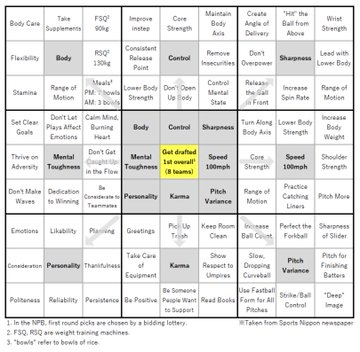
When Ohtani came up with the eight boxes that would surround his central dream of being the No. 1 pick, some were tied directly to performance (speed, conditioning, sharpness), while others were tied to the type of person he needed to become (mental strength, character, karma).
…when Frei teaches the method, she encourages students to start with the center square and fill out only a few surrounding categories at first. That way they really take the time to mean what they’re writing down, rather than just trying to fill the boxes.
In the documentary “Shohei Ohtani: Beyond the Dream,” Ohtani said he was embarrassed when his goal chart was made public. He wanted to keep it hidden away. Then he explained that he “wasn’t trying to think too hard” when he wrote down his goals and subgoals. He just thought about what was important to him and what he “saw as necessary.”
“In the early stage, it helps to put in writing,” Ohtani said. “People have a tendency to forget. And as you continue what you’ve written, the things you do will eventually become second nature.”
https://www.nytimes.com/athletic/7369165/2026/06/18/shohei-ohtani-goals-harada-method-dodgers
Is AI ruining our skills? Early results are in — and they’re not good
Seventy per cent of nurses and 77% of physicians, for example, are worried about losing their skills because of over-reliance on AI systems, according to a survey of US health-care workers published earlier this month1.
Evidence suggests that AI-driven ‘deskilling’ is starting to happen in medicine, computer science and other fields. Researchers are now discussing how to preserve important human expertise in the age of AI.
Once physicians began using it, their performance dropped significantly whenever the system was unavailable.
https://www.nature.com/articles/d41586-026-01947-1
Random Thoughts . . .
Click the Play button below to listen to the show!
Podcast: Play in new window | Download

You must be logged in to post a comment.